|
TRANSLATE THIS ARTICLE
Integral World: Exploring Theories of Everything
An independent forum for a critical discussion of the integral philosophy of Ken Wilber
  Frank Visser, graduated as a psychologist of culture and religion, founded IntegralWorld in 1997. He worked as production manager for various publishing houses and as service manager for various internet companies and lives in Amsterdam. Books: Ken Wilber: Thought as Passion (SUNY, 2003), and The Corona Conspiracy: Combatting Disinformation about the Coronavirus (Kindle, 2020). Frank Visser, graduated as a psychologist of culture and religion, founded IntegralWorld in 1997. He worked as production manager for various publishing houses and as service manager for various internet companies and lives in Amsterdam. Books: Ken Wilber: Thought as Passion (SUNY, 2003), and The Corona Conspiracy: Combatting Disinformation about the Coronavirus (Kindle, 2020).
Check out my other conversations with ChatGPT ChatGPTWhat the G, P, and T Actually MeanFrank Visser / ChatGPT
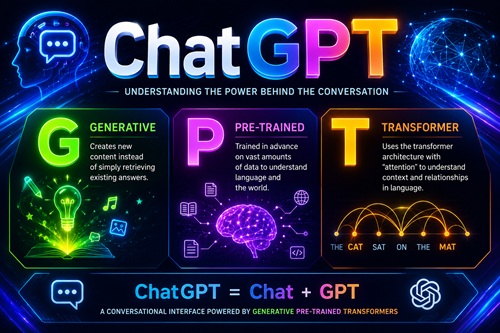 The name “ChatGPT” refers to a conversational system built on a specific type of language model. The letters “GPT” describe the underlying architecture, while “Chat” describes the interactive use case. Each part points to a different layer of the system. Generative: the G“Generative” means the system creates new text rather than selecting a fixed response from a list. A useful contrast is with rule-based systems or simple classifiers. Those systems map inputs to predefined outputs. A generative model instead composes language dynamically, token by token. A simple way to see this is to compare it with a multiple-choice test. A classifier can only choose A, B, C, or D. A generative model writes its own response from scratch, word by word, based on patterns it has learned. Example: If you ask, “Explain gravity in simple terms,” a generative model does not fetch a pre-written definition. Instead, it constructs something like: “Gravity is the force that pulls objects toward each other, like how Earth pulls you toward the ground.” That sentence is newly generated for your request. Another example: If you ask for a poem about rain, it can produce a unique poem each time, even if the theme is the same. The exact wording will differ, because the system is composing rather than retrieving. Example: If you ask, “Explain photosynthesis simply,” the system produces a fresh explanation such as: plants use sunlight to convert carbon dioxide and water into energy (glucose), releasing oxygen as a byproduct. That sentence is generated on the spot, not retrieved verbatim from a stored answer. Another example: If you request “Write a short story about a lost astronaut,” the model can produce an entirely new narrative each time, varying plot, tone, and structure while staying within learned patterns of storytelling. Pre-trained: the P“Pre-trained” means the model has already learned from a very large dataset before any conversation begins. This training phase teaches statistical patterns of language: grammar, style, factual associations, and common reasoning structures. After training, the model is deployed for use without needing to relearn language from scratch in each interaction. Example: Before you ever ask about history, the model has already “seen” many historical explanations in its training data. So if you ask, “What caused the French Revolution?” it can produce a plausible explanation immediately, without needing to look it up in real time. Another example: If you ask how to write a formal email, it can generate a structured version (“Dear Sir or Madam…”) because it has already learned the conventions of formal writing from its training phase. Example: If you ask about the causes of World War I, the model can produce a coherent explanation immediately because it has already encountered many historical explanations during training. It does not “look up” the answer; it reconstructs a response based on learned patterns. Another example: If you ask for a professional email, it can generate a standard format (“Dear Dr. Smith…”) because it has learned formal writing conventions during pre-training. Transformer: the T“Transformer” refers to the neural network architecture that processes language using a mechanism called attention. Instead of reading text strictly left to right, it evaluates relationships between all words in a sequence simultaneously. This allows it to track meaning across long sentences and paragraphs more effectively than earlier architectures. Example: In the sentence, “The trophy did not fit in the suitcase because it was too big,” the word “it” is ambiguous. A transformer can use context to determine whether “it” refers to the trophy or the suitcase, by comparing relationships between all relevant words in the sentence. Another example: If you give a long paragraph about a political argument and later ask, “What does this position depend on?”, the transformer architecture helps the model track which ideas refer to which earlier statements, even across multiple sentences. Example: In the sentence, “The city council denied the protest permit because it feared violence,” the word “it” could be ambiguous. A transformer uses contextual relationships to infer that “it” most likely refers to the city council, not the protest permit. Another example: In a long technical explanation, the model can keep track of earlier definitions and apply them later in the text, maintaining coherence across multiple paragraphs. ChatGPT vs other chatbots: are they all GPTs?Not all chatbots are GPT-based, even though many modern ones are. “Chatbot” is a general term for any system designed to simulate conversation. Under that umbrella, there are several distinct families: Some chatbots are rule-based. These rely on scripted decision trees. If you type a question, they match keywords and return prewritten answers. Early customer service bots often worked this way, and many still do in narrow domains like banking menus or FAQ assistants. Other chatbots are retrieval-based. These systems search a database of known answers and return the closest match. They do not generate new sentences; they select existing ones. This can be useful for technical support systems where answers must be exact and controlled. ChatGPT and Large Language ModelsGPT-based chatbots, such as ChatGPT, belong to a class of large language models (LLMs). They generate responses dynamically using neural networks trained on large text corpora. However, not all LLM chatbots use GPT specifically. “GPT” refers to a particular family of models developed by OpenAI, but other organizations have built alternative architectures with different names and design choices. Examples include systems like Claude, Gemini, and LLaMA-based assistants. These are also large language models, but they are not GPT models, even though they often behave similarly in conversation. The similarity comes from shared underlying principles (transformer-based neural networks), not from being the same model family. So the key distinction is this: all GPT systems are chatbots when used conversationally, but not all chatbots are GPTs. And more broadly, not all modern AI assistants are GPT-based—even if they look and feel similar in practice. Appendix: Online Resources on ChatGPTThe best online resources for learning ChatGPT fall into a few distinct categories: official documentation (most reliable), structured courses (best for beginners), developer resources (for deeper control), and community-curated guides (useful but variable quality). Here is a curated, high-signal overview. The most authoritative starting point is OpenAI's own learning and documentation ecosystem. The OpenAI Learning Hub provides practical guides, business use cases, and explanations of features like agents, coding workflows, and enterprise deployment patterns. It is particularly strong for understanding how ChatGPT is used in real workflows rather than just in theory. For hands-on onboarding, OpenAI Academy is one of the clearest structured learning paths. It includes “ChatGPT 101” and “ChatGPT 102” style webinars that walk through core usage patterns, prompting basics, interface navigation, and applied productivity techniques. These are designed specifically to move users from casual interaction to competent daily use. If you want a more systematic, curriculum-style approach outside OpenAI itself, DataCamp's ChatGPT learning guide is one of the better third-party resources. It focuses on prompt design, mental models of how ChatGPT behaves, and practical workflows (writing, analysis, automation). It's structured as a progression from beginner to intermediate use rather than scattered tutorials. For developers or technically inclined users, the OpenAI Cookbook is the most important resource. It contains runnable examples for structured outputs, API usage, retrieval-augmented generation, function calling, and agent-style workflows. Unlike general tutorials, it is implementation-oriented: you learn by modifying working code patterns rather than reading explanations. A useful complement is community knowledge, especially curated Reddit compilations and prompt-engineering threads. These often surface practical prompts, workflows, and edge-case techniques not yet formalized in official docs. However, quality varies widely, so they work best as experimentation material rather than foundational learning. Finally, there are curated “prompt libraries” and ebooks (like Dutch-language ChatGPT collections and professional prompt engineering compilations). These are helpful for accelerating specific tasks—writing, research, teaching—but tend to be derivative of official guidance rather than foundational sources. If you want a clean learning path, the most efficient sequence is: OpenAI Academy (concepts and interface), OpenAI Learning Hub (applied use cases), then DataCamp or similar structured courses (workflow mastery), and finally the Cookbook (if you want technical depth).
Widget is loading comments...
|