|
TRANSLATE THIS ARTICLE
Integral World: Exploring Theories of Everything
An independent forum for a critical discussion of the integral philosophy of Ken Wilber
  Frank Visser, graduated as a psychologist of culture and religion, founded IntegralWorld in 1997. He worked as production manager for various publishing houses and as service manager for various internet companies and lives in Amsterdam. Books: Ken Wilber: Thought as Passion (SUNY, 2003), and The Corona Conspiracy: Combatting Disinformation about the Coronavirus (Kindle, 2020). Frank Visser, graduated as a psychologist of culture and religion, founded IntegralWorld in 1997. He worked as production manager for various publishing houses and as service manager for various internet companies and lives in Amsterdam. Books: Ken Wilber: Thought as Passion (SUNY, 2003), and The Corona Conspiracy: Combatting Disinformation about the Coronavirus (Kindle, 2020).
Check out my other conversations with ChatGPT The Meaning of the IntegralWilber, Gebser, and Aurobindo in ConversationFrank Visser / ChatGPT
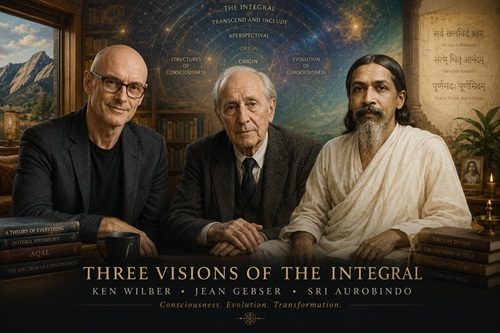 The setting is an impossible salon somewhere outside time: part Vedic ashram, part Swiss study, part Boulder loft. Shelves of philosophy line the walls. A cosmic diagram glows faintly in the background. Three men sit around a circular table. Ken Wilber leans forward energetically, legal pad in hand. Jean Gebser sits quietly, almost suspicious of the whole enterprise. Sri Aurobindo appears serene, as if the conversation has already happened on subtler planes. Wilber begins immediately. “Gentlemen, I think we all agree humanity is evolving toward more integral forms of consciousness. The challenge is to articulate the structure of that emergence clearly and comprehensively.” Gebser raises an eyebrow. “Already,” he says softly, “you reveal the problem.” “The problem?” “Yes. You speak of ‘structure,’ ‘evolution,’ and ‘comprehensiveness’ as though consciousness were assembling itself like a larger filing cabinet.” Wilber laughs. “Well, not merely that. I mean increasing depth, inclusion, differentiation, transcend-and-include—” Gebser interrupts. “Ah yes. Your famous formula. Transcend and include. A magnificent slogan. But perhaps too magnificent.” Aurobindo smiles faintly. “There are worse accusations than magnificence.” Gebser turns toward him respectfully. “My concern is not grandeur. It is inflation. The integral is not the apex of a pyramid.” Wilber points excitedly. “But it is post-rational! Worldcentric! Integrative! Capable of holding multiple perspectives simultaneously.” Gebser shakes his head. “You still imagine consciousness historically, progressively, almost biologically climbing upward. My integral-aperspectival consciousness was not meant as another altitude badge.” Wilber scribbles notes furiously. “But surely you admit structures emerge developmentally? Magic, mythic, mental, integral?” “Yes,” says Gebser, “but not as a triumphalist staircase. The integral is the transparency of all structures to origin. It is not simply ‘more complex thinking.’” Aurobindo finally enters more directly. “In fairness, Ken’s evolutionary instinct is not entirely misplaced. Consciousness does unfold.” Gebser nods cautiously. “Perhaps. But your unfoldment, Sri Aurobindo, is metaphysical in a way mine is not.” “Of course,” Aurobindo replies calmly. “Because evolution without spirit is unintelligible.” Wilber beams. “Exactly!” Gebser visibly winces. Aurobindo continues. “Matter conceals life. Life conceals mind. Mind conceals supermind. Evolution is the gradual manifestation of what was always involved within Being.” Gebser responds carefully. “You speak as a yogi and metaphysician. I spoke phenomenologically. I observed mutations of consciousness in culture, language, art, temporality.” “And yet,” says Aurobindo, “your integral consciousness bears unmistakable kinship to spiritual realization.” Gebser pauses. “Yes. But realization without system-building.” Wilber laughs loudly. “Too late for that.” The room briefly glows turquoise for no apparent reason. Wilber continues enthusiastically. “Look, both of you laid foundations for what I’m trying to do. Jean gave us structures of consciousness. Sri Aurobindo gave us involution and evolution. I’m synthesizing East and West, psychology and spirituality, science and mysticism.” Gebser replies dryly: “And occasionally inventing categories faster than reality can sustain them.” Aurobindo chuckles softly. Wilber grins. “Fair.” “But seriously,” he continues, “humanity faces fragmentation everywhere. Postmodern relativism shattered universal narratives. The integral approach rebuilds coherence.” Gebser leans back. “Or perhaps postmodernity was the revenge of suppressed perspectivism. Mental consciousness exhausted itself through abstraction. The integral is not a grand synthesis dominating all perspectives. It is freedom from perspectival fixation itself.” Wilber pauses. “That’s actually good.” “It was always good,” says Gebser. Aurobindo intervenes diplomatically. “Perhaps the disagreement concerns the nature of integration itself.” “Yes!” says Wilber. Gebser sighs gently. Aurobindo continues. “For Ken, the integral means a higher-order integration of previous stages. For Jean, it means a transparency beyond fixation. For me, it means the divinization of life through supramental descent.” Wilber nods enthusiastically. “Exactly. Three integrals!” “Three very different integrals,” Gebser mutters. Aurobindo folds his hands. “Ken’s vision remains developmental and systemic. Jean’s is phenomenological and existential. Mine is spiritual and cosmological.” “And critics,” says Gebser quietly, “might say Ken transformed the integral into a managerial operating system.” Wilber laughs again. “Ouch.” “But not entirely wrong,” Gebser adds. Wilber defends himself. “Look, AQAL is just a map. Quadrants, levels, lines, states, types—it helps organize human knowledge.” “Yes,” says Gebser, “but eventually maps begin mistaking themselves for continents.” Aurobindo looks amused. “The mental consciousness loves architecture.” Wilber points at him. “And yogis love cosmic teleology.” “Indeed,” says Aurobindo serenely. Silence settles briefly. Then Gebser asks Aurobindo: “Tell me honestly. Did you truly believe evolution possesses an inherent spiritual drive?” Aurobindo answers without hesitation. “Yes.” “Even biological evolution?” “Yes.” “Even suffering?” “Yes.” Gebser studies him. “And what evidence persuaded you?” Aurobindo smiles. “Consciousness itself.” Gebser nods slowly. “There we differ. I saw no need to metaphysically explain consciousness through cosmic intention.” Wilber jumps in. “But without Eros, evolution becomes accidental machinery!” “Perhaps,” Gebser replies, “reality owes us no spiritual reassurance.” That lands heavily. Even Wilber pauses. Aurobindo finally says: “Yet the hunger for wholeness persists.” “Yes,” says Gebser. “But wholeness may not be a destination. It may be a mode of presence.” Wilber looks thoughtful now instead of triumphant. “So perhaps integral should remain open-ended?” Gebser smiles faintly. “Now you are becoming integral.” Aurobindo closes his eyes briefly. “The integral cannot merely categorize reality. It must transform consciousness.” Wilber nods. “And consciousness must avoid turning its own models into idols.” Gebser adds: “Especially integral models.” The three men laugh. Somewhere in the distance, a giant holarchy quietly rearranges itself.
Widget is loading comments...
|