|
TRANSLATE THIS ARTICLE
Integral World: Exploring Theories of Everything
An independent forum for a critical discussion of the integral philosophy of Ken Wilber
  Frank Visser, graduated as a psychologist of culture and religion, founded IntegralWorld in 1997. He worked as production manager for various publishing houses and as service manager for various internet companies and lives in Amsterdam. Books: Ken Wilber: Thought as Passion (SUNY, 2003), and The Corona Conspiracy: Combatting Disinformation about the Coronavirus (Kindle, 2020). Frank Visser, graduated as a psychologist of culture and religion, founded IntegralWorld in 1997. He worked as production manager for various publishing houses and as service manager for various internet companies and lives in Amsterdam. Books: Ken Wilber: Thought as Passion (SUNY, 2003), and The Corona Conspiracy: Combatting Disinformation about the Coronavirus (Kindle, 2020).
Check out my other conversations with ChatGPT Ken Wilber's 'An Integral Theory of Consciousness' (1997)A Long Overdue Critical ReviewFrank Visser / ChatGPT
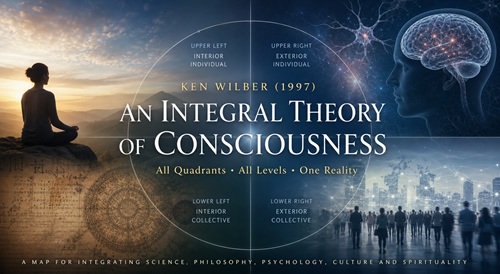 Ken Wilber's 1997 paper, “An Integral Theory of Consciousness,” published in the Journal of Consciousness Studies, is one of the foundational manifestos of Integral Theory.[1] The essay attempted something extraordinarily ambitious: not merely a theory of mind, but a meta-framework capable of integrating nearly every major approach to consciousness research into a single architecture. The paper is historically important because it crystallized Wilber's mature “AQAL” framework (“all quadrants, all levels”), which would dominate his later work and influence a generation of transpersonal and integral thinkers. At the same time, the paper exemplifies many of the conceptual, methodological, and scientific problems that critics have identified in Wilber's work over the past three decades. Its strengths lie primarily in synthesis and philosophical breadth; its weaknesses lie in evidential overreach, conceptual inflation, and a tendency to confuse metaphorical integration with empirical explanation. The Appeal of the Integral VisionThe paper opens with an admirable impulse. Rather than dismissing competing schools of consciousness studies, Wilber argues that each captures a partial truth. He surveys twelve approaches, including cognitive science, phenomenology, psychotherapy, developmental psychology, contemplative traditions, quantum consciousness theories, and subtle energy research. This pluralistic orientation was refreshing in the 1990s, when consciousness studies were highly fragmented. Wilber's insistence that no single discipline can exhaustively explain consciousness remains one of the paper's strongest insights. His famous “four quadrants” model distinguishes between subjective experience (Upper Left), objective behavior and brain processes (Upper Right), cultural meaning systems (Lower Left), and social systems (Lower Right). The basic intuition behind this schema is reasonable: human existence indeed has subjective, behavioral, social, and cultural dimensions, and reductionism becomes problematic when one dimension is treated as exhaustive. This anti-reductionist critique is often persuasive. Wilber correctly notes that neuroscience alone cannot account for lived experience, meaning, ethics, or culture. His discussion of the “hard problem” of consciousness, drawing on David Chalmers, anticipated debates that later became central in consciousness studies. The Problem of the “Data Search”The paper's central weakness appears almost immediately: Wilber consistently presents speculative metaphysical claims as if they emerge naturally from a “data search” across disciplines. He repeatedly insists that his model is “a posteriori” and empirically grounded rather than metaphysical. Yet many of his core conclusions are not empirical findings at all but interpretive constructions layered atop disparate sources. For example, the paper claims that examination of “over two hundred developmental sequences” revealed four universal quadrants and roughly corresponding developmental levels. But no actual methodology for this “data search” is presented. There are no operational criteria, no statistical analyses, no falsifiable predictions, and no explanation of how radically different domains—stellar evolution, moral development, contemplative states, and cultural history—can legitimately be mapped onto one another. The procedure resembles comparative metaphysics far more than scientific synthesis. This is a recurring pattern throughout the essay. Wilber repeatedly moves from analogy to ontology without sufficient justification. Because multiple systems appear hierarchical, he infers the existence of a universal evolutionary pattern. Because developmental psychology identifies stages of cognition, he extrapolates cosmic structures of consciousness. Because contemplative traditions describe mystical states, he concludes these correspond to objective developmental levels. The leap from descriptive parallels to ontological conclusions is enormous and rarely defended rigorously. Evolution SpiritualizedA second major problem concerns Wilber's treatment of evolution and development. The paper assumes evolution has an inherent directionality toward increasing “depth,” complexity, and consciousness. This quasi-teleological framework reflects Wilber's long-standing attraction to evolutionary spirituality and the Great Chain of Being. He attempts to modernize ancient metaphysical hierarchies by embedding them within developmental and evolutionary discourse. But this synthesis is philosophically unstable. The Great Chain of Being was historically a static, premodern cosmology rooted in metaphysical essentialism. Evolutionary biology, by contrast, is contingent, non-teleological, and driven by natural selection without intrinsic spiritual direction. Wilber attempts to fuse these incompatible paradigms by portraying evolution as “transcend and include,” a universal movement toward greater consciousness. Yet the paper provides no biological mechanism for this alleged tendency. Evolutionary complexity becomes subtly spiritualized. The Hierarchy of ConsciousnessThis becomes especially evident in Wilber's treatment of postformal and transpersonal stages. He claims there is “substantial crosscultural evidence” for higher stages such as the psychic, subtle, causal, and nondual. But the evidence is largely anecdotal, phenomenological, or drawn from contemplative traditions themselves. The existence of mystical experiences is not in doubt. What is doubtful is Wilber's interpretation of them as universal developmental structures objectively “higher” than rationality. The hierarchy here is strongly value-laden. Rationality is “transcended,” mystical awareness becomes more evolved, and contemplative adepts implicitly occupy superior developmental strata. This reproduces a perennialist spiritual hierarchy that many contemporary scholars of religion regard as culturally biased and insufficiently critical. The Limits of Developmental PsychologyWilber draws heavily on stage theorists such as Jean Piaget and extends their findings into spiritual territory. Yet developmental psychology itself became far more cautious after the 1990s about rigid hierarchical stage models. Human cognition, morality, and identity development turned out to be more domain-specific, context-sensitive, and culturally variable than grand stage theories had assumed. Wilber's framework tends to over-systematize human diversity into a single ascending ladder. His system often treats complexity as inherently superior and spirituality as the culmination of development. This creates a subtle but powerful elitism embedded in the structure of the theory itself. Mysticism as “Inner Science”The paper also suffers from a persistent category confusion between epistemology and ontology. Wilber argues that contemplative practices follow the same “injunction-apprehension-confirmation” structure as science. This is one of his most famous claims: meditation is supposedly an “interior science” analogous to empirical inquiry. There is a partial truth here. Disciplined contemplative traditions do involve reproducible practices and intersubjective validation within trained communities. But Wilber stretches the analogy too far. Scientific claims are publicly testable, independently replicable, and constrained by external measurement. Mystical claims are phenomenological, interpretive, and culturally mediated. Consensus within a contemplative tradition does not function like empirical falsifiability in physics or biology. Wilber's framework repeatedly blurs these distinctions. Quantum Mysticism and Psi SpeculationWilber's treatment of quantum consciousness and psi research further weakens the paper. Although he expresses caution about quantum theories, he still grants them a place within the integral framework. Likewise, he entertains psi phenomena as “quite likely.” This openness may appear intellectually generous, but it also illustrates a chronic weakness in Wilber's epistemology: the tendency to include poorly substantiated claims because they fit the larger metaphysical architecture. The result is a framework that becomes almost impossible to falsify. Nearly any phenomenon can be incorporated somewhere within the quadrants and levels. A theory that explains everything risks explaining nothing. A Taxonomy More Than a TheoryWilber repeatedly accuses critics of “reductionism” or “quadrant absolutism,” while presenting his own framework as uniquely comprehensive. But comprehensiveness alone does not guarantee explanatory power. A taxonomy is not necessarily a theory. Much of AQAL functions more as a classificatory matrix than as a predictive scientific model. One could argue that the four quadrants are ultimately a sophisticated organizational heuristic rather than a discovery about reality itself. They can help structure interdisciplinary conversations, but that is very different from demonstrating that reality is fundamentally composed of four ontological dimensions evolving through invariant levels. The Rhetoric of Total IntegrationThe paper's prose oscillates between academic terminology and grand metaphysical rhetoric. Terms like “Kosmos,” “nondual consciousness,” and “Great Chain” coexist with appeals to systems theory and developmental science. This blending gives the paper an aura of profundity, but it often obscures the lack of clear evidential boundaries between empirical findings and spiritual interpretation. The rhetorical style itself contributes to the persuasive power of the system. Vast syntheses can feel intellectually overwhelming even when the underlying conceptual links remain weak or metaphorical. What Wilber Got RightDismissing the paper entirely would nevertheless be unfair. Its lasting influence stems from genuine strengths. Wilber recognized earlier than many theorists that consciousness cannot be adequately understood through neuroscience alone. He emphasized the importance of culture, language, interpretation, development, and contemplative experience. He also attempted to create dialogue between science and spirituality without simply rejecting modernity. His critique of narrow materialism retains considerable force. Human beings do indeed inhabit subjective, social, and symbolic worlds that cannot be reduced to brain scans or behavioral outputs alone. The problem is that his synthesis repeatedly outruns the evidence. Conclusion: A Brilliant Vision Undermined by Metaphysical OverreachIn retrospect, “An Integral Theory of Consciousness” is best understood not as a successful scientific theory, but as an ambitious philosophical worldview. Its enduring value lies in its attempt to resist reductionism and encourage interdisciplinary thinking. Its central failure lies in conflating integrative vision with empirical demonstration. The paper reflects the optimism of the late twentieth century: a belief that systems theory, developmental psychology, spirituality, and evolutionary thinking could all be woven into a single grand narrative of human becoming. But contemporary scholarship has generally moved in the opposite direction—toward methodological caution, domain specificity, cultural contextualization, and skepticism toward universal hierarchies. Ultimately, Wilber's paper remains fascinating less as a breakthrough in consciousness science than as a revealing intellectual artifact: an elaborate attempt to resurrect a modernized Great Chain of Being under the language of systems theory and developmental evolution. Appendix: How Does Ken Wilber Fit into the Wider Philosophy of Mind Field?To understand Ken Wilber's place within the wider philosophy of mind landscape, it is important to recognize that he occupies a highly unusual position. He is neither a mainstream analytic philosopher nor a conventional scientist of consciousness. Instead, he represents a hybrid figure: part systems theorist, part developmental psychologist, part spiritual metaphysician, and part modern interpreter of mystical traditions. This makes him difficult to classify within standard academic categories. Outside the MainstreamWithin contemporary philosophy of mind, the dominant positions have generally revolved around debates between: • physicalism/materialism, • dualism, • functionalism, • emergentism, • panpsychism, • idealism, • and phenomenology. Most mainstream analytic philosophers work within highly specialized discussions about neural correlates, intentionality, qualia, representation, computation, or the metaphysics of consciousness. Wilber operates very differently. He rarely engages closely with technical philosophical arguments in the style of analytic philosophy. Instead, he constructs large-scale synthetic frameworks that combine psychology, spirituality, developmental theory, sociology, and systems thinking. As a result, Wilber is largely absent from mainstream philosophy-of-mind discussions in universities. One rarely encounters his work in academic anthologies alongside figures like Daniel Dennett, David Chalmers, John Searle, Patricia Churchland, or Thomas Nagel. His influence has been much stronger in transpersonal psychology, integral studies, spirituality, coaching cultures, and alternative intellectual circles than in academic philosophy proper. Wilber as an Anti-ReductionistAt his core, Wilber belongs to the broad anti-reductionist tradition in philosophy of mind. Like phenomenologists and existentialists, he rejects the idea that consciousness can be exhaustively explained through objective neuroscience alone. He insists that first-person experience, meaning, culture, and interpretation are irreducible dimensions of reality. In this respect, he shares some affinities with: • Edmund Husserl, • Maurice Merleau-Ponty, • Jürgen Habermas, • and even later thinkers like David Chalmers. His criticism of reductive materialism anticipated later dissatisfaction with strictly computational or eliminativist models of consciousness. But Wilber differs from most phenomenologists because he embeds consciousness within a grand developmental and spiritual cosmology. He does not merely defend subjective experience; he hierarchizes it into ascending stages culminating in mystical realization. That is where many philosophers part company with him. Wilber and PanpsychismOne of the closest contemporary neighbors to Wilber's worldview is probably panpsychism. Wilber repeatedly suggests that interiority or “prehension” exists throughout nature in graded form. This resembles the panpsychist claim that consciousness, or proto-consciousness, is a fundamental feature of reality rather than a late accidental byproduct of matter. In recent years, panpsychism has gained renewed attention through philosophers such as: • Galen Strawson, • Philip Goff, • and, indirectly, David Chalmers. But Wilber's version differs significantly from contemporary analytic panpsychism. Modern panpsychists usually proceed cautiously and attempt to remain compatible with physics and metaphysical rigor. Wilber, by contrast, embeds proto-consciousness within an explicitly evolutionary and spiritual hierarchy aimed toward nondual realization. In other words, his view is not merely panpsychist but teleological and mystical. Wilber and IdealismWilber also overlaps partly with idealist traditions, though he never fully embraces idealism in the strict philosophical sense. Classical idealists such as: • George Berkeley, • Georg Wilhelm Friedrich Hegel, • or more recently Bernardo Kastrup, typically argue that mind or consciousness is ontologically primary. Wilber instead attempts a balancing act between matter and consciousness through his “four quadrants.” He does not deny physical reality, but he also insists that interior dimensions are equally fundamental. Critics nevertheless argue that his system subtly privileges consciousness and spirit, making his apparent pluralism effectively a disguised spiritual idealism. This criticism gains force because Wilber's evolutionary narrative culminates in spiritual realization as the highest expression of development. Wilber and Process PhilosophyAnother important comparison is with Alfred North Whitehead and process philosophy. Whitehead argued that reality is composed not of static substances but experiential processes or “actual occasions.” Wilber's notion of “holons” and developmental unfolding strongly reflects Whiteheadian influence. Like Whitehead, Wilber sees mind-like qualities as deeply woven into the fabric of reality rather than appearing suddenly in human brains. But again, Wilber extends these ideas into a more explicitly spiritual and hierarchical direction. Why Mainstream Philosophy Remains SkepticalMainstream philosophers of mind tend to remain skeptical of Wilber for several reasons. First, his arguments often lack the conceptual precision expected in analytic philosophy. Terms like “spirit,” “subtle energies,” “nondual,” or “higher consciousness” are frequently treated as if their meanings were self-evident when they are actually highly contested. Second, his framework absorbs enormous amounts of material into one overarching system without clearly distinguishing empirical findings from metaphysical interpretation. Third, his developmental hierarchies often appear culturally and spiritually biased. Rationality becomes merely a midpoint toward mystical realization, which many philosophers regard as an ideological assumption rather than a demonstrated fact. Finally, Wilber's willingness to include controversial subjects such as psi phenomena, subtle energies, and transpersonal states has damaged his credibility within more empirically oriented circles. Wilber's Real Intellectual RoleWilber is probably best understood not as a philosopher of mind in the narrow academic sense, but as a grand synthesizer in the tradition of earlier speculative system-builders. In this respect, he resembles figures such as: • Pierre Teilhard de Chardin, • Sri Aurobindo, • Georg Wilhelm Friedrich Hegel, • and even Herbert Spencer. Like them, he attempts to construct a universal narrative connecting cosmos, life, mind, culture, and spirituality into a single developmental arc. That ambition explains both his appeal and his academic marginality. Specialized disciplines tend to distrust universal systems because such systems often sacrifice rigor for scope. Wilber consistently chooses scope. Final AssessmentWithin the philosophy of mind field, Ken Wilber occupies a liminal position: too spiritual for mainstream analytic philosophy, too metaphysical for neuroscience, too systematic for postmodern theory, yet too eclectic for traditional religious philosophy. His work remains important primarily as a contemporary attempt to revive grand metaphysical synthesis in an intellectual culture increasingly dominated by specialization and fragmentation. Whether one sees that as visionary or deeply flawed depends largely on how one judges the tradeoff between breadth and rigor. NOTES[1] Ken Wilber, AN INTEGRAL THEORY OF CONSCIOUSNESS, Journal of Consciousness Studies, 4, No. 1, 1997, pp. 71-92 Abstract: An extensive data search among various types of developmental and evolutionary sequences yielded a “four quadrant” model of consciousness and its development (the four quadrants being intentional, behavioural, cultural, and social). Each of these dimensions was found to unfold in a sequence of at least a dozen major stages or levels. Combining the four quadrants with the dozen or so major levels in each quadrant yields an integral theory of consciousness that is quite comprehensive in its nature and scope. This model is used to indicate how a general synthesis and integration of twelve of the most influential schools of consciousness studies can be effected, and to highlight some of the most significant areas of future research. The conclusion is that an “all-quadrant, all-level” approach is the minimum degree of sophistication that we need into order to secure anything resembling a genuinely integral theory of consciousness.
Widget is loading comments...
|