|
TRANSLATE THIS ARTICLE
Integral World: Exploring Theories of Everything
An independent forum for a critical discussion of the integral philosophy of Ken Wilber
  Frank Visser, graduated as a psychologist of culture and religion, founded IntegralWorld in 1997. He worked as production manager for various publishing houses and as service manager for various internet companies and lives in Amsterdam. Books: Ken Wilber: Thought as Passion (SUNY, 2003), and The Corona Conspiracy: Combatting Disinformation about the Coronavirus (Kindle, 2020). Frank Visser, graduated as a psychologist of culture and religion, founded IntegralWorld in 1997. He worked as production manager for various publishing houses and as service manager for various internet companies and lives in Amsterdam. Books: Ken Wilber: Thought as Passion (SUNY, 2003), and The Corona Conspiracy: Combatting Disinformation about the Coronavirus (Kindle, 2020).
Check out my other conversations with ChatGPT Beyond Materialism, Beyond ClarityThe Hidden Metaphysical Costs of Post-Materialist WorldviewsFrank Visser / ChatGPT
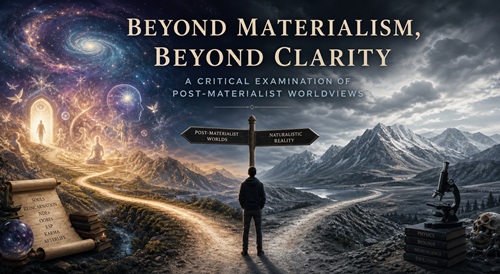 Over the past century, dissatisfaction with strict materialism has steadily grown. Consciousness seems difficult to reduce to neural firings. Reports of near-death experiences, out-of-body experiences, reincarnation memories, apparitions, synchronicities, and extrasensory perception continue to attract serious attention from researchers and the public alike. A growing number of philosophers, psychologists, and spiritual writers now argue that reality must be “post-materialist” in some sense. Importantly, skepticism toward these claims no longer stems only from accusations of fraud, superstition, or poor methodology. In many cases, the research itself is sophisticated, statistically careful, and pursued by credible investigators. The deeper problem lies elsewhere. Even if some psi phenomena were genuine, what exactly would follow from that? What kind of universe would suddenly become necessary? And would that universe actually explain more than it obscures? This is where post-materialist worldviews often encounter their greatest difficulty: not at the level of evidence, but at the level of implication. From Anomalies to OntologyA recurring pattern in psi discourse is the leap from unexplained phenomena to vast metaphysical conclusions. A statistically significant ESP experiment, a striking reincarnation case, or a vivid NDE is often treated as evidence that consciousness transcends the brain. But this transition is far from straightforward. Suppose, for argument's sake, that telepathy exists. That does not automatically establish immortal souls, cosmic purpose, astral realms, karmic evolution, or divine consciousness. It merely establishes that something anomalous occurred under certain conditions. The explanatory gap remains enormous. In practice, however, post-materialist systems rarely stop at modest conclusions. They tend to expand rapidly into elaborate metaphysical architectures populated by subtle bodies, nonphysical dimensions, karmic laws, spiritual hierarchies, pre-birth planning, cosmic intelligence, and evolutionary destinies. The original anomaly becomes the thin edge of an immense speculative wedge. The result is often a proliferation of unanswered questions larger than the original mystery. The Soul ProblemConsider reincarnation research, perhaps the most philosophically ambitious branch of psi studies. If reincarnation is literally true, then one immediately confronts a series of difficult ontological questions. How many souls exist? Has the number remained constant throughout history, despite the enormous growth in human population? If not, are new souls continuously created? By what mechanism? And for what purpose? If souls preexist bodies, where do they reside between incarnations? In another dimension? A spiritual plane? A universal mind? Why are memories of previous lives usually absent? Why are alleged past-life memories fragmentary, culturally shaped, and concentrated in childhood? Why reincarnate at all? What cosmic process requires repeated embodiment? And why does reincarnation appear almost entirely tied to Earth? Are souls exclusively human? Do animals reincarnate? Did dinosaurs possess souls? Would extraterrestrials? These are not trivial details. They are structural questions. Yet post-materialist literature frequently treats them with mythological flexibility rather than explanatory rigor. One quickly notices that the supposed explanation—reincarnation—itself demands a far larger explanatory framework whose own foundations remain obscure. Near-Death Experiences and the Geography of the AfterlifeNear-death experiences raise similar issues. Experiencers often report tunnels, lights, deceased relatives, panoramic memories, transcendence, and overwhelming peace. Even granting the sincerity of these reports, interpretation remains deeply contested. Do NDEs reveal an actual afterlife, or are they neuropsychological states generated under extreme stress? Even if some perceptions during clinical death prove difficult to explain neurologically, what follows metaphysically? Suppose consciousness can temporarily function independently of ordinary brain activity. One still faces enormous unanswered questions. Where exactly does consciousness “go” during an NDE? Why do reports vary significantly across cultures and religions? Why do many descriptions resemble symbolic narratives rather than coherent descriptions of an objective realm? If an afterlife exists, what are its laws, structures, limitations, and purposes? Again, the explanatory burden multiplies rather than diminishes. The afterlife begins to resemble an invisible continent whose geography is endlessly described yet never consistently mapped. The Inflation of Invisible WorldsOne striking feature of post-materialist thought is its tendency toward ontological inflation. Once matter is declared insufficient, entire invisible ecosystems often emerge. We hear of etheric bodies, astral planes, morphogenetic fields, akashic records, transpersonal dimensions, subtle energies, cosmic consciousness, archetypal realms, or nonlocal minds. Each concept attempts to bridge explanatory gaps left by the others. But the cumulative effect can become epistemically unstable. Unlike scientific theories, which ideally reduce complexity through unified explanatory principles, post-materialist systems often increase complexity dramatically. Every unresolved problem generates another invisible layer. Why do souls forget previous lives? A veil of incarnation. How does telepathy work? Morphic resonance. Where are memories stored? Akashic fields. How does karma operate? Subtle causal laws across lifetimes. The system becomes progressively harder to falsify because every anomaly can be absorbed into an ever-expanding metaphysical framework. The Problem of Selective EvidenceAnother difficulty concerns evidential asymmetry. Psi advocates often emphasize “hard cases”—the strongest reincarnation reports, the most compelling veridical NDEs, the most statistically significant ESP findings. Yet any comprehensive worldview must also explain the overwhelming inconsistency, ambiguity, and unreliability of psi phenomena. Why are psychic abilities weak, erratic, and non-reproducible? Why do mediums contradict each other? Why do afterlife descriptions vary wildly? Why does spiritual insight so often mirror cultural expectations? Why has no clear and universally accepted demonstration of psi emerged despite more than a century of investigation? Post-materialist thinkers sometimes argue that spiritual realities are inherently elusive or resist laboratory conditions. But this introduces another complication: a phenomenon that systematically evades reliable verification risks becoming indistinguishable from projection, interpretation, or belief. The Human Longing Behind Post-MaterialismThe attraction of post-materialist worldviews is understandable. Materialism can appear emotionally barren, existentially cold, and spiritually unsatisfying. A universe of particles and impersonal forces seems unable to accommodate meaning, transcendence, morality, or mystical experience. Post-materialist systems restore depth and drama to existence. They offer continuity after death, cosmic significance, spiritual evolution, and hidden dimensions of reality. But existential appeal is not the same as explanatory success. Indeed, one reason these systems proliferate may be precisely because they resonate with perennial human desires: the desire for survival, purpose, justice, reunion, transcendence, and cosmic belonging. This does not automatically make them false. But it does require caution. Human beings are exceptionally skilled at constructing metaphysical narratives around emotional needs. The Irony of Post-MaterialismIronically, many post-materialist theories end up recreating the very problem they accuse materialism of having. Materialism is criticized for reducing reality to blind mechanisms. Yet post-materialist systems often invoke equally opaque mechanisms—karmic laws, soul contracts, vibrational frequencies, cosmic memory fields, or spiritual planes—whose operations remain undefined and empirically inaccessible. The vocabulary changes, but explanatory opacity remains. In some cases, the opacity increases. A neuron can at least be observed under a microscope. An astral body cannot. The Modest AlternativeNone of this proves that materialism is correct. Consciousness remains profoundly mysterious, and some anomalous phenomena may ultimately force revisions to current scientific paradigms. But intellectual caution suggests a more restrained conclusion. Unexplained phenomena do not automatically justify grand metaphysical systems. One may acknowledge anomalies without constructing entire invisible cosmologies around them. One may remain open-minded without abandoning explanatory discipline. And one may recognize the limits of current neuroscience without populating the universe with immortal souls, astral realms, and karmic machinery. The wisest position may therefore be neither dogmatic materialism nor enthusiastic post-materialism, but disciplined agnosticism. Conclusion: Mystery Is Not a MetaphysicsThe central problem with many post-materialist worldviews is not merely lack of evidence. It is conceptual overreach. A single anomaly becomes the gateway to an immense metaphysical edifice filled with entities, dimensions, purposes, and processes that generate more questions than answers. The original mystery does not disappear; it metastasizes. Instead of asking how consciousness emerges from brains, one now must explain souls, afterlives, karmic systems, reincarnation logistics, spiritual evolution, and invisible ontological realms. The explanatory burden becomes vastly heavier. Mystery, in other words, is real. But mystery alone does not constitute a worldview. Appendix: The Unbearable Lightness of NaturalismCritics of materialism often argue that a purely naturalistic worldview is existentially intolerable. If human beings are accidental products of blind evolution inhabiting a temporary planet in an indifferent universe, then meaning, morality, purpose, and transcendence appear radically undermined. Naturalism, they say, leaves us suspended in a cosmos devoid of ultimate significance. This emotional and philosophical discomfort has fueled much of the contemporary turn toward post-materialism. The attraction is understandable. A universe infused with consciousness, spirit, cosmic purpose, or survival after death feels existentially richer than one governed solely by physical processes. Yet this criticism frequently confuses psychological satisfaction with explanatory adequacy. Naturalism may indeed feel “light” in the sense that it does not provide cosmic guarantees. It offers no assurance of immortality, divine justice, karmic balance, or ultimate meaning. Human existence becomes finite, contingent, and fragile. Consciousness emerges briefly within evolutionary history and eventually disappears again. But this very lightness may also constitute its intellectual strength. Naturalism does not multiply unseen entities beyond necessity. It does not populate reality with subtle planes, soul trajectories, invisible karmic systems, or metaphysical bureaucracies designed to preserve existential hope. It accepts that some questions may remain unanswered without compensating for uncertainty through speculative cosmology. In this sense, naturalism possesses a certain epistemic austerity. The accusation that naturalism is “reductive” is often true descriptively but misleading evaluatively. Reduction is not automatically a flaw. Scientific progress has repeatedly involved reducing apparently mysterious phenomena to simpler underlying mechanisms: disease to pathogens, lightning to electricity, biological diversity to evolution, planetary motion to gravitation. What matters is explanatory power, not emotional resonance. Post-materialist systems frequently promise existential fullness, but at the cost of ontological inflation. Meaning is purchased through metaphysical expansion. The universe becomes crowded with souls, dimensions, cosmic intentions, spiritual hierarchies, and evolutionary teleologies whose existence remains deeply uncertain. Naturalism refuses this inflationary move. Its “lightness” can certainly feel unbearable at times. Human beings appear as temporary organisms suspended between two oblivions. Death becomes real in the strongest possible sense. The universe owes us neither justice nor permanence. But there is also a strange liberation in this perspective. Meaning no longer descends from cosmic architecture; it becomes a human creation. Ethics emerges not from supernatural decree but from the conditions of social existence, empathy, reciprocity, and suffering. Beauty, love, curiosity, and creativity become more precious precisely because they are finite. Under naturalism, the universe does not narrate our importance to us. We must construct significance ourselves. This may appear spiritually impoverished compared to grand metaphysical visions. Yet it also avoids the speculative excesses that so often accompany attempts to transcend materialism. It preserves intellectual humility by resisting the temptation to transform existential longing into ontology. The irony is that post-materialist thinkers often portray naturalism as simplistic, while their own systems become staggeringly complex and conceptually unstable. A naturalistic universe may feel emotionally sparse, but it is structurally parsimonious. Post-materialist universes feel emotionally rich, but frequently at the cost of explanatory coherence. In the end, the “unbearable lightness” of naturalism may simply reflect adulthood at the cosmic scale: the difficult recognition that reality is under no obligation to satisfy human hopes.
Comment Form is loading comments...
|