|
TRANSLATE THIS ARTICLE
Integral World: Exploring Theories of Everything
An independent forum for a critical discussion of the integral philosophy of Ken Wilber
  Frank Visser, graduated as a psychologist of culture and religion, founded IntegralWorld in 1997. He worked as production manager for various publishing houses and as service manager for various internet companies and lives in Amsterdam. Books: Ken Wilber: Thought as Passion (SUNY, 2003), and The Corona Conspiracy: Combatting Disinformation about the Coronavirus (Kindle, 2020). Frank Visser, graduated as a psychologist of culture and religion, founded IntegralWorld in 1997. He worked as production manager for various publishing houses and as service manager for various internet companies and lives in Amsterdam. Books: Ken Wilber: Thought as Passion (SUNY, 2003), and The Corona Conspiracy: Combatting Disinformation about the Coronavirus (Kindle, 2020).
Check out my other conversations with ChatGPT LUCA: The Last Universal Common Ancestor of All LifeFrank Visser / ChatGPT
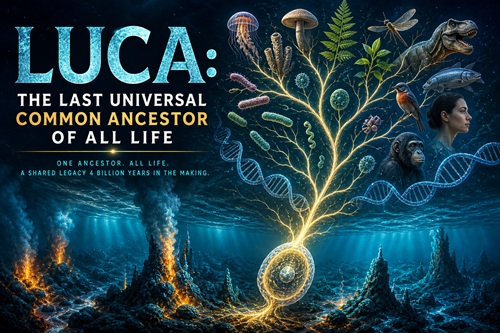
The Most Important Organism That No Longer ExistsEvery bacterium, oak tree, mushroom, whale, and human being belongs to a single unbroken family tree stretching back nearly four billion years. At the root of that tree lies a hypothetical organism known as LUCA: the Last Universal Common Ancestor. LUCA was not the first living thing. Nor was it the only organism alive in its era. It was simply the ancestral population from which all currently existing life descends. Earlier forms of life almost certainly existed before it, but they either went extinct or left no surviving lineage. The concept of LUCA emerged from molecular biology in the late twentieth century, especially through the comparison of DNA, RNA, and protein sequences across different organisms. The deeper scientists looked into the shared biochemical machinery of life, the more striking the unity became. All known organisms use DNA as genetic storage, RNA as intermediary, proteins built from the same twenty amino acids, ATP as an energy currency, and a nearly universal genetic code. These commonalities strongly imply inheritance from a common ancestor. LUCA therefore represents the point before the great divergence of life into the three major domains recognized today: Bacteria, Archaea, and Eukaryotes. How Scientists Inferred LUCALUCA was not discovered as a fossil. It was reconstructed indirectly through comparative genomics and evolutionary inference. The key insight came from studying genes shared universally across life. If a gene appears in bacteria, archaea, and eukaryotes alike, it is likely extremely ancient. By identifying these conserved genes and molecular systems, researchers can infer features that LUCA probably possessed. The strongest evidence concerns core informational machinery. LUCA almost certainly had: • Ribosomes for protein synthesis • RNA-based translation • DNA replication systems • ATP metabolism • Cell membranes • Enzymes and protein catalysts • A genetic code very close to the modern one One of the most powerful lines of evidence comes from ribosomal RNA. In the 1970s, microbiologist Carl Woese used ribosomal RNA comparisons to reconstruct deep evolutionary relationships. His work led to the discovery of the Archaea as a separate domain of life and reinforced the conclusion that all life shares a common ancestry. The resulting “tree of life” suggested that LUCA existed before the split between Bacteria and Archaea, with Eukaryotes later emerging through complex symbiotic events involving archaeal and bacterial ancestors. What LUCA Probably Looked LikeLUCA was almost certainly microscopic and unicellular. It was not a primitive blob barely qualifying as alive. Surprisingly, evidence suggests it was already biochemically sophisticated. LUCA probably possessed: • A lipid membrane enclosing cellular contents • Ribosomes and a functioning genetic code • Hundreds of genes • Protein enzymes • Metabolic pathways for energy conversion • Mechanisms for reproduction and error correction However, LUCA was likely simpler than modern cells in several respects. It may have lacked fully modern membrane structures or advanced regulatory systems. Some researchers think LUCA existed as part of a communal network of early cells exchanging genes horizontally rather than through strict vertical inheritance. This idea complicates the image of a single isolated organism. Early life may have resembled a genetic ecosystem in which lineages frequently swapped molecular innovations. In that case, LUCA might better be understood as a population rather than a single individual. The Environment of LUCAWhere LUCA lived remains debated, but one hypothesis dominates contemporary discussion: hydrothermal vent environments in the deep ocean. These environments contain mineral-rich hot water emerging from Earth's crust. They provide strong chemical gradients capable of driving primitive metabolism without sunlight. Modern hydrothermal vent ecosystems are populated by organisms that rely on chemosynthesis rather than photosynthesis, making them plausible analogues for early life. Some researchers propose that LUCA was thermophilic, meaning adapted to high temperatures. Others argue that this may reflect later adaptation rather than original conditions. A major 2016 genomic reconstruction suggested that LUCA may have been anaerobic, hydrogen-dependent, and adapted to geochemically active environments rich in iron and sulfur compounds. It may have obtained energy through reactions involving hydrogen gas and carbon dioxide, resembling some modern archaea and bacteria inhabiting deep-sea vents. The hydrothermal vent hypothesis is attractive because it links geology directly to biochemistry. Mineral pores in vents could have acted as natural proto-cellular compartments, concentrating molecules and catalyzing reactions before fully autonomous cells evolved. Still, competing ideas exist. Some researchers favor shallow tidal pools, volcanic ponds, or ice-covered environments. The origin of life remains one of science's greatest unresolved questions, and LUCA appears relatively late in that process. By the time LUCA existed, evolution had already produced a surprisingly advanced cellular system. LUCA Was Not AloneOne common misunderstanding is imagining LUCA as the first and only early organism. In reality, LUCA likely coexisted with many other lineages. The early Earth was probably populated by a diverse microbial world undergoing intense evolutionary experimentation. Some lineages may have used alternative biochemistries or metabolic systems. Others simply lost the evolutionary competition. The descendants of LUCA survived because their lineage happened to persist and diversify successfully. All known organisms are therefore members of a single surviving branch from a once broader evolutionary radiation. This insight carries a profound implication: evolution's history is full of extinction even at the deepest levels. Entire early biological worlds may have vanished without trace. The Genetic Code and the Unity of LifeOne of the most astonishing clues about LUCA is the near universality of the genetic code. Throughout life on Earth, the same nucleotide triplets generally correspond to the same amino acids. This consistency is difficult to explain except through common descent. The code appears so deeply entrenched that major changes became nearly impossible once life diversified. The universality of the code suggests that LUCA inherited it from even earlier life forms. In other words, the genetic code itself may predate LUCA. This pushes the mystery further back. Before LUCA there may have existed an “RNA world” in which RNA molecules both stored information and catalyzed reactions. DNA and proteins may have evolved later as more stable and efficient systems. LUCA thus stands not at the beginning of life, but at the end of a much earlier prebiotic and proto-biological evolutionary process. Horizontal Gene Transfer and the “Web of Life”Modern biology often depicts evolution as a branching tree, but early evolution may have resembled a tangled web. Microbes can exchange genes horizontally, meaning across unrelated lineages rather than strictly from parent to offspring. This process is still common among bacteria today. In early life, horizontal gene transfer may have been extraordinarily widespread. Some researchers therefore argue that LUCA should not be imagined as a sharply defined organism but as a loosely connected community sharing genetic innovations. This challenges simplistic images of evolution as a neat linear progression. The earliest stages of life may have been messy, collective, and fluid. Nevertheless, despite these complications, the existence of a universal common ancestry remains overwhelmingly supported by molecular evidence. What LUCA Tells Us About LifeLUCA reveals something fundamental about biology: all life on Earth is deeply related. The differences between a bacterium and a human are enormous on the surface, yet at the molecular level they share ancient biochemical machinery inherited across billions of years. Every living organism uses variations of the same cellular toolkit. This unity has philosophical as well as scientific significance. It means that the history of life is literally a single genealogical process. Evolution did not independently invent modern organisms from scratch. It diversified one ancestral biochemical system into the vast complexity seen today. LUCA also informs the search for extraterrestrial life. If life elsewhere exists, scientists ask whether it would converge on similar biochemical solutions or whether Earth's molecular architecture is historically contingent. Was LUCA's chemistry inevitable, or merely one successful accident among many possibilities? We do not yet know. ConclusionLUCA is one of the most remarkable scientific inferences ever made: an organism—or ancestral population—that left no fossil, no direct trace, yet whose existence is written into every genome on Earth. Modern genetics has allowed scientists to reconstruct aspects of a creature that lived nearly four billion years ago. LUCA was not the first life form, but it was already highly sophisticated, possessing much of the molecular machinery still used today. Its existence demonstrates the profound unity of life and the immense continuity of evolution across geological time. Every living thing alive today, from microbes in deep-sea vents to human civilization itself, carries within its cells the biochemical legacy of LUCA. Appendix: Was LUCA Too Complex to Have Evolved?One of the recurring arguments raised by critics of evolutionary theory is that LUCA already appears astonishingly complex. If the Last Universal Common Ancestor possessed ribosomes, genetic coding, enzymes, membranes, ATP metabolism, and hundreds of genes, does this not imply that life was “fully formed” from the beginning? Some proponents of Intelligent Design argue precisely this point. They claim LUCA was too sophisticated to have arisen through natural processes. At first glance, the objection has intuitive force. LUCA was clearly not a primitive droplet of chemicals barely crossing the threshold into life. Modern reconstructions suggest it already possessed a highly integrated molecular system. The ribosome alone is an extraordinarily intricate molecular machine involving RNA and dozens of proteins working in coordinated fashion. The genetic code itself is deeply structured and nearly universal. Compared to simplistic textbook images of “the first cell,” LUCA looks remarkably advanced. But this observation does not imply impossibility, nor does it support supernatural design. The crucial point is that LUCA was not the beginning of life. It was the last common ancestor of all currently surviving life. By the time LUCA existed, evolution had already been operating for a very long period—perhaps hundreds of millions of years. In other words, critics often smuggle in a false assumption: that LUCA appeared suddenly out of nonliving chemistry in one step. Modern origin-of-life research proposes nothing of the sort. Between simple prebiotic chemistry and LUCA lies an enormous span of gradual molecular evolution. Scientists hypothesize many intermediate stages: • Self-organizing chemical networks • Autocatalytic molecule • RNA-based replicators • Proto-metabolic systems • Primitive membrane compartments • Early forms of selection and competition • Increasingly stable genetic mechanisms The likely pathway was cumulative rather than instantaneous. The RNA World hypothesis is especially important here. It proposes that RNA molecules once served both as genetic carriers and catalytic agents before the evolution of DNA and proteins. RNA can store information and catalyze reactions, making it a plausible bridge between chemistry and biology. Over immense spans of time, systems based initially on RNA may have evolved into more efficient DNA-protein cellular systems. Seen from this perspective, LUCA represents not the origin of complexity, but the survivor of a long prehistory of evolutionary experimentation. Another misconception concerns complexity itself. Modern biology has repeatedly shown that complex systems can emerge incrementally through selection acting on simpler precursors. The vertebrate eye, immune system, and bacterial flagellum were once claimed to be impossible products of evolution, yet comparative biology revealed numerous intermediate stages and evolutionary pathways. The same logic applies to LUCA. Its complexity reflects cumulative evolution before the bacterial-archaeal split, not miraculous appearance. Ironically, the fact that LUCA already appears sophisticated actually strengthens evolutionary reasoning. It suggests that life originated earlier than once assumed, allowing substantial evolutionary development before the diversification of modern lineages. Geological evidence increasingly points toward very ancient life on Earth, perhaps emerging surprisingly soon after the planet became habitable. Some critics also misunderstand how evolution works at molecular scales. Early evolution was probably far more communal and experimental than later multicellular evolution. Horizontal gene transfer, molecular cooperation, and shared biochemical innovation may have accelerated the spread of useful systems among primitive cells. Evolution at this stage may have resembled a network more than a linear lineage. There is also a deeper philosophical issue. Arguments that LUCA was “too complex” often rely less on scientific calculation than on intuitions about improbability. But complexity alone is not evidence of design. Snowflakes, hurricanes, crystal structures, and galaxies are also highly organized products of natural processes. Biology differs because it involves replication and selection, but the principle remains: natural systems can generate remarkable order under the right conditions. To invoke design merely because a system appears intricate risks turning ignorance into explanation. Historically, many phenomena once attributed to divine intervention—planetary motion, lightning, disease, heredity—later received natural explanations. Origin-of-life research remains incomplete, but incomplete knowledge is not positive evidence for supernatural causation. Most importantly, Intelligent Design does not actually solve the problem of complexity. It merely relocates it. If biological organization requires an intelligent designer, then the designer itself must presumably possess even greater informational complexity. The explanatory burden is therefore deferred rather than resolved. LUCA remains one of the greatest scientific mysteries precisely because it sits near the edge of recoverable history. We still do not know exactly how nonliving chemistry became living systems. But the complexity of LUCA does not invalidate evolution. Instead, it reveals how much evolutionary history had already unfolded before the last universal common ancestor of modern life emerged.
Comment Form is loading comments...
|