|
TRANSLATE THIS ARTICLE
Integral World: Exploring Theories of Everything
An independent forum for a critical discussion of the integral philosophy of Ken Wilber
  Frank Visser, graduated as a psychologist of culture and religion, founded IntegralWorld in 1997. He worked as production manager for various publishing houses and as service manager for various internet companies and lives in Amsterdam. Books: Ken Wilber: Thought as Passion (SUNY, 2003), and The Corona Conspiracy: Combatting Disinformation about the Coronavirus (Kindle, 2020). Frank Visser, graduated as a psychologist of culture and religion, founded IntegralWorld in 1997. He worked as production manager for various publishing houses and as service manager for various internet companies and lives in Amsterdam. Books: Ken Wilber: Thought as Passion (SUNY, 2003), and The Corona Conspiracy: Combatting Disinformation about the Coronavirus (Kindle, 2020).
Check out my other conversations with ChatGPT Eating EntropyThe Paradox of Life Sustaining Itself by Consuming the WorldFrank Visser / ChatGPT
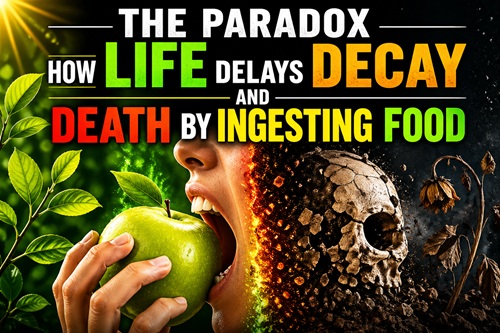
The Thermodynamic Problem of Being AliveAt its core, life is a defiance of equilibrium. The second law of thermodynamics dictates that systems tend toward disorder, toward the even distribution of energy, toward what we casually call decay. A living organism, however, is an island of improbability: highly ordered, metabolically active, and persistently resisting the drift toward equilibrium. Cells maintain gradients, organisms sustain structure, and ecosystems preserve dynamic complexity. All of this appears, at first glance, to run counter to the universal tendency toward entropy. But the paradox dissolves once we widen the frame. Life does not violate thermodynamics; it exploits it. The key lies in the fact that organisms are not closed systems. They are open systems that exchange energy and matter with their surroundings. And the primary mechanism for doing so is ingestion—eating. Order from Disorder: The Logic of MetabolismTo stay alive, an organism must continuously repair itself. Proteins degrade, DNA accumulates damage, membranes lose integrity. Left alone, the organism would quickly succumb to molecular chaos. Food provides the raw materials and energy required to counteract this drift. Yet here lies the paradox: in order to maintain its own order, the organism must consume other forms of order. When an animal eats a plant, or a predator consumes prey, it is effectively importing structured matter—complex molecules built through prior biological processes. These molecules are then broken down, metabolized, and partially reassembled into the organism's own structure. The rest is dissipated as heat and waste. In thermodynamic terms, the organism lowers its internal entropy at the cost of increasing the entropy of its environment. So life delays its own decay by accelerating decay elsewhere. The Asymmetry of SurvivalThis creates a fundamental asymmetry. The organism persists by degrading what it consumes. Every act of nourishment is also an act of destruction. Even in the most benign cases—say, a human eating fruit—the fruit's organized biological structure is dismantled to sustain another system. At higher trophic levels, the asymmetry becomes more obvious: the life of one organism is literally the condition for the continued life of another. This is not an accidental feature of life; it is its defining logic. Biological systems are hierarchically organized flows of energy, where each level depends on the breakdown of the level below. Plants capture solar energy and build complex molecules. Herbivores consume plants. Carnivores consume herbivores. Decomposers eventually recycle everything. At each step, energy is dissipated, and entropy increases overall, even as local pockets of order persist. The Illusion of StabilityFrom the inside, life feels like continuity. An organism experiences itself as a stable entity, maintaining identity over time. But this stability is deceptive. The organism is in constant flux, replacing its components, exchanging matter with the environment, and burning through energy gradients. What appears as persistence is actually a process—a dynamic equilibrium sustained by continuous throughput. Eating is central to this illusion. Without constant intake, the organism's internal order would collapse. Starvation reveals the underlying truth: deprived of external inputs, the organism rapidly succumbs to the very entropy it has been holding at bay. The boundary between life and death is thus not a fixed state but a metabolic condition. Life as a Local ReversalThe paradox can be sharpened: life is a local reversal of entropy achieved by participating in its global increase. Organisms carve out temporary zones of order by channeling energy flows through themselves. They do not escape the second law; they ride it. In this sense, eating is not merely a biological necessity but a thermodynamic strategy. It is the means by which life taps into existing gradients—chemical, solar, or ecological—and converts them into temporary structure. The price is always the same: increased disorder elsewhere. The Ethical and Existential EdgeThis thermodynamic perspective has an unsettling implication. The persistence of life is inseparable from the consumption of other forms of order. There is no purely self-sustaining existence, no life that does not, in some sense, feed on the world. Even photosynthetic organisms depend on solar flux and mineral resources; even ecosystems depend on cycles of growth and decay. What we often frame in moral or existential terms—the struggle for survival, the competition for resources, the inevitability of death—has a deeper physical basis. Life is not merely in tension with death; it is structurally dependent on processes that produce it. Conclusion: Sustained by What We UndoThe paradox resolves into a stark clarity. Life delays its own decay by ingesting and dismantling other organized systems, converting their structure into its own, and exporting entropy back into the environment. It is a continuous negotiation with the second law: a temporary, localized victory that ensures a larger, unavoidable loss. To live is to eat, and to eat is to participate in the universal drift toward disorder—while briefly, and precariously, holding it at bay within oneself.
Widget is loading comments...
|