|
TRANSLATE THIS ARTICLE
Integral World: Exploring Theories of Everything
An independent forum for a critical discussion of the integral philosophy of Ken Wilber
  Frank Visser, graduated as a psychologist of culture and religion, founded IntegralWorld in 1997. He worked as production manager for various publishing houses and as service manager for various internet companies and lives in Amsterdam. Books: Ken Wilber: Thought as Passion (SUNY, 2003), and The Corona Conspiracy: Combatting Disinformation about the Coronavirus (Kindle, 2020). Frank Visser, graduated as a psychologist of culture and religion, founded IntegralWorld in 1997. He worked as production manager for various publishing houses and as service manager for various internet companies and lives in Amsterdam. Books: Ken Wilber: Thought as Passion (SUNY, 2003), and The Corona Conspiracy: Combatting Disinformation about the Coronavirus (Kindle, 2020).
Check out my other conversations with ChatGPT The Kundalini MirageWhy “Cosmic Inspiration” Collapses Under ScrutinyFrank Visser / ChatGPT
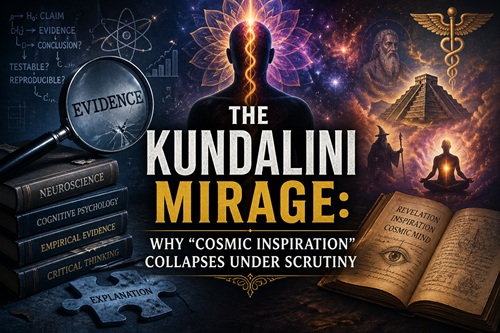 It substitutes assertion for evidenceThe central claim of the ICR Canada essay is that revelation and inspiration stem from a biologically grounded yet “supersensory” mechanism—often framed in terms of Kundalini awakening and an emergent organ of higher perception.[1] This is presented as a hypothesis, but it never rises to the level of a testable scientific theory. There are no operational definitions, no measurable variables, and no reproducible experiments offered in support. Instead, the argument leans heavily on mythological archetypes, religious traditions, and anecdotal reports. Figures like Merlin or Hermes are invoked alongside modern geniuses such as Einstein or Beethoven, as if their perceived brilliance constitutes evidence of a shared biological process. Personal testimonies, particularly those of mystics like Gopi Krishna, are treated as data points rather than subjective narratives. Even the authors acknowledge the absence of empirical grounding by proposing that a large-scale scientific initiative—something akin to a “Manhattan Project”—would be needed to properly investigate these claims. That admission alone underscores the speculative nature of the entire framework. Category error: subjective experience is not objective mechanismA persistent flaw in the essay is its conflation of phenomenology with ontology. The fact that inspiration often feels as though it comes “from beyond” the self is taken as evidence that it literally does. This is a textbook category mistake. Contemporary cognitive science offers a far more parsimonious explanation. Creative insight frequently emerges from unconscious processing, where the brain integrates information outside of conscious awareness and then delivers it suddenly into consciousness. This gives rise to the familiar “aha” experience, which can feel external or transcendent. But this feeling does not imply an external source; it reflects the architecture of cognition itself. The essay mistakes the subjective texture of experience for a description of its underlying cause. Misuse of physics and scientific rhetoricThe article attempts to bolster its claims by invoking quantum mechanics and citing early twentieth-century physicists such as James Jeans. The suggestion is that modern science has already moved toward a view of the universe as fundamentally mental or consciousness-based. This is a distortion. While quantum theory challenges classical intuitions about matter, it does not entail that consciousness creates reality or that the universe is literally a thought. These interpretations belong to philosophical speculation, not to the empirical core of physics. The essay takes metaphorical or interpretive statements from scientists and reifies them into ontological claims, thereby overstating the scientific legitimacy of its position. Cherry-picking historical authoritiesA recurring rhetorical strategy is the enlistment of major historical figures—Einstein, Newton, Plato—as implicit supporters of the perennial philosophy. This move collapses under even minimal scrutiny. Einstein rejected mystical and personalist interpretations of divinity, Newton's theological commitments were complex and often idiosyncratic, and Plato's metaphysics bears no relation to Kundalini biology. What we see here is not intellectual continuity but selective appropriation. The authority of these figures is used to lend weight to a theory they neither formulated nor endorsed. The arbitrary divide between “true” and “false” revelationThe essay draws a sharp distinction between authentic revelation, which it associates with higher evolutionary development, and regressive phenomena like channeling, which it dismisses as pathological or subconscious. This distinction is asserted rather than demonstrated. Both categories involve altered states of consciousness, both rely on subjective reporting, and neither can be independently verified. The criteria used to separate them are internal to the theory itself, making the distinction circular. It is a way of preserving the credibility of preferred experiences while excluding inconvenient parallels. The nonexistent “supersensory organ”Perhaps the most striking claim is the existence of a latent biological structure—a supersensory organ activated through Kundalini processes. This is presented as if it were a natural extension of human evolution. Yet no such organ has been identified in anatomy, physiology, or neuroscience. Modern brain science has extensively mapped sensory systems and cognitive functions, and while much remains to be understood, there is no evidence for a hidden perceptual apparatus of this kind. If it existed, it would produce measurable and reproducible effects. Its complete absence from empirical observation is not a minor gap; it is a decisive refutation. Metaphor masquerading as mechanismThe essay relies heavily on terms like “energy,” “vibration,” and “cosmic intelligence,” but these are used in a fluid and ambiguous manner. In physics, energy has a precise quantitative meaning. In this context, it functions as a metaphor that is gradually reinterpreted as a literal causal force. This equivocation allows the argument to appear scientifically grounded while remaining conceptually vague. The language shifts between poetic and technical registers without acknowledging the transition, creating an illusion of explanatory depth where none exists. Immunity to falsificationA defining feature of the framework is its resistance to disproof. Any instance of inspiration is taken as confirmation of the theory. The absence of measurable evidence is attributed to the “subtle” nature of the phenomenon. Contradictory findings can be dismissed as manifestations of lower levels of consciousness. This renders the theory effectively unfalsifiable. It cannot be tested in a way that would allow it to fail, which places it outside the domain of science. Ockham's Razor and the simpler explanationAll the phenomena the essay seeks to explain—creative insight, mystical experience, sudden revelation—are already well accounted for within established disciplines. Neuroscience explains the distributed and often unconscious nature of cognition. Psychology details the mechanisms of incubation and associative thinking. Cultural studies illuminate the recurrence of symbolic patterns across societies. There is no explanatory gap that necessitates the introduction of Kundalini energy or a Cosmic Mind. These additions complicate the picture without increasing its explanatory power. By the standard of parsimony, they are unnecessary. Conclusion: transcendence without transcendenceAt its core, the essay rests on a single intuitive leap: because certain experiences feel transcendent, they must originate from a transcendent source. This is a powerful and deeply human intuition, but it does not withstand analytical scrutiny. What the article offers is not a scientific account of revelation and inspiration, but a metaphysical narrative that reinterprets subjective experience as evidence of cosmic processes. Once the rhetoric is stripped away, the structure of the argument becomes clear—and its weaknesses become impossible to ignore. NOTES
[1] G. Philippe Menos and Karen A. Jones Menos, "Revelation and Inspiration: Paranormal Phenomena in Light of the Kundalini Paradigm", Institute for Consciousness Research Canada, Presented at the 14th Annual Conference of the Academy of Religion and Psychical Research, May 21-23, 1989, Rosemont College, Rosemont, Pennsylvania. (This article was linked in a Facebook post by Helen Malinowski, who claims Kundalini experiences and God-consciousness.)
Widget is loading comments...
|