|
TRANSLATE THIS ARTICLE
Integral World: Exploring Theories of Everything
An independent forum for a critical discussion of the integral philosophy of Ken Wilber
  Frank Visser, graduated as a psychologist of culture and religion, founded IntegralWorld in 1997. He worked as production manager for various publishing houses and as service manager for various internet companies and lives in Amsterdam. Books: Ken Wilber: Thought as Passion (SUNY, 2003), and The Corona Conspiracy: Combatting Disinformation about the Coronavirus (Kindle, 2020). Frank Visser, graduated as a psychologist of culture and religion, founded IntegralWorld in 1997. He worked as production manager for various publishing houses and as service manager for various internet companies and lives in Amsterdam. Books: Ken Wilber: Thought as Passion (SUNY, 2003), and The Corona Conspiracy: Combatting Disinformation about the Coronavirus (Kindle, 2020).
Check out my other conversations with ChatGPT The Myth of Second TierA Critical Examination of Integral Developmental HierarchiesFrank Visser / ChatGPT
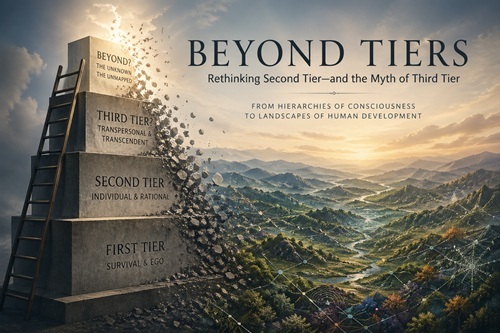 Introduction: a seductive ladder of consciousnessWithin integral circles, few ideas have had more rhetorical power than the notion of “Second Tier” consciousness, and its even more speculative extension, “Third Tier.” Popularized through the Integral Theory framework associated with Ken Wilber and the developmental model of Spiral Dynamics, these tiers are often presented as qualitative leaps in human awareness. Second Tier is described as the point where earlier value systems are transcended and integrated; Third Tier, when mentioned at all, tends to drift into near-mythic territory, gesturing toward transpersonal or even post-human forms of cognition. The appeal is obvious. It offers a clean developmental ladder, a sense of evolutionary direction, and—perhaps most importantly—a way of distinguishing “higher” integral thinkers from those still embedded in “lower” paradigms. But precisely because of this appeal, the concept deserves careful scrutiny. When examined closely, Second Tier functions less as a descriptive psychological category and more as a symbolic or ideological construct. Origins: Spiral Dynamics and the inflation of stagesThe idea of Second Tier is inseparable from Spiral Dynamics, developed from the work of Clare Graves and later systematized by Don Beck and Chris Cowan. In that model, human value systems evolve through nested stages, often color-coded, culminating in a “yellow” and “turquoise” tier that supposedly integrates all previous stages into a more complex worldview. Wilber adopted this structure and embedded it within his broader Integral Theory. In doing so, he elevated Second Tier from a heuristic model into something closer to an ontological claim about consciousness itself. What began as a descriptive typology of value systems became a quasi-evolutionary hierarchy of awareness. The problem is not that developmental differences do not exist. The problem is the leap from observed psychological variation to a reified “tiered” structure of consciousness that implies qualitative superiority in a metaphysical sense. Second Tier as epistemic self-validationOne of the most persistent criticisms of the Second Tier concept is that it tends to become self-sealing. Those who adopt integral frameworks are often implicitly or explicitly placed within Second Tier, while critics are positioned as belonging to earlier stages. This creates a circular epistemology: the model validates the user, and the user validates the model. In practice, this can lead to a subtle but significant form of intellectual insulation. Disagreement is not primarily interpreted as an alternative interpretation of evidence, but as evidence of developmental limitation. This shifts the discourse away from argumentation and toward status assignment. Once this move is accepted, the theory becomes difficult to falsify. Any critique can be absorbed as “lower-tier thinking,” which is precisely why the model is attractive to adherents and problematic in academic or scientific contexts. The problem of qualitative leapsThe Second Tier concept relies on the assumption that human cognition can undergo discrete qualitative jumps that are both general and integrative. Yet empirical psychology more often describes development in terms of domain-specific growth, uneven capacities, and context-dependent reasoning. People can exhibit high abstraction in one domain and simplistic thinking in another. Political reasoning, moral judgment, emotional regulation, and epistemic sophistication do not necessarily evolve in lockstep. The Second Tier model smooths over this unevenness in favor of a unified developmental identity. This produces a theoretical elegance, but at the cost of psychological realism. Third Tier: from model to metaphysical driftIf Second Tier is already contentious, Third Tier tends to push the model into speculative territory. In many integral discussions, Third Tier is not clearly defined in empirical or psychological terms. Instead, it functions as a placeholder for future evolutionary stages of consciousness that are not yet accessible or describable. At this point, the model begins to resemble metaphysical projection more than developmental psychology. Third Tier becomes a horizon of imagined integration, often described in language that borders on spiritual futurism. The issue is not imagination itself, but the lack of operational grounding. Without clear criteria, Third Tier cannot be meaningfully distinguished from aesthetic speculation about human potential. Hierarchy, value, and the risk of covert normativityAny hierarchical model of development carries implicit value judgments. The Second Tier framework is no exception. Even when presented as descriptive, it tends to smuggle in normative assumptions: later stages are better, more integrated, more adequate. This is where philosophical tension emerges. Hierarchy can be useful as a descriptive tool, but when it becomes value-laden in an unexamined way, it risks collapsing into intellectual elitism. In integral discourse, this can manifest as a quiet division between those who “see the whole” and those who do not. Such distinctions are rhetorically powerful but epistemically fragile. What remains valuable in the ideaA fair critique should also acknowledge what the Second Tier concept attempts to capture. There is genuine evidence that individuals can develop broader integrative capacities over time: greater tolerance for complexity, reduced dogmatism, and improved meta-cognitive awareness. The problem lies not in recognizing these differences, but in over-systematizing them into rigid tiers that imply universal developmental endpoints. Human cognition is more plural, context-sensitive, and uneven than the model allows. A more cautious approach would treat “integrative thinking” as a cluster of capacities rather than a stage of consciousness. Conclusion: from ladders to landscapesThe concept of Second Tier consciousness functions best as a metaphor for increased integrative capacity, not as a literal stage in an ontological hierarchy of awareness. Third Tier, meanwhile, belongs more to the realm of speculative futurism than to empirical psychology. The deeper issue is not whether development exists, but how we conceptualize it. Ladders of consciousness are intellectually tempting because they simplify complexity into directionality. But human cognition may be better understood as a landscape of partially overlapping competencies rather than a single ascending staircase. Seen in that light, Second Tier is less a discovery about consciousness than a story we tell about intellectual maturity—and like all such stories, it reveals as much about its narrators as about its subject. Appendix: Third Tier as Introspective PhenomenologyA relevant addition here concerns how the Third Tier discourse is sometimes anchored in Wilber's own extended writings on higher stages and states, particularly in The Religion of Tomorrow. In that work, Ken Wilber offers detailed phenomenological descriptions of advanced meditative states and stage transitions, drawing on contemplative traditions and introspective reports rather than empirical measurement in the scientific sense. Wilber's introspective expansion of higher tiersIn The Religion of Tomorrow, Wilber attempts to map a continuum of consciousness that extends beyond conventional psychological development into what he calls subtle, causal, and nondual realization. Within this expanded architecture, what some integral readers interpret as “Third Tier” becomes associated with increasingly rarefied forms of awareness, often described through first-person contemplative phenomenology rather than third-person data. This is important because it reveals a subtle but decisive shift in evidential style. The justification for post-Second Tier claims is not derived from controlled developmental psychology, longitudinal studies, or cross-cultural metrics. Instead, it relies heavily on introspective reports from contemplative practice traditions, combined with Wilber's own interpretive synthesis of those traditions into a developmental schema. From a critical standpoint, this creates an ambiguity that is often overlooked in integral discourse: phenomenological richness is treated as developmental validation. In other words, the vividness or coherence of introspective descriptions is allowed to function as if it were evidence of ontological hierarchy. The problem of translating contemplation into developmental stagesThe difficulty arises when these introspective mappings are folded back into a tiered model of human evolution. Meditative or altered-state experiences may indeed report expansions of awareness, reductions in subject-object duality, or changes in affective structure. However, translating these experiential reports into a universal developmental ladder assumes that such states are not only real but also sequentially hierarchical and broadly generalizable. This is precisely where the Third Tier concept begins to blur into metaphysical interpretation. What is presented as a continuation of development increasingly depends on the assumption that subjective reports from contemplative traditions can be systematized into a single coherent evolutionary structure of consciousness. Critically, this does not invalidate the phenomenological material itself. It simply weakens the claim that it supports a strict tiered ontology of mind. The move from “this is reported in contemplative experience” to “this represents a higher stage of universal development” is not self-evident; it is theoretical interpretation layered onto experience. Revisiting the earlier critiqueThis additional layer strengthens the earlier concern: Second Tier is already a conceptual abstraction that risks reification, and Third Tier intensifies that tendency by drawing increasingly on introspective synthesis rather than independently verifiable developmental markers. The result is a model that becomes progressively more dependent on interpretive frameworks as it ascends its own hierarchy. Seen in this light, Third Tier is not so much an empirical extension of development as it is a narrative projection built from contemplative phenomenology, systematized into a hierarchical architecture that exceeds the evidential base that originally motivated it.
Comment Form is loading comments...
|