|
TRANSLATE THIS ARTICLE
Integral World: Exploring Theories of Everything
An independent forum for a critical discussion of the integral philosophy of Ken Wilber
  Frank Visser, graduated as a psychologist of culture and religion, founded IntegralWorld in 1997. He worked as production manager for various publishing houses and as service manager for various internet companies and lives in Amsterdam. Books: Ken Wilber: Thought as Passion (SUNY, 2003), and The Corona Conspiracy: Combatting Disinformation about the Coronavirus (Kindle, 2020). Frank Visser, graduated as a psychologist of culture and religion, founded IntegralWorld in 1997. He worked as production manager for various publishing houses and as service manager for various internet companies and lives in Amsterdam. Books: Ken Wilber: Thought as Passion (SUNY, 2003), and The Corona Conspiracy: Combatting Disinformation about the Coronavirus (Kindle, 2020).
Check out my other conversations with ChatGPT Voyagers at the EdgeHumanity's Longest Journey into the DarkFrank Visser / ChatGPT
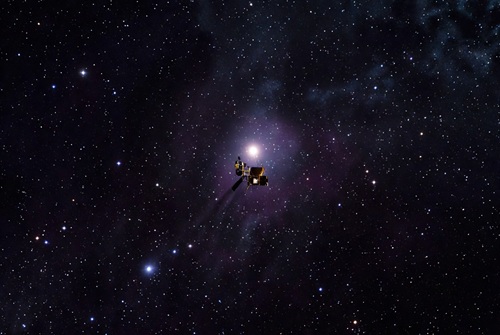 When NASA launched Voyager 1 and Voyager 2 in 1977, the mission was framed as an ambitious “Grand Tour” of the outer planets. Nearly half a century later, these twin spacecraft have become something far more consequential: the first human-made objects to enter interstellar space, carrying with them not only instruments, but a symbolic record of Earth itself. A Once-in-a-Lifetime TrajectoryThe timing of the Voyager launches exploited a rare alignment of the outer planets—Jupiter, Saturn, Uranus, and Neptune—that occurs roughly every 175 years. This configuration allowed each spacecraft to use gravitational assists, effectively slingshotting from one planet to the next while conserving fuel and dramatically increasing velocity. Voyager 2, launched first, followed the full planetary tour, becoming the only spacecraft to visit Uranus and Neptune. Voyager 1, though launched slightly later, took a faster trajectory, prioritizing encounters with Jupiter and Saturn before heading upward out of the plane of the solar system. Distance Records: Crossing into Interstellar SpaceIn terms of sheer distance, the Voyagers are unrivaled. Voyager 1 is currently the most distant human-made object from Earth, at over 24 billion kilometers (about 160 astronomical units). It crossed the boundary known as the heliopause—the edge of the Sun's influence—in 2012, officially entering interstellar space. Voyager 2 followed in 2018, crossing the same boundary at roughly 18 billion kilometers. The fact that both spacecraft are still transmitting data across such distances is a triumph of engineering, relying on the Deep Space Network, a worldwide array of massive radio antennas. Signals from Voyager 1 now take over 22 hours to reach Earth, traveling at the speed of light. Communication is slow, faint, and increasingly fragile—yet still intact. Scientific Discoveries: Rewriting the Outer Solar SystemThe Voyagers fundamentally transformed planetary science. At Jupiter, they revealed active volcanism on its moon Io—the first evidence of ongoing geological activity beyond Earth. They also provided detailed images of Jupiter's turbulent atmosphere and complex ring system. At Saturn, they uncovered intricate ring structures and shepherd moons that maintain those rings through gravitational interactions. Voyager 1's flyby of Titan revealed a thick nitrogen-rich atmosphere, sparking decades of interest in its potential for prebiotic chemistry. Voyager 2 extended these discoveries outward. At Uranus, it found a planet tipped on its side, with extreme seasons and a surprisingly complex magnetic field. At Neptune, it captured the first close-up images of the Great Dark Spot and measured the fastest winds in the solar system. Beyond planetary science, the Voyagers' most profound contribution may be heliophysics. As they approached and crossed the heliopause, they provided direct measurements of the transition from the solar wind-dominated heliosphere to the interstellar medium. This boundary turned out to be far more complex and dynamic than expected, challenging earlier theoretical models. The Golden Record: A Message in a BottleEach Voyager carries a Voyager Golden Record, a 12-inch gold-plated copper disk containing sounds and images from Earth. Curated by a team led by Carl Sagan, the record includes music from multiple cultures, greetings in dozens of languages, and encoded scientific information about humanity's place in the cosmos. It is unlikely to ever be found. But that is not the point. The Golden Record is less a practical communication device than a philosophical gesture—a statement that a technological civilization once existed and chose to announce itself. The Long FadeThe Voyagers are powered by radioisotope thermoelectric generators, which convert heat from decaying plutonium into electricity. This power source is steadily declining. Instruments have been turned off one by one to conserve energy, and by the early 2030s, both spacecraft are expected to fall silent. Even then, their journey continues. Untethered from Earth, they will drift through the galaxy for millions of years, orbiting the center of the Milky Way. Voyager 1 is headed roughly toward the constellation Ophiuchus; Voyager 2 toward Sagittarius. A Different Kind of ExplorationThe Voyager missions represent a form of exploration that is almost alien to contemporary expectations. There are no real-time images, no course corrections based on immediate feedback, no possibility of repair. Everything unfolds on timescales that exceed human attention spans. And yet, they endure. Not as relics, but as active participants in a slow unfolding experiment: what happens when intelligence sends its artifacts beyond the domain of its origin? In that sense, Voyager 1 and Voyager 2 are not just spacecraft. They are the first emissaries of a species testing the limits of its reach—quietly, persistently, and without any guarantee of return. Appendix: The Inner-Space Equivalent of VoyagerIf the Voyager probes represent the outward vector of human curiosity—precision instruments pushed beyond the known frontier—then their “inner space” equivalent is less a machine than a methodological convergence across psychology, neuroscience, and contemplative practice. The analogy holds, but only up to a point. Outer space yields to instrumentation and telemetry; inner space resists such clean externalization. The closest scientific analogue to the Voyagers is the study of consciousness through brain imaging and cognitive modeling. Technologies such as functional MRI and electroencephalography extend perception inward, mapping neural correlates of thought, emotion, and perception. Where Voyager 1 sends back plasma density and magnetic field data from the heliopause, these instruments return signal patterns associated with attention, memory, or self-referential processing. Yet this is not a perfect symmetry. Brain scans do not capture experience itself; they capture its correlates. The “heliopause” of inner space—the boundary between objective measurement and subjective experience—remains uncrossed. A second, older pathway into inner space is disciplined introspection, especially in traditions of meditation. Practices grouped under Buddhist meditation, for instance, systematically investigate the structure of awareness: sensation, thought, emotion, and the elusive sense of self. Long-term practitioners report increasingly fine-grained phenomenological distinctions—analogous, in a loose sense, to how Voyager resolved the layered structure of planetary atmospheres or magnetic fields. Modern neuroscience has begun to intersect with these traditions. Researchers study experienced meditators to correlate subjective reports with neural data, attempting a kind of triangulation: first-person experience, third-person measurement, and computational modeling. This hybrid approach is sometimes framed within the broader field of consciousness studies. There are also more speculative frontiers. Psychoactive substances, investigated under controlled conditions, can dramatically alter perception and self-modeling, offering another route into atypical regions of inner space. However, unlike Voyager's calibrated instruments, these are blunt and variable tools, producing data that is difficult to standardize or interpret. The deeper asymmetry remains unavoidable. Outer space exploration accumulates stable, shareable knowledge: images, spectra, trajectories. Inner space exploration produces insights that are often private, interpretive, and culturally mediated. One can transmit Voyager's data across billions of kilometers with minimal distortion; transmitting the structure of a meditative insight across individuals or traditions is far less reliable. In that sense, there is no true “Voyager of the mind.” There are only partial analogues: brain scanners that map activity without capturing experience, and contemplative disciplines that refine experience without external validation. The ambition to unify these—sometimes framed as a science of consciousness—remains ongoing, and unresolved. If the Voyagers ask, “What lies beyond the Sun's influence?”, inner-space exploration asks a more elusive question: “What is the nature of the observer itself?”
Comment Form is loading comments...
|