|
TRANSLATE THIS ARTICLE
Integral World: Exploring Theories of Everything
An independent forum for a critical discussion of the integral philosophy of Ken Wilber
  Frank Visser, graduated as a psychologist of culture and religion, founded IntegralWorld in 1997. He worked as production manager for various publishing houses and as service manager for various internet companies and lives in Amsterdam. Books: Ken Wilber: Thought as Passion (SUNY, 2003), and The Corona Conspiracy: Combatting Disinformation about the Coronavirus (Kindle, 2020). Frank Visser, graduated as a psychologist of culture and religion, founded IntegralWorld in 1997. He worked as production manager for various publishing houses and as service manager for various internet companies and lives in Amsterdam. Books: Ken Wilber: Thought as Passion (SUNY, 2003), and The Corona Conspiracy: Combatting Disinformation about the Coronavirus (Kindle, 2020).
Check out my other conversations with ChatGPT Frank Visser and the Fate of Critical Integral DiscourseAssessing the relevance and reception of a one-man intellectual platformFrank Visser / ChatGPT
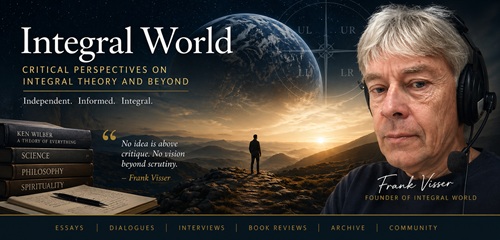
Introduction: A Peripheral Figure with a Persistent VoiceFew figures occupy such a paradoxical position within a philosophical movement as Frank Visser. As the founder and long-time curator of Integral World, he stands simultaneously inside and outside the integral community: deeply informed about its core doctrines, yet persistently critical of its leading architect, Ken Wilber. Since its founding in 1997, Integral World has evolved from a fan site into what Visser himself describes as an “independent forum” for critique, publishing thousands of essays by hundreds of contributors. The result is a unique intellectual archive—part scholarly repository, part polemical arena—that raises an important question: what is the relevance of Visser's life project, and how is it perceived? The answer depends heavily on whom you ask. From Devotee to DissenterVisser's trajectory mirrors a familiar arc within intellectual movements: early enthusiasm followed by critical disengagement. Initially an expositor of Wilber's work—culminating in his 2003 monograph Ken Wilber: Thought as Passion—Visser later became one of his most systematic critics. Integral World reflects this shift. What began as “The World of Ken Wilber” gradually transformed into a platform for dissent, particularly after conflicts between Wilber and his online critics in the mid-2000s. Over time, the site carved out a niche as arguably the most extensive archive of critiques of Integral Theory. For supporters, this evolution demonstrates intellectual independence. For detractors, it marks a descent into obsession. The Admirers: Guardian of Critical StandardsAmong sympathetic readers, Visser is often seen as a necessary counterweight to what they perceive as the excesses of integral thought. His central contribution lies in insisting that a “theory of everything” must remain accountable to empirical science and logical coherence. Several features underpin this positive evaluation: • Archival significance: Integral World hosts over 2000 essays, preserving debates that might otherwise have disappeared into blogs or forums. • Pluralism: Contributors range from scientists to mystics, critics to defenders, creating a heterogeneous discourse rarely found in movement-centered platforms. • Scientific rigor: Visser consistently challenges Wilber's interpretations of evolution, physics, and cosmology, arguing that they often rely on metaphysical extrapolation rather than scientific evidence. In this view, Visser functions as what one might call the critical conscience of the integral movement—a role explicitly attributed to him in retrospective analyses of his work. The Critics: A Fixation Disguised as ScholarshipLess charitable interpretations are equally widespread. Within integral circles, Visser is sometimes dismissed as overly fixated on Wilber, devoting decades to dismantling a single thinker rather than developing an alternative framework. Common criticisms include: • Repetition: His critiques, especially regarding evolution and “Eros,” are seen as variations on a limited set of themes. • Negativity bias: The site's emphasis on critique is perceived as disproportionate relative to constructive contributions. • Marginal impact: Despite its scale, Integral World has not significantly altered the trajectory of mainstream integral institutions. There is also a sociological dimension to this critique. Movements centered around charismatic figures often resist internal dissent, interpreting it as hostility rather than engagement. In such contexts, Visser's persistence can appear less like intellectual rigor and more like ideological opposition. The Ambivalent Middle: A Valuable but Limited EnterpriseBetween admiration and dismissal lies a more nuanced assessment. From this perspective, Visser's work is both significant and constrained. Significant, because: • He has created a durable infrastructure for critique—something rare in spiritually oriented movements. • He documents the evolution of integral thought, including its internal tensions and controversies. • His work exemplifies a broader Enlightenment ideal: that no theory, however comprehensive, should be immune to scrutiny. Constrained, because: • Integral World remains largely external to the institutional centers of integral theory. • Its influence is more archival than transformative; it records debates rather than resolving them. • The focus on Wilber, while justified historically, limits broader philosophical engagement. This middle view treats Integral World less as a movement-shaping force and more as a parallel discourse—a shadow conversation running alongside the official narrative. The AI Turn: Reinvention or Dilution?In recent years, Visser has incorporated AI-generated dialogues into his work, using tools like ChatGPT to simulate debates and explore philosophical questions. This development has sparked a new round of reactions. Supporters see this as an innovative extension of his method: using AI as a “neutral arbiter” to test arguments and expose inconsistencies. Critics, however, argue that it risks diluting authorial voice and turning serious critique into a kind of intellectual experiment. Either way, it demonstrates a key trait of Visser's project: adaptability. Rather than ossifying, Integral World continues to evolve alongside technological and cultural shifts. Relevance: Measured in Influence or Integrity?Assessing Visser's relevance depends on the quality one adopts. If relevance is defined in terms of institutional influence, then his impact appears limited. Integral Theory continues largely unaffected by his critiques. If, however, relevance is defined in terms of intellectual integrity and archival value, then his contribution is substantial. He has created a space where integral ideas are subjected to sustained, detailed, and often uncomfortable scrutiny. In that sense, Visser's project resembles a long-term philosophical audit—less visible than the main enterprise, but essential for evaluating its claims. Conclusion: The Outsider as InstitutionFrank Visser occupies an unusual role: a one-man institution of critique. Over nearly three decades, he has built and maintained a platform that challenges one of the most ambitious philosophical systems of our time. Whether one sees him as a necessary skeptic, a persistent critic, or a marginal figure depends largely on one's prior stance toward Integral Theory itself. But even his detractors must contend with a basic fact: few intellectual movements possess such a comprehensive internal archive of dissent. In the long run, that may be his most enduring legacy—not winning debates, but ensuring they are preserved.
Comment Form is loading comments...
|