|
TRANSLATE THIS ARTICLE
Integral World: Exploring Theories of Everything
An independent forum for a critical discussion of the integral philosophy of Ken Wilber
  Frank Visser, graduated as a psychologist of culture and religion, founded IntegralWorld in 1997. He worked as production manager for various publishing houses and as service manager for various internet companies and lives in Amsterdam. Books: Ken Wilber: Thought as Passion (SUNY, 2003), and The Corona Conspiracy: Combatting Disinformation about the Coronavirus (Kindle, 2020). Frank Visser, graduated as a psychologist of culture and religion, founded IntegralWorld in 1997. He worked as production manager for various publishing houses and as service manager for various internet companies and lives in Amsterdam. Books: Ken Wilber: Thought as Passion (SUNY, 2003), and The Corona Conspiracy: Combatting Disinformation about the Coronavirus (Kindle, 2020).
Check out my other conversations with ChatGPT Volution: A Synthetic Vision or Conceptual Overreach?Peter Merry's Attempt to Reconcile Involution and EvolutionFrank Visser / ChatGPT
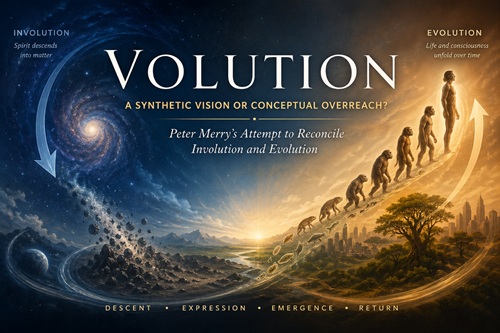 Introduction: The Promise of IntegrationThe concept of “volution,” developed by Peter Merry, seeks to unify two grand narratives about the nature of reality: involution and evolution. Involution refers to a primordial descent of spirit or consciousness into matter, while evolution describes the unfolding of complexity and awareness over time. By merging these into a single term, Merry aims to present a seamless account of cosmic development—one in which the universe is both emerging and expressing a prior depth. At face value, this synthesis appears to resolve a tension within spiritually inflected evolutionary models, especially those associated with Ken Wilber.[1] Yet the elegance of the term may conceal deeper conceptual difficulties. Involution vs. Evolution: Unequal Epistemic StatusA central problem with volution lies in the asymmetry between its components. Evolution is a robust scientific framework, grounded in empirical observation and supported by extensive evidence from biology, paleontology, and genetics. Involution, by contrast, is a metaphysical hypothesis. It posits a pre-material state of consciousness that “descends” into the physical world, but this claim is not empirically testable. By combining these two into a single concept, volution risks conflating fundamentally different kinds of knowledge. The scientific credibility of evolution may inadvertently lend legitimacy to the speculative claims of involution, creating an impression of explanatory unity where none has been independently established. The Problem of Teleology: Purpose Smuggled into ProcessVolution often carries implicit teleological assumptions. If evolution is understood as the unfolding of a prior involutionary depth, then it appears guided or oriented toward a pre-existing goal. This introduces purpose and direction into natural processes without empirical support. Such a move shifts the framework from a descriptive account of change over time to a quasi-theological narrative. The language may be modernized, but the underlying structure resembles older metaphysical systems in which the cosmos is driven by an inherent intention. Without clear evidence, this risks becoming a sophisticated form of re-enchanted cosmology rather than a genuine explanatory advance. Redundancy and Circularity: What Does Volution Explain?Another issue concerns explanatory necessity. Evolutionary theory already accounts for increasing complexity through mechanisms like variation and selection. What additional work does involution—or its rebranded form as volution—actually perform? Typically, proponents argue that involution explains the potential for complexity: that higher forms of consciousness must pre-exist in some latent form. However, this line of reasoning tends toward circularity. It assumes that complexity requires prior encoding, rather than exploring how it might emerge from simpler systems. Contemporary approaches in complexity science and systems theory offer non-teleological explanations for emergence, reducing the need for such metaphysical supplementation. Blurring Domains: Science, Metaphysics, and Hybrid ConceptsVolution also muddies the boundary between empirical and metaphysical domains. Evolution operates within a framework of testable hypotheses and methodological rigor. Involution belongs to a symbolic or speculative register. When fused, the resulting concept becomes difficult to evaluate: it borrows the authority of science while evading its constraints. This ambiguity weakens both domains. Scientific explanations lose clarity when infused with untestable assumptions, while metaphysical ideas lose their interpretive richness when presented as quasi-scientific claims. Rhetoric of Integration: Unity at the Expense of PrecisionThe appeal of volution is partly rhetorical. Within integral discourse, integration is often treated as an intrinsic good—a sign of higher-order thinking. But synthesis without discrimination can lead to conceptual inflation. In this case, the drive to unify involution and evolution may reflect an unwillingness to critically reassess inherited metaphysical commitments. Rather than questioning whether involution is necessary or defensible, volution preserves it under a more contemporary label. Conclusion: A Compelling Narrative, a Fragile FrameworkPeter Merry's concept of volution offers a compelling narrative of a universe that both expresses and returns to a deeper source. Its strength lies in its integrative vision and existential appeal. However, as a conceptual framework, it struggles under scrutiny. By merging empirically grounded science with speculative metaphysics, volution risks obscuring crucial distinctions and overextending its explanatory reach. A more rigorous approach would either treat involution as a symbolic construct or set it aside in favor of fully naturalistic accounts. Without such clarity, volution remains an ambitious but unstable synthesis—more evocative than explanatory. NOTES[1] See: Frank Visser, "The involution/evolution cosmology Ken Wilber Holds on to an Outdated Scheme of Existence", www.integralworld.net, May 2017.
Comment Form is loading comments...
|