|
TRANSLATE THIS ARTICLE
Integral World: Exploring Theories of Everything
An independent forum for a critical discussion of the integral philosophy of Ken Wilber
  Frank Visser, graduated as a psychologist of culture and religion, founded IntegralWorld in 1997. He worked as production manager for various publishing houses and as service manager for various internet companies and lives in Amsterdam. Books: Ken Wilber: Thought as Passion (SUNY, 2003), and The Corona Conspiracy: Combatting Disinformation about the Coronavirus (Kindle, 2020). Frank Visser, graduated as a psychologist of culture and religion, founded IntegralWorld in 1997. He worked as production manager for various publishing houses and as service manager for various internet companies and lives in Amsterdam. Books: Ken Wilber: Thought as Passion (SUNY, 2003), and The Corona Conspiracy: Combatting Disinformation about the Coronavirus (Kindle, 2020).
Check out my other conversations with ChatGPT Cosmic ConsciousnessFrom Mystical Illumination to Modern SpeculationFrank Visser / ChatGPT
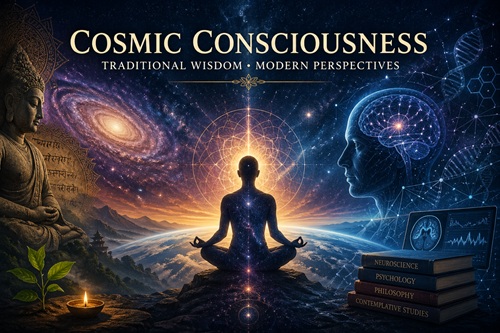 The idea of “cosmic consciousness” occupies a curious borderland between spirituality, philosophy, and science. It gestures toward a mode of awareness that transcends the individual mind, dissolving the boundary between self and universe. While the term itself is relatively modern, the underlying intuition is ancient. Across cultures and epochs, humans have reported experiences of unity, totality, and boundless awareness. What differs is how these experiences are interpreted: as revelation, as metaphysical truth, or increasingly, as neurocognitive phenomena. Traditional Interpretations: Unity as Ultimate RealityIn its classical form, cosmic consciousness is inseparable from mystical traditions. In Advaita Vedanta, it corresponds to the realization that Atman (the self) is identical with Brahman (ultimate reality). The apparent multiplicity of the world is seen as Maya—an illusion masking the underlying unity. Similarly, in Mahayana Buddhism, particularly in Zen, the dissolution of ego-boundaries reveals a non-dual awareness in which subject and object vanish. The experience is not one of “knowing” the cosmos but of being it. Western mystical traditions echo this. Christian mystics describe union with God in terms that blur personal identity, while Neoplatonic philosophy speaks of the One as the source of all being, accessible through contemplative ascent. In these traditions, cosmic consciousness is not merely an altered state but a disclosure of ultimate reality. It carries epistemic weight: to experience unity is to know something fundamental about existence.[1] A key feature of these interpretations is their metaphysical confidence. The experience of unity is taken at face value, not as a subjective anomaly but as a veridical insight into the structure of reality. This is where traditional accounts diverge sharply from modern skepticism. The Modern Turn: Psychology, Neuroscience, and ReductionThe term “cosmic consciousness” itself was popularized in the early 20th century by Richard Maurice Bucke, who catalogued what he saw as rare but transformative experiences of universal awareness. Bucke treated these as evolutionary advances in human consciousness—a theme that would later resonate with thinkers proposing directional or teleological development in mind and cosmos. However, contemporary science approaches such claims with methodological restraint. Experiences of unity are now studied under the umbrella of altered states of consciousness, including those induced by meditation, sensory deprivation, or psychedelics. Neuroimaging studies suggest that such states correlate with decreased activity in the brain's default mode network, which is associated with self-referential processing. When this network quiets down, the sense of a bounded, narrative self can dissolve, giving rise to feelings of unity and boundlessness. From this perspective, cosmic consciousness is not evidence of metaphysical unity but a product of specific brain states. The “cosmos” one feels united with may be a cognitive construction rather than an ontological reality. This does not invalidate the experience—it can be profound, transformative, even therapeutic—but it reframes its significance. The question shifts from “What does this reveal about the universe?” to “What does this reveal about the brain?” Philosophical Reinterpretations: Between Realism and IdealismModern philosophy offers a spectrum of interpretations that attempt to bridge or adjudicate between these views. Some forms of idealism take mystical experience as evidence that consciousness is fundamental, perhaps even constitutive of reality. In this view, cosmic consciousness is not an illusion but a glimpse into the true nature of being. Others adopt a more deflationary stance. They argue that the brain is capable of generating compelling illusions of unity, much like it generates the stable perception of a self. The fact that an experience feels absolute or all-encompassing does not guarantee its metaphysical accuracy. Cognitive science has repeatedly shown that intuitions about reality—whether spatial, temporal, or personal—can be systematically misleading. There are also intermediate positions. Panpsychism, for instance, posits that consciousness is a fundamental feature of matter, though not necessarily unified at a cosmic scale. Integrated Information Theory attempts to quantify consciousness in terms of informational integration, potentially allowing for degrees of “cosmic” awareness without invoking mysticism. These frameworks aim to naturalize consciousness without reducing it entirely to neural activity, but they remain speculative and empirically contested. Cultural Persistence and Contemporary AppealDespite scientific skepticism, the idea of cosmic consciousness retains strong cultural appeal. It surfaces in New Age spirituality, psychedelic revival movements, and even in some interpretations of quantum mechanics. The allure is understandable: it promises a reconciliation of self and world, a dissolution of existential isolation, and a sense of participation in a larger whole. In contemporary discourse, especially in integrative or “post-materialist” circles, cosmic consciousness is often invoked as evidence that science is incomplete or overly reductionist. Yet this move frequently conflates phenomenology with ontology. The fact that an experience feels like unity does not entail that the universe is unified in the way the experience suggests. This is a classic case where Ockham's Razor becomes relevant: do we posit a cosmic mind to explain the experience, or do we account for it in terms of known brain processes? Conclusion: Experience Without OverreachCosmic consciousness, stripped to its core, refers to a class of experiences characterized by unity, boundlessness, and the dissolution of self-other distinctions. These experiences are real in the phenomenological sense and can have lasting psychological impact. Traditional interpretations elevate them to metaphysical revelations; modern science tends to interpret them as brain-based phenomena. The tension between these views is unlikely to be resolved soon. What can be said with some confidence is that caution is warranted when moving from experience to ontology. The history of human thought is replete with cases where compelling experiences led to overextended metaphysical claims. A disciplined approach acknowledges the depth and significance of such states without prematurely turning them into cosmological doctrines. Cosmic consciousness may tell us much about the flexibility and range of human awareness. Whether it tells us anything definitive about the structure of the universe remains, at best, an open question. Appendix: Where Does Ken Wilber Stand?Ken Wilber occupies a distinctive—and controversial—position in the landscape of interpretations of cosmic consciousness. He neither fully aligns with traditional mysticism nor accepts the reductive conclusions of contemporary neuroscience. Instead, he attempts a synthesis, embedding cosmic consciousness within a sweeping developmental and metaphysical framework known as Integral Theory. At the core of Wilber's model is the claim that consciousness evolves through structured stages, from pre-personal to personal to transpersonal. Cosmic consciousness, in this schema, is not an anomaly or a rare mystical accident but a predictable, higher-stage realization. It corresponds to what he often calls “nondual awareness,” where the distinction between subject and object collapses. Unlike traditional mystics, however, Wilber situates this realization within an evolutionary trajectory—one that includes biological, psychological, and cultural development. This is where his view diverges sharply from both classical and scientific interpretations. Traditional systems tend to regard cosmic consciousness as timeless and ever-present, accessible through insight but not “developed” in a linear sense. Scientific accounts, by contrast, treat such states as neurocognitive events without ontological implications. Wilber rejects both limitations. He argues that these states are not only real but also progressively stabilizable—that is, they can become enduring traits rather than fleeting experiences, reflecting a genuine advance in human development. Wilber also introduces a metaphysical dimension often described in terms of “Eros”—a supposed intrinsic drive toward greater complexity, consciousness, and unity. In this view, cosmic consciousness is not merely a human achievement but the universe becoming aware of itself through evolving forms. This places him closer to process philosophy and certain strands of idealism, where mind-like properties are seen as fundamental or at least coextensive with reality. However, this is precisely where criticism tends to concentrate. From a scientific standpoint, Wilber's appeal to Eros or intrinsic directionality lacks empirical grounding. Evolutionary biology, as it stands, does not posit a built-in drive toward higher consciousness; it operates through variation and selection without foresight or purpose. Critics argue that Wilber imports teleology under a different name, reintroducing a form of cosmic intentionality that modern science has largely discarded. Philosophically, his position raises additional concerns. By treating mystical experience as both developmentally advanced and ontologically revealing, Wilber risks conflating phenomenology with metaphysics. The fact that individuals report nondual awareness does not, in itself, validate claims about the universe's fundamental nature. This is the same inferential leap seen in traditional mysticism, now embedded in a more elaborate theoretical structure. Wilber attempts to shield his model from reductionism by distinguishing between “states” and “stages.” One can have a temporary experience of cosmic consciousness (a state) without being developmentally advanced (a stage). This allows him to acknowledge neuroscientific findings—such as the brain correlates of mystical experience—while maintaining that the interpretation and integration of these experiences depend on one's level of development. It's a sophisticated move, but it does not fully resolve the underlying tension: whether these experiences disclose reality or merely reflect brain dynamics interpreted through cultural lenses. In summary, Wilber stands as a system-builder who elevates cosmic consciousness from a sporadic mystical insight to a central feature of an evolving cosmos. He integrates traditional spiritual claims with developmental psychology and systems theory, but does so at the cost of introducing speculative metaphysical assumptions that remain unverified. For supporters, this is a bold and necessary synthesis. For critics, it is an instance of intellectual overstretch—where the desire for integration outpaces the available evidence. His position, therefore, can be seen as a modernized revival of the perennial philosophy, reframed in the language of evolution and complexity, yet still anchored in the conviction that consciousness, at its highest, reveals the very fabric of reality. NOTES[1] See: Frank Visser, "The Search for a 'Big Wholeness' Review of Ken Wilber's Finding Radical Wholeness", www.integralworld.net, July 2024. Ultimate Truth does not deal with a particular being or a group of beings; it deals with Being itself, with a capital B—the Ground of All Being, spaceless and therefore infinite, timeless and therefore eternal, and a groundless Ground that underlies every relative truth in existence but is not itself a relative truth and thus is not detectable by ordinary, external science but only by an interior, meditative science. (p. 20) The simplest explanation for this direct experience is not that your brain has had a physiological meltdown and that you are deeply confused and delusional. It's that in the timeless Now-moment of Waking Up, you have directly and immediately experienced the fundamental, all-pervading, groundless Ground of All Being—which is timeless, which means ever-present, which means eternal." (p. 34)
Widget is loading comments...
|