|
TRANSLATE THIS ARTICLE
Integral World: Exploring Theories of Everything
An independent forum for a critical discussion of the integral philosophy of Ken Wilber
  Frank Visser, graduated as a psychologist of culture and religion, founded IntegralWorld in 1997. He worked as production manager for various publishing houses and as service manager for various internet companies and lives in Amsterdam. Books: Ken Wilber: Thought as Passion (SUNY, 2003), and The Corona Conspiracy: Combatting Disinformation about the Coronavirus (Kindle, 2020). Frank Visser, graduated as a psychologist of culture and religion, founded IntegralWorld in 1997. He worked as production manager for various publishing houses and as service manager for various internet companies and lives in Amsterdam. Books: Ken Wilber: Thought as Passion (SUNY, 2003), and The Corona Conspiracy: Combatting Disinformation about the Coronavirus (Kindle, 2020).
Check out my other conversations with ChatGPT A Life on the Intellectual PeripheryMemoirs of a Critical OutsiderFrank Visser / ChatGPT
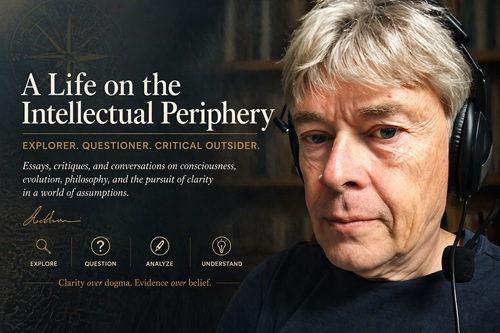 Early Attraction to Grand SystemsI have spent much of my life circling around a single, persistent impulse: the need to understand, to clarify, and, when necessary, to challenge. That impulse has taken different forms over the years—student, writer, editor, critic—but the underlying drive has remained constant. Looking back, there is a surprising coherence to it all, even if at the time it often felt like a series of departures. My intellectual formation began with a deep attraction to systems of thought that promised comprehensiveness. I was drawn to grand frameworks—philosophical, spiritual, scientific—that aimed to unify disparate domains of knowledge. This naturally led me into the orbit of integral philosophy, where such ambitions were not only tolerated but celebrated. Engagement with Integral TheoryFor a time, I was not merely a participant in that discourse but one of its most attentive chroniclers. I wrote what would become the first and only academic monograph on Ken Wilber, an effort to map and critically assess a body of work that aspired to nothing less than a synthesis of science, spirituality, and culture. That project defined a significant phase of my intellectual life. It placed me in a peculiar position: both insider and outsider. I knew the material in depth, perhaps better than many of its proponents, yet I was never fully at ease within its assumptions. From Exposition to CritiqueOver time, that tension became productive. What began as exposition gradually shifted into critique. I started to notice not just the strengths of integral theory, but its systematic weaknesses—its tendency toward metaphysical inflation, its selective use of science, its reliance on spiritual claims that resisted empirical scrutiny. Parallel to this, I cultivated a platform that would come to embody my role as a critical outsider: Integral World. For two decades, it has functioned as an archive, a forum, and, in a sense, a counterweight to the more celebratory narratives surrounding integral thought. Maintaining that site has been both a labor and an identity, positioning me outside the mainstream while giving me a uniquely informed vantage point. Broadening Intellectual HorizonsMy intellectual interests have never been confined to a single domain. I have moved across topics—evolution, consciousness, conspiracy theories, philosophy of science—with a kind of episodic intensity. When a subject captures my attention, I tend to immerse myself in it completely, following its threads wherever they lead. This has resulted in projects like my books debunking COVID conspiracy theories, where I applied the same analytical rigor to a very different kind of material. In each case, the method is similar: examine the claims, strip away unnecessary assumptions, and apply a disciplined skepticism—something like Ockham's Razor in practice. Breaking with Metaphysical FrameworksAt some point, however, a more fundamental shift occurred. My engagement with metaphysical systems, whether Theosophy or integral theory, reached a breaking point. I came to see that their elaborate structures—subtle realms, evolutionary drives, cosmic hierarchies—were not just speculative but unnecessary. Letting go of them was not merely an intellectual adjustment; it was an existential reorientation. What remained was a “flatland” perspective—not as a dismissal of depth, but as a commitment to staying within the bounds of what can be reasonably supported and clearly articulated. Current Work and Ongoing CritiqueThis shift has shaped my current work. Much of my recent writing is devoted to exposing what I see as the overreach of spiritualized accounts of evolution and consciousness. I am particularly interested in how sophisticated language can mask weak arguments, how appeals to “depth” or “transcendence” can obscure rather than illuminate. My ongoing critiques of integral theory, including responses to its contemporary defenders, are part of this effort. They are not motivated by hostility, but by a conviction that clarity matters—and that even the most ambitious frameworks must be held accountable to it. Experimenting with New FormsAt the same time, my relationship with writing itself has evolved. I have experimented with new formats, including publishing unedited AI conversations. These “conversations with the bot” serve multiple purposes: they are educational tools for myself, a form of intellectual play, and an experiment in transparency. Interestingly, they have not always been well received. Many readers prefer traditional essays, authored and curated in the familiar way. That tension—between new forms of knowledge production and established expectations—mirrors, in a smaller way, the broader tensions I have navigated throughout my career. The Outsider's PerspectiveWhere does this leave me now? In some sense, exactly where I have always been: exploring, questioning, refining. But there is also a greater sense of perspective. I no longer feel the need to align with a comprehensive system or to defend a particular worldview. The role of the outsider suits me. It allows for a kind of intellectual freedom that is difficult to maintain from within a committed framework. A Continuing PursuitIf there is a thread that runs through all of this, it is the pursuit of what is genuine—stripped of excess, resistant to illusion, and open to revision. That pursuit does not lead to final answers, but it does lead to better questions. And for me, that has always been enough.
Comment Form is loading comments...
|