|
TRANSLATE THIS ARTICLE
Integral World: Exploring Theories of Everything
An independent forum for a critical discussion of the integral philosophy of Ken Wilber
  Frank Visser, graduated as a psychologist of culture and religion, founded IntegralWorld in 1997. He worked as production manager for various publishing houses and as service manager for various internet companies and lives in Amsterdam. Books: Ken Wilber: Thought as Passion (SUNY, 2003), and The Corona Conspiracy: Combatting Disinformation about the Coronavirus (Kindle, 2020). Frank Visser, graduated as a psychologist of culture and religion, founded IntegralWorld in 1997. He worked as production manager for various publishing houses and as service manager for various internet companies and lives in Amsterdam. Books: Ken Wilber: Thought as Passion (SUNY, 2003), and The Corona Conspiracy: Combatting Disinformation about the Coronavirus (Kindle, 2020).
Check out my other conversations with ChatGPT Gaia RevisitedScience, Metaphor, and Controversy in Lovelock's Earth System VisionFrank Visser / ChatGPT
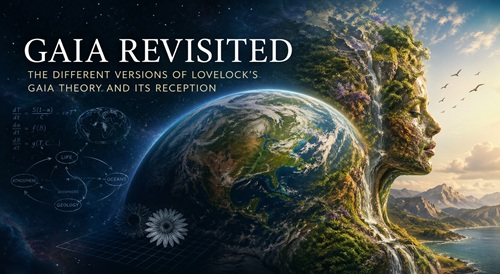 Origins of the Gaia HypothesisThe Gaia hypothesis, first articulated by James Lovelock in the 1970s, proposed a strikingly holistic idea: the Earth functions as a self-regulating system in which life actively maintains conditions favorable for its own persistence. Developed in collaboration with Lynn Margulis, the concept challenged the dominant reductionist framework of biology and geophysics. Rather than viewing organisms as passive inhabitants of a fixed environment, Gaia suggested that life and environment co-evolve in a tightly coupled feedback system. The name “Gaia,” borrowed from the Greek goddess of Earth, proved both evocative and problematic. It helped popularize the theory beyond scientific circles but also invited misinterpretations, especially those implying intention, consciousness, or purpose at the planetary level—claims Lovelock himself would later attempt to clarify and distance from. Strong Gaia: A Living Earth?The earliest and most controversial version of Gaia—often called “strong Gaia”—treated the Earth almost as a literal organism. In this formulation, the biosphere was said to regulate global temperature, atmospheric composition, and ocean chemistry in a way analogous to homeostasis in living beings. The suggestion that Earth might be “alive” in a quasi-biological sense drew immediate criticism from evolutionary biologists and geologists. Critics, including figures like Richard Dawkins, argued that natural selection operates at the level of genes and organisms, not planets. Without a mechanism for planetary-level selection, the idea of Earth evolving self-regulating traits seemed teleological—smuggling purpose into a process that Darwinian theory explains through blind variation and selection. Weak Gaia: Feedback Without TeleologyIn response to such criticisms, Lovelock reformulated his hypothesis into what became known as “weak Gaia.” This version stripped away the organismic metaphor and emphasized instead the existence of coupled feedback loops between life and the environment. For example, the regulation of atmospheric oxygen levels or the role of phytoplankton in cloud formation could be understood as emergent outcomes of ecological interactions, not as intentional acts of a planetary superorganism. A key contribution to this shift was the “Daisyworld” model, a simplified mathematical simulation introduced by Lovelock to demonstrate how self-regulation could emerge without foresight or planning. In this model, black and white daisies influence planetary temperature through their differing albedos, creating a stable climate across a range of solar inputs. The point was not realism but plausibility: complex feedback systems can stabilize environmental conditions without invoking purpose. Weak Gaia gained more traction within the scientific community because it aligned better with established principles of Earth System Science and avoided metaphysical overreach. Geophysiology and Earth System ScienceLovelock later preferred the term “geophysiology” to describe his approach, framing the Earth as a system whose physical and chemical processes are deeply intertwined with biological activity. This perspective helped bridge the gap between Gaia and mainstream science, particularly as the field of Earth system science matured. Today, many aspects of Gaia are embedded—often implicitly—in climate science. The recognition that biotic processes influence carbon cycles, cloud dynamics, and albedo is now standard. However, these insights are typically framed in mechanistic, model-based terms rather than in the holistic or metaphorical language Lovelock initially used. Reception in the Scientific CommunityThe reception of Gaia has been mixed, evolving over time from skepticism to partial acceptance. Early reactions ranged from outright dismissal to cautious interest. The main scientific objections centered on the lack of a clear evolutionary mechanism and the perceived teleology of the theory. Over time, however, elements of Gaia were absorbed into more rigorous frameworks. The idea that life modifies its environment in ways that feed back into evolutionary processes is now widely accepted, though usually discussed under different labels, such as niche construction or biogeochemical cycling. Still, the more expansive claims of strong Gaia—especially those implying planetary purpose or consciousness—remain outside the bounds of mainstream science. These interpretations are often relegated to philosophy, spirituality, or speculative systems theory. Gaia in Culture and Spiritual ThoughtWhile scientists debated its validity, Gaia flourished in cultural and spiritual contexts. Environmental movements embraced it as a powerful metaphor for planetary interconnectedness, and New Age thinkers often took it as literal truth. In some circles, Gaia became synonymous with a kind of ecological mysticism, portraying Earth as a sentient being deserving reverence. This dual life—scientific hypothesis on one hand, spiritual symbol on the other—has been both a strength and a liability. It broadened Gaia's appeal but also blurred the line between empirical science and metaphysical speculation, complicating its reception in academic circles. Lovelock's Late ReflectionsIn his later years, Lovelock adopted a more cautious tone, acknowledging the criticisms and refining his claims. He remained committed to the core insight that life and environment are inseparable components of a dynamic system, but he distanced himself from the more extravagant interpretations of Gaia as a conscious entity. He also became increasingly focused on climate change, warning that Gaia's regulatory mechanisms might be overwhelmed by human activity. In this context, Gaia was no longer a benevolent caretaker but a system with limits—capable of shifting to states less hospitable to human life. Conclusion: Between Insight and OverreachGaia theory occupies a peculiar position in the history of science. It began as a bold, almost poetic vision of Earth as a living system, provoked sharp criticism for its apparent teleology, and gradually evolved into a more scientifically grounded framework emphasizing feedback and co-evolution. Its legacy is twofold. On the one hand, it helped catalyze the development of Earth system science and deepened our understanding of planetary feedbacks. On the other, it serves as a cautionary tale about the risks of metaphorical inflation—how a compelling image can drift into unwarranted metaphysical claims. In the end, Gaia endures not as a unified theory but as a spectrum of ideas, ranging from rigorous science to speculative philosophy. Its value lies less in any single formulation than in the questions it continues to provoke about the nature of life, environment, and the complex system we call Earth. Appendix: Gaia and the Nuclear OptionIn his later writings, James Lovelock took a position that surprised many of his environmentalist admirers: he became an outspoken advocate of nuclear energy. For Lovelock, this was not a peripheral opinion but a direct consequence of his Gaia perspective. If the Earth system is understood as a complex, self-regulating entity under stress from human activity, then the priority shifts from ideological purity to systemic stability. Lovelock argued that climate change represents a serious perturbation of Gaia's regulatory balance, primarily driven by greenhouse gas emissions from fossil fuels. In this context, he saw nuclear power as one of the few scalable, low-carbon energy sources capable of sustaining industrial civilization without further destabilizing the climate. Unlike wind or solar, which he viewed as intermittent and land-intensive, nuclear energy offered high energy density and continuous output—features he considered essential for maintaining the energy demands of modern societies. He was particularly critical of what he saw as the romanticism of parts of the environmental movement. In his view, opposition to nuclear power often rested on exaggerated fears and a failure to weigh relative risks. Lovelock pointed out that the health and environmental impacts of coal, oil, and gas—air pollution, mining damage, and carbon emissions—far exceed those associated with nuclear energy, even when accounting for accidents and waste. From a Gaia-informed standpoint, the real danger was not nuclear radiation but atmospheric disruption. This stance placed him at odds with many “green” activists, who had embraced Gaia as a symbol of ecological harmony but rejected nuclear technology as inherently unnatural or dangerous. Lovelock's position exposed a tension within environmental thought: whether to prioritize symbolic alignment with “natural” systems or pragmatic interventions that minimize large-scale harm. Importantly, Lovelock did not claim that nuclear energy is without risks. Rather, he framed it as the least bad option in a constrained set of choices. His reasoning reflects a broader shift in his later work toward a more sober, even pessimistic view of humanity's relationship with Gaia. The Earth system, he suggested, will ultimately regulate itself—with or without us. Nuclear energy, in this light, becomes not a utopian solution but a tool that might allow human civilization to persist without triggering more severe climatic corrections. In sum, Lovelock's advocacy of nuclear power underscores a key feature of his mature Gaia thinking: a willingness to follow systemic logic to conclusions that cut against ideological expectations.
Widget is loading comments...
|