|
TRANSLATE THIS ARTICLE
Integral World: Exploring Theories of Everything
An independent forum for a critical discussion of the integral philosophy of Ken Wilber
  Frank Visser, graduated as a psychologist of culture and religion, founded IntegralWorld in 1997. He worked as production manager for various publishing houses and as service manager for various internet companies and lives in Amsterdam. Books: Ken Wilber: Thought as Passion (SUNY, 2003), and The Corona Conspiracy: Combatting Disinformation about the Coronavirus (Kindle, 2020). Frank Visser, graduated as a psychologist of culture and religion, founded IntegralWorld in 1997. He worked as production manager for various publishing houses and as service manager for various internet companies and lives in Amsterdam. Books: Ken Wilber: Thought as Passion (SUNY, 2003), and The Corona Conspiracy: Combatting Disinformation about the Coronavirus (Kindle, 2020).
Check out my other conversations with ChatGPT Replaying Life's TapeContingency, Convergence, and Cosmic PurposeFrank Visser / ChatGPT
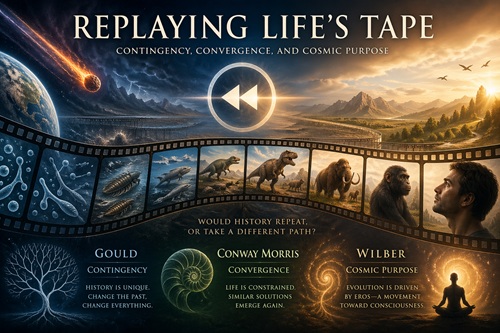 Introduction: A Thought Experiment with Deep StakesWhat would happen if we could rewind the history of life on Earth and let it unfold again? Would humans reappear? Would intelligence arise in a similar form, or would evolution take a radically different path? This deceptively simple thought experiment—“winding back the tape of life”—has become one of the most revealing fault lines in evolutionary theory. It exposes deep disagreements not only about biology, but about chance, necessity, and even the meaning of existence. Three influential voices offer sharply contrasting answers: Stephen Jay Gould, who emphasized contingency and unpredictability; Simon Conway Morris, who argued for convergence and inevitability; and Ken Wilber, who interpreted evolution through a spiritual lens of cosmic directionality. Their divergent views illuminate how scientific interpretation can shade into philosophical—and even metaphysical—commitment. Gould: The Tyranny of ContingencyGould's formulation of the “tape of life” thought experiment, most famously articulated in Wonderful Life, leads to a stark conclusion: if we replayed the tape, the outcome would be radically different each time. Evolution, in his view, is profoundly contingent on historical accidents. Central to Gould's argument is the role of chance events—mass extinctions, climatic shifts, genetic mutations—that redirect the course of life in unpredictable ways. The survival of early chordates, the extinction of dinosaurs, and the subsequent radiation of mammals are not seen as inevitable steps toward humanity, but as improbable turns in a branching, path-dependent process. If the Cretaceous-Paleogene extinction event had not occurred, mammals might have remained small and marginal, and intelligent primates might never have evolved. Gould's deeper point is methodological as much as empirical. Evolutionary biology, he argued, must resist the temptation to read history backward as if it were a linear progression toward complexity or intelligence. Humans are not the “goal” of evolution but a contingent outcome—one twig among countless possibilities. Conway Morris: The Power of ConvergenceIn direct contrast, Simon Conway Morris accepts the importance of contingency but insists it operates within strong constraints. His concept of evolutionary convergence highlights the repeated, independent emergence of similar solutions to biological problems across unrelated lineages. Eyes, wings, echolocation, and even aspects of intelligence have evolved multiple times in different evolutionary contexts. For Conway Morris, this suggests that the landscape of biological possibility is not open-ended but structured. Certain forms—especially those associated with complex cognition—may be attractors in evolutionary space. If we rewound the tape, he argues, the details would differ, but key outcomes might recur. Intelligence, perhaps even something analogous to humans, could emerge again. Not because evolution has a predetermined goal, but because physical laws, environmental pressures, and developmental constraints channel it in particular directions. Conway Morris's position thus softens Gould's radical contingency without reverting to teleology. Evolution is neither pure accident nor strict destiny; it is a constrained exploration of possibility, where similar endpoints can arise from different starting points. Wilber: Eros in the KosmosKen Wilber takes the discussion into explicitly metaphysical territory. For him, the debate between contingency and convergence misses a deeper truth: evolution is driven by an intrinsic force he calls “Eros in the Kosmos.” This is not merely a metaphor for complexity or self-organization, but a formative, purposive principle guiding the universe toward higher levels of consciousness. Wilber readily acknowledges scientific accounts of mutation, selection, and even convergence, but he interprets them as surface manifestations of a deeper, spiritual dynamic. The emergence of mind, culture, and self-awareness is not a lucky accident or a constrained inevitability—it is the expression of a fundamental drive toward transcendence. From this perspective, rewinding the tape would still lead, in some form, to consciousness and self-reflection, because these are built into the fabric of reality itself. Evolution is not just a historical process but a developmental unfolding of Spirit. Points of Tension: Science, Philosophy, and MetaphysicsThe differences between these three thinkers are not merely empirical disagreements; they reflect distinct epistemological commitments. Gould's position is rigorously naturalistic and historical. It emphasizes the unpredictability of complex systems and the limits of retrospective interpretation. His resistance to teleology is methodological: science should not infer purpose where none is empirically demonstrable. Conway Morris occupies a middle ground. He remains within a scientific framework but allows that the recurrence of certain forms hints at deeper regularities in nature. His view opens the door to philosophical reflection, but stops short of invoking cosmic purpose. Wilber, by contrast, explicitly transcends the boundaries of empirical science. His notion of Eros is not testable in the conventional sense, and critics argue that it functions more as a metaphysical assertion than an explanatory hypothesis. While it offers a unifying narrative of evolution and consciousness, it does so by introducing a level of causation that lies outside standard scientific methodology. Rewinding the Tape: What Is Really at Stake?At first glance, the question of replaying life's history seems speculative. But it functions as a diagnostic tool, revealing how one interprets the interplay of chance and necessity. For Gould, the answer underscores the fragility and uniqueness of our existence. Humanity is a historical accident, and recognizing this should temper any sense of cosmic centrality. For Conway Morris, the answer suggests a more structured universe, where certain outcomes are likely, if not inevitable. Intelligence may not be guaranteed, but neither is it vanishingly improbable. For Wilber, the answer affirms a universe imbued with direction and meaning. Evolution is not a blind process but a purposeful unfolding, culminating—at least for now—in self-aware beings capable of reflecting on their own origins. Conclusion: Three Visions of Life's MeaningThe “tape of life” thought experiment does not yield a single answer because it is not purely a scientific question. It straddles the boundary between empirical inquiry and existential interpretation. Gould reminds us of the power of contingency and the humility it demands. Conway Morris highlights the patterns that emerge despite contingency, suggesting an underlying order. Wilber projects a grand narrative of cosmic purpose, transforming evolution into a spiritual drama. Each perspective carries its own implications, not only for how we understand the past, but for how we situate ourselves in the universe. Whether life is an accident, an inevitability, or a meaningful unfolding remains an open question—one that continues to invite both scientific investigation and philosophical reflection. Appendix: The Templeton Prize and the Religious Reading of ConvergenceThe awarding of the 2026 Templeton Prize to Simon Conway Morris is not incidental to the philosophical interpretation of his work—it actively foregrounds it. The Templeton Prize is explicitly designed to honor contributions that engage “the deepest questions of the universe and humankind's place and purpose within it.” This already situates Conway Morris not just as a technical evolutionary biologist, but as a thinker whose ideas resonate beyond strict empirical science. Convergence and “Deeper Order”Conway Morris's central scientific claim—that evolution repeatedly arrives at similar solutions—has always carried philosophical implications. His work on convergence suggests that biological evolution is not an open-ended, purely contingent process, but one shaped by underlying constraints and regularities. As the Templeton citation itself emphasizes, he interprets convergence as evidence of a “deeper order to biology” that channels evolution along certain pathways. This is where the interpretive fork appears. Scientifically, one can read “deeper order” in a strictly naturalistic way: physical laws, developmental constraints, and ecological pressures narrow the space of viable forms. On this reading, convergence strengthens evolutionary theory without invoking anything beyond it. But the same language—“deeper order,” “directional pathways,” recurring emergence of intelligence—also lends itself to metaphysical extrapolation. Does This Support a Religious Interpretation?The short answer is: it permits one, but does not require one. Conway Morris himself is a professing Christian and has been openly critical of strict materialism. He has argued that convergence points toward a universe that is, in some sense, intelligible and structured in a way that makes outcomes like intelligence plausible, perhaps even likely. This can be—and often is—read as congenial to a theistic worldview, in which the laws of nature are not arbitrary but reflect a deeper rational or even divine order. At the same time, he explicitly distances his position from Intelligent Design, insisting that natural processes are sufficient to generate complexity. That is a crucial boundary: convergence does not imply intervention, design events, or supernatural tinkering. So the structure of his argument is best understood as philosophically suggestive but scientifically underdetermined. It opens a conceptual space where religious interpretations can enter, but it does not entail them. Templeton's Role: Amplifying the AmbiguityThe Templeton Prize itself operates precisely in this boundary zone. Historically, it has rewarded figures who bridge science and spiritual reflection, sometimes drawing criticism for “blurring” the line between them. By awarding Conway Morris, the foundation effectively endorses the broader significance of his ideas—not just as biology, but as contributions to questions of meaning and purpose. This does not validate any specific religious conclusion. What it does is highlight that his version of evolutionary theory is unusually hospitable to such conclusions compared to Gould's strict contingency. Contrast with Gould and WilberPlaced back into the “tape of life” debate, the implications become clearer. Stephen Jay Gould offers no foothold for religious teleology. His world is one of radical contingency, where meaning must be constructed, not discovered. Conway Morris occupies a middle position. His convergence thesis suggests that the universe is structured in a way that makes certain outcomes recurrent. Whether that structure is purely physical or metaphysically grounded remains an open interpretive layer. Ken Wilber goes much further, explicitly asserting a cosmic drive—Eros—that guarantees directionality and meaning. Where Conway Morris hints, Wilber declares. Conclusion: An Invitation, Not a ProofConway Morris's Templeton Prize underscores a key point: his evolutionary vision is not religious in itself, but it is unusually compatible with religious interpretation. It invites metaphysical reflection without collapsing into it. If Gould closes the door on cosmic purpose, and Wilber throws it wide open, Conway Morris leaves it ajar—and the Templeton recognition is, in effect, a spotlight on that open threshold.
Comment Form is loading comments...
|