|
TRANSLATE THIS ARTICLE
Integral World: Exploring Theories of Everything
An independent forum for a critical discussion of the integral philosophy of Ken Wilber
  Frank Visser, graduated as a psychologist of culture and religion, founded IntegralWorld in 1997. He worked as production manager for various publishing houses and as service manager for various internet companies and lives in Amsterdam. Books: Ken Wilber: Thought as Passion (SUNY, 2003), and The Corona Conspiracy: Combatting Disinformation about the Coronavirus (Kindle, 2020). Frank Visser, graduated as a psychologist of culture and religion, founded IntegralWorld in 1997. He worked as production manager for various publishing houses and as service manager for various internet companies and lives in Amsterdam. Books: Ken Wilber: Thought as Passion (SUNY, 2003), and The Corona Conspiracy: Combatting Disinformation about the Coronavirus (Kindle, 2020).
Check out my other conversations with ChatGPT Eros, Evolution, and EvasionA Critical Look at Wilber's ReasoningFrank Visser / ChatGPT
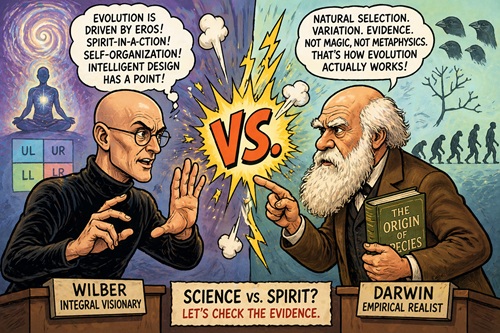 The Argument in QuestionFor those who haven't tracked the trajectory of Ken Wilber's views on evolution, his line of reasoning can be reconstructed in a few stark steps. First, a sweeping dismissal: Darwinian theory is deemed fundamentally inadequate. Second, an appeal to complexity science, especially the work of Stuart Kauffman, to introduce self-organization as a necessary supplement. Third, this self-organizing dynamic is reinterpreted as “Eros,” or Spirit-in-action—an immanent drive toward complexity and consciousness. Finally, a partial concession to Intelligent Design: its critique of Darwinism is seen as valid, even if its theological framing is rejected. At face value, this sequence presents itself as an integrative synthesis. In practice, it is a conceptual leapfrog—moving from gaps in evolutionary explanation to metaphysical conclusions without sufficient justification. Darwinism: Mischaracterized and UndervaluedThe opening claim—that Darwinism “can't explain” evolution—is not merely exaggerated; it is demonstrably false. The modern synthesis, combining Charles Darwin's original insights with genetics, population biology, and molecular evolution, explains a vast range of phenomena. Adaptation, speciation, genetic drift, and phylogenetic patterns are all robustly accounted for within this framework. Critiques of Darwinism often hinge on unresolved questions—such as the origin of life or the emergence of complex systems—but these are active research frontiers, not evidence of theoretical collapse. To dismiss the entire edifice on this basis is to ignore over a century of empirical success. Self-Organization: Real but LimitedThe invocation of self-organization introduces a legitimate scientific domain. Researchers like Kauffman have shown that complex systems can exhibit spontaneous order under certain conditions. However, this does not equate to an alternative theory of evolution. Self-organization operates within physical and chemical constraints, often producing patterns or structures—such as autocatalytic sets—but it does not account for the adaptive diversification of species over time. Natural selection remains the only known mechanism that systematically explains the accumulation of functional complexity in biological organisms. To conflate self-organization with evolutionary dynamics is to blur distinct explanatory levels. Eros as Explanation: A Category ErrorThe move from self-organization to “Eros” is where the argument shifts from science to metaphysics. By identifying a directional, quasi-intentional force behind evolution, Wilber reintroduces teleology under a new label. But this move does not clarify the phenomena—it redescribes them. Labeling complexity as “Spirit-in-action” adds no predictive or explanatory power. Worse, it risks rendering the concept of Spirit redundant: if natural processes suffice to generate complexity, invoking Eros becomes unnecessary; if they do not, Eros remains undefined and untestable. In either case, the concept fails to meet basic criteria for explanatory utility. Intelligent Design: A Misguided ConcessionThe suggestion that Intelligent Design “has a point” reflects a misunderstanding of its scientific status. Intelligent Design has been extensively critiqued and rejected within the scientific community, not only by secular researchers but also by many religious scientists. It does not offer testable hypotheses or a coherent research program. Instead, it relies on arguments from ignorance—asserting that because certain features are not yet fully explained, they must be the product of design. This line of reasoning has been systematically dismantled across multiple domains, from molecular biology to paleontology. To grant it partial legitimacy is to overlook this extensive body of critique. Motivated Reasoning and the Absence of EngagementWhat emerges from this analysis is not a balanced synthesis but a pattern of motivated reasoning. The conclusion—evolution as Spirit-driven—is established in advance, and scientific concepts are selectively appropriated to support it. What is striking is the lack of detailed engagement with evolutionary biology itself. Despite evolution being central to Integral Theory, Wilber has not substantively interacted with its core literature, debates, or methodologies. There is little evidence of sustained dialogue with population genetics, evo-devo, or comparative genomics. This absence raises a structural question: how can a theory claim to integrate disciplines it does not rigorously engage? Integral Ideology and Epistemic ClosureAt a certain point, the issue ceases to be about specific claims and becomes one of epistemology. When critique is deflected, and counterarguments are not addressed, a framework risks hardening into ideology. Appeals to spiritual insight—such as the notion that one “knows” the truth through higher consciousness—do not resolve empirical disputes. They bypass them. Suggesting that Wilber's perspective should be trusted because of an “opened third eye” substitutes authority for argument. This is not integration; it is insulation. Conclusion: A Synthesis That Doesn't HoldThe attempt to reconcile Darwinism, self-organization, and spirituality into a single explanatory framework is, in principle, a worthwhile endeavor. But it requires conceptual rigor, empirical grounding, and openness to critique. In this case, the synthesis collapses under scrutiny. Darwinism is misrepresented, self-organization is overstretched, Eros is undefined, and Intelligent Design is misjudged. What remains is not a compelling alternative to evolutionary theory, but a metaphysical overlay in search of justification. If Integral Theory aims to be taken seriously as a framework for understanding evolution, it will need to engage the science it seeks to transcend—on its own terms, and in full detail.
Widget is loading comments...
|