|
TRANSLATE THIS ARTICLE
Integral World: Exploring Theories of Everything
An independent forum for a critical discussion of the integral philosophy of Ken Wilber
  Frank Visser, graduated as a psychologist of culture and religion, founded IntegralWorld in 1997. He worked as production manager for various publishing houses and as service manager for various internet companies and lives in Amsterdam. Books: Ken Wilber: Thought as Passion (SUNY, 2003), and The Corona Conspiracy: Combatting Disinformation about the Coronavirus (Kindle, 2020). Frank Visser, graduated as a psychologist of culture and religion, founded IntegralWorld in 1997. He worked as production manager for various publishing houses and as service manager for various internet companies and lives in Amsterdam. Books: Ken Wilber: Thought as Passion (SUNY, 2003), and The Corona Conspiracy: Combatting Disinformation about the Coronavirus (Kindle, 2020).
Check out my other conversations with ChatGPT Cosmic Evolution and the Emergence of ConsciousnessA Skeptical ReviewFrank Visser / ChatGPT
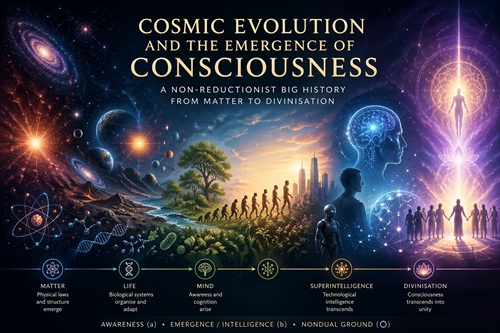 This is an ambitious and, at times, rhetorically powerful paper by M. Alan Kazlev—but as a piece of analysis it repeatedly overreaches its evidential base.[1] What you have here is less a “non-reductionist Big History” than a layered metaphysical system that selectively appropriates scientific concepts while insulating its core claims from empirical scrutiny. I'll walk through the main fault lines. 1. The central move: from explanatory gap to metaphysical inflationThe paper hinges on the familiar appeal to the David Chalmers. The author treats the existence of subjective experience as a decisive refutation of “reductive materialism,” and then immediately upgrades consciousness to a fundamental feature of reality. That jump is not logically warranted. The hard problem establishes an explanatory gap, not a license for ontological expansion. Contemporary philosophy of mind offers multiple live options—illusionism, higher-order theories, predictive processing accounts—none of which require panpsychism or “awareness_(a)” as a cosmic primitive. The paper never engages these alternatives; it treats them as already defeated. The result is a classic case of argument from ignorance: because current physicalist models are incomplete, a metaphysical framework is introduced and treated as explanatory. 2. “Minimal metaphysics” is neither minimal nor neutralThe triadic schema (◯, awareness_(a), emergence_(b)) is presented as “substrate neutral” and “metaphysically neutral.” It is neither. • It presupposes a nondual ground of being. • It assumes that consciousness is ontologically basic. • It interprets evolution teleologically as “growth of awareness.” Those are strong metaphysical commitments. Calling them “minimal” is rhetorical positioning, not conceptual accuracy. In fact, the framework closely resembles forms of Panpsychism and Process philosophy, but without engaging the extensive criticisms those traditions have faced (combination problem, vagueness of proto-experience, etc.). 3. Misuse and stretching of scientific constructsThe paper repeatedly imports scientific concepts and reinterprets them metaphysically: • Energy rate density is treated as a quasi-correlate of consciousness. • Integrated Information Theory is invoked as a supplement. • Thermodynamic “tendencies” are reinterpreted as directional drives toward awareness. The problem is not that these ideas are mentioned—it's that they are repurposed beyond their evidential scope. Chaisson's metric tracks energy throughput, not interiority. IIT is controversial and far from empirically validated as a measure of consciousness. The paper acknowledges some of this, but then proceeds as if the overall convergence supports its thesis. This is a recurring pattern: caveat, then leap. 4. Teleology smuggled in through languageThe claim that “the universe tends toward the increase of consciousness” is presented as if it follows from complexity science. It does not. Evolutionary biology and cosmology are fundamentally non-teleological. Increasing complexity is contingent, local, and reversible. The paper selectively highlights trends (e.g., rising complexity) while ignoring countervailing phenomena (extinction, entropy, collapse). This is textbook teleological bias dressed in systems language. The appeal to authors like Pierre Teilhard de Chardin and Sri Aurobindo makes the lineage explicit: this is a modernized spiritual evolutionism, not a neutral extension of science. 5. The “five domains” and “evolutionary singularities” problemThe staged model (Matter → Life → Mind → Superintelligence → Divinisation) is presented as if it tracks objective discontinuities in nature. In reality, these categories are: • Anthropocentric (privileging human cognition as a pivot point) • Retrospectively imposed (we identify “singularities” after the fact) • Conceptually vague (no clear criteria for domain boundaries) The notion that each transition is “unpredictable from below” is rhetorically appealing but scientifically weak. While full prediction is impossible, evolutionary transitions (e.g., multicellularity, cognition) are increasingly understood in mechanistic terms. The paper exaggerates discontinuity to justify metaphysical rupture. 6. AI claims: the weakest empirical groundingThe sections on AI are the most problematic. The assertion that LLMs possess “paraqualia” and genuine interiority is not argued—it is stipulated. There is no engagement with competing interpretations (e.g., statistical pattern modeling, lack of grounded semantics). The claim that AI exhibits a “Spiritual Bliss Attractor State” is anecdotal and unfalsifiable. Similarly, the dismissal of AI risk research (e.g., Nick Bostrom) as “empirically vacuous” is polemical rather than analytical. One can critique doom scenarios, but the paper replaces them with an equally speculative optimism grounded in metaphysics rather than modeling. 7. The Fermi paradox: speculative narrative presented as inferenceThe treatment of the Fermi paradox illustrates the broader method. The “civilisations go inward” hypothesis is imaginative, but it is one speculative story among many. The paper elevates it because it fits the symnoetic/divinisation narrative. No discriminating criteria are provided. The hypothesis is unfalsifiable and therefore scientifically inert. 8. Maximal metaphysics: explicit departure from testabilityBy the time the paper reaches “Maximal Metaphysics,” it effectively abandons any pretense of empirical constraint. Esoteric traditions, emanation hierarchies, and mystical phenomenology are integrated without methodological safeguards. At this point, the framework becomes internally coherent but externally ungrounded. It is a synthesis, not an explanation. 9. Style versus substanceThe prose is confident, often rhetorically sharp (“materialism has already lost the plot”), which creates an impression of argumentative strength. But much of that strength comes from: • Framing alternatives as already inadequate • Re-labeling metaphysical assumptions as neutral • Moving quickly from acknowledged gaps to sweeping conclusions This is persuasive writing, not careful inference. Bottom lineThe paper is best understood as a contemporary revival of evolutionary spiritual metaphysics, updated with AI language and systems theory. Its core weaknesses are: • Conflating explanatory gaps with ontological conclusions • Appropriating scientific concepts without respecting their limits • Embedding teleology and anthropocentrism into “cosmic evolution” • Making strong claims about AI consciousness without evidence • Relying on unfalsifiable, integrative narratives If evaluated as speculative philosophy or mythopoetic system-building, it's creative and internally rich. If evaluated as a contribution to scientific or philosophical understanding of consciousness and evolution, it does not meet the required standards of argument, evidence, or conceptual rigor. NOTES[1] M. Alan Kazlev, "Cosmic Evolution and the Emergence of Consciousness, A Non-Reductionist Big History from Matter to Divinisation", Academia.edu, 23 February 2026.
Widget is loading comments...
|