|
TRANSLATE THIS ARTICLE
Integral World: Exploring Theories of Everything
An independent forum for a critical discussion of the integral philosophy of Ken Wilber
  Frank Visser, graduated as a psychologist of culture and religion, founded IntegralWorld in 1997. He worked as production manager for various publishing houses and as service manager for various internet companies and lives in Amsterdam. Books: Ken Wilber: Thought as Passion (SUNY, 2003), and The Corona Conspiracy: Combatting Disinformation about the Coronavirus (Kindle, 2020). Frank Visser, graduated as a psychologist of culture and religion, founded IntegralWorld in 1997. He worked as production manager for various publishing houses and as service manager for various internet companies and lives in Amsterdam. Books: Ken Wilber: Thought as Passion (SUNY, 2003), and The Corona Conspiracy: Combatting Disinformation about the Coronavirus (Kindle, 2020).
Check out my other conversations with ChatGPT Eros in the KosmosA Defense of Direction in EvolutionFrank Visser / ChatGPT
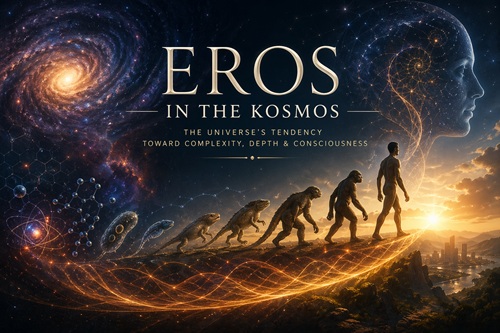 Introduction: Rehabilitating a Dangerous IdeaFew ideas in contemporary philosophy of evolution are as quickly dismissed as Ken Wilber's notion of “Eros in the Kosmos.” It is typically caricatured as a mystical projection—a smuggling of teleology into a domain long purified by Darwinian mechanisms. And yet, the speed with which the idea is rejected may itself signal a kind of conceptual rigidity. If we take seriously the full arc of cosmic, biological, and cultural evolution, the question is not whether blind mechanisms operate—they clearly do—but whether they are sufficient to account for the persistent emergence of increasing complexity, depth, and interiority. To defend Eros here is not to deny natural selection, but to argue that it may not be the whole story. The Pattern of Emergence: More Than RandomnessFrom quarks to atoms, from molecules to cells, from organisms to minds—evolution presents us with a striking pattern: the emergence of wholes that are greater than the sum of their parts. Each level introduces new properties that cannot be reduced to prior configurations. This is the domain of emergence. Standard evolutionary theory explains adaptation within already-existing forms, but it struggles more with the origin of radically novel forms. The jump from non-life to life, or from neural activity to subjective experience, remains deeply mysterious. Invoking sheer contingency begins to look less like an explanation and more like a placeholder. Wilber's proposal is that there is an intrinsic drive—a kind of immanent “Eros”—within the fabric of reality that biases the unfolding of complexity. Not a supernatural force imposed from outside, but a tendency inherent in the Kosmos itself. Eros as a Principle of Self-OrganizationModern science already recognizes that matter is not inert. Systems far from equilibrium spontaneously organize themselves into ordered structures. This is the domain explored by Ilya Prigogine, whose work on dissipative structures shows that under the right conditions, order emerges naturally from chaos. Similarly, Stuart Kauffman has argued for the concept of “self-organization” as a co-equal partner to natural selection. In such frameworks, the universe possesses a latent creativity—a propensity to generate novelty that cannot be reduced to selection alone. Wilber's Eros can be interpreted as a philosophical generalization of this insight: a name for the directional tendency inherent in self-organizing systems toward greater complexity, integration, and depth. Interior Depth: The Missing DimensionA strictly third-person account of evolution overlooks something crucial: the emergence of interiority. At some point, matter begins to feel. With the rise of nervous systems, we encounter sensation; with humans, self-awareness. The “hard problem” of consciousness—formulated by David Chalmers—underscores the explanatory gap between physical processes and subjective experience. If consciousness cannot be fully reduced to matter, then its emergence demands a broader framework. Wilber's model posits that interiority is present in rudimentary form from the beginning—what he calls a pan-interior dimension. Eros, in this sense, is not just a drive toward complexity, but toward increasing depth of experience. Evolution is not only getting bigger and more complex; it is getting more inward. Against Reductionism: The Limits of ChanceNeo-Darwinian orthodoxy rests heavily on random mutation filtered by selection. While this mechanism is undoubtedly powerful, its explanatory reach may be overstated. The sheer improbability of certain evolutionary innovations—such as the emergence of language or symbolic thought—raises legitimate questions. At what point does the accumulation of improbabilities suggest an underlying bias in the system? To posit Eros is to suggest that evolution is not a purely blind search through possibility space, but a constrained exploration shaped by intrinsic tendencies. These constraints do not determine outcomes in a rigid way, but they make certain pathways more likely than others. Eros Without AnthropomorphismCritics often object that Eros smuggles in anthropomorphic or theological assumptions. But this objection may miss the mark. To speak of “gravity” does not imply that masses “want” to attract each other; it is simply a way of describing a consistent pattern of behavior. Likewise, Eros need not imply intention or consciousness in a human sense. It can be understood as a structural feature of reality—a bias toward the emergence of greater complexity and depth. In this interpretation, Eros is closer to a law-like tendency than a divine agent. Conclusion: A Plausible Metaphysical HypothesisWilber's Eros in the Kosmos should not be seen as a scientific hypothesis competing directly with evolutionary biology, but as a metaphysical interpretation that seeks to integrate its findings into a broader explanatory framework. It asks a simple but profound question: why does the universe produce increasing complexity, rather than remain in a state of maximal entropy? Why does it generate beings capable of reflecting on its own processes? To answer “just chance” is not wrong—but it may be incomplete. Eros names the possibility that the universe is not indifferent to its own unfolding, but is, in some deep sense, inclined toward the emergence of complexity, consciousness, and meaning. Appendix: Why “Eros in the Kosmos” Remains Deeply ProblematicThe preceding defense gives Eros its strongest philosophical reading—as an immanent tendency toward complexity, depth, and self-organization. Even in that charitable framing, however, the concept faces a series of substantial, and arguably decisive, objections. 1. Explanatory Inflation Rather Than ExplanationThe central issue is that Eros risks functioning as a promissory label rather than a mechanism. To say that complexity arises because of an intrinsic drive toward complexity is perilously close to circular reasoning. The phenomenon to be explained is redescribed in more evocative language, but not actually accounted for. In contrast, natural selection and related evolutionary processes provide testable, mechanistic explanations. They specify how variation, inheritance, and differential survival cumulatively generate adaptation. Eros, by comparison, lacks operational definition. It does not specify conditions under which it operates, how it interacts with known processes, or how its presence could be empirically distinguished from their sufficiency. A principle that explains everything in general often explains nothing in particular. 2. The Problem of Non-FalsifiabilityA robust explanatory framework must, at minimum, expose itself to the risk of being wrong. Eros does not. Any instance of increasing complexity can be cited as evidence for it, while instances of stagnation, regression, or extinction can be dismissed as local setbacks in a larger arc. This immunizes the concept against disconfirmation. In the philosophy of science, this places it closer to metaphysical speculation than to explanatory theory. Without clear criteria for falsification, Eros cannot compete epistemically with standard evolutionary accounts—it can only accompany them rhetorically. 3. Misreading EmergenceAppeals to emergence are often used to support Eros, but this move is not straightforward. Emergence, as understood in complexity science, does not imply directionality or purpose. It describes how novel properties arise from interactions within systems, often unpredictably. Crucially, emergent systems frequently produce disorder, collapse, or chaotic behavior alongside order. There is no built-in vector toward “higher” forms. By selectively emphasizing cases of increasing complexity, the Eros narrative risks confirmation bias—spotlighting upward trends while ignoring the vast background of entropy, extinction, and failed complexity. 4. Thermodynamic TensionThe appeal to self-organization, inspired by figures like Ilya Prigogine, is often overstretched. While local decreases in entropy are indeed possible in open systems, they are always coupled to greater entropy production elsewhere. The overall trajectory of the universe, as described by thermodynamics, remains toward equilibrium—not toward complexity. Complex structures arise not because the universe “prefers” them, but because energy flows temporarily sustain them. When those flows cease, complexity dissolves. Eros, if interpreted as a universal tendency toward increasing order, sits uneasily with this broader physical picture. 5. The Anthropocentric BiasThe intuition that evolution is “going somewhere” is strongly shaped by our position as reflective, language-using beings. From that vantage point, the emergence of mind appears as a culmination. But this perspective is retrospective and anthropocentric. Evolution does not aim at humans; humans are one contingent outcome among countless possibilities. If intelligent life had not emerged, the narrative of Eros would lack its most compelling evidence—yet the underlying processes would be unchanged. Eros risks projecting a human-centered sense of direction onto a process that is fundamentally indifferent. 6. The Problem of Suffering and WasteIf Eros is a drive toward greater depth and complexity, it must also account for the immense cost of evolution: mass extinctions, pervasive suffering, and vast biological waste. The history of life is not a smooth ascent but a jagged landscape marked by catastrophe. To integrate this into an Eros framework, one must either downplay these phenomena or reinterpret them as necessary for higher development. Both moves are philosophically fraught. The former ignores empirical reality; the latter risks justifying suffering in teleological terms that are difficult to defend. 7. Consciousness Without ErosThe appeal to the “hard problem” of consciousness, associated with David Chalmers, does highlight genuine explanatory gaps. However, introducing Eros does not resolve them. If anything, it shifts the mystery rather than dissolves it. Instead of asking how subjective experience arises from physical processes, we are asked to accept a pre-existing tendency toward interiority. This may be metaphysically suggestive, but it does not provide a clearer account of the mechanisms involved. Alternative frameworks—such as physicalist, panpsychist, or neutral monist models—attempt to address consciousness more directly, without invoking a directional drive in evolution. 8. Ockham's Razor and Theoretical EconomyFrom the standpoint of William of Ockham's principle of parsimony, Eros introduces an additional layer of explanation that is not strictly necessary. If known processes can, in principle, account for observed phenomena—even if incompletely—then positing an extra metaphysical driver may be unwarranted. Parsimony does not guarantee truth, but it provides a methodological constraint. Eros, as an added explanatory entity, must justify its inclusion by offering explanatory power that simpler models lack. At present, that case remains unconvincing. Conclusion: A Suggestive but Unstable IdeaEros in the Kosmos is not without intuitive appeal. It resonates with our sense that the universe has produced something remarkable in the emergence of life and mind. As a poetic or metaphysical vision, it can be stimulating. But when pressed as an explanatory framework, it shows significant weaknesses: lack of precision, absence of falsifiability, tension with established science, and susceptibility to anthropocentric projection. In the end, Eros may tell us more about our desire for meaning and direction than about the actual dynamics of the Kosmos itself.
Comment Form is loading comments...
|