|
TRANSLATE THIS ARTICLE
Integral World: Exploring Theories of Everything
An independent forum for a critical discussion of the integral philosophy of Ken Wilber
  Frank Visser, graduated as a psychologist of culture and religion, founded IntegralWorld in 1997. He worked as production manager for various publishing houses and as service manager for various internet companies and lives in Amsterdam. Books: Ken Wilber: Thought as Passion (SUNY, 2003), and The Corona Conspiracy: Combatting Disinformation about the Coronavirus (Kindle, 2020). Frank Visser, graduated as a psychologist of culture and religion, founded IntegralWorld in 1997. He worked as production manager for various publishing houses and as service manager for various internet companies and lives in Amsterdam. Books: Ken Wilber: Thought as Passion (SUNY, 2003), and The Corona Conspiracy: Combatting Disinformation about the Coronavirus (Kindle, 2020).
Check out my other conversations with ChatGPT The Joys of SecularismClarity, Freedom, and the Courage to Live Without EnchantmentFrank Visser / ChatGPT
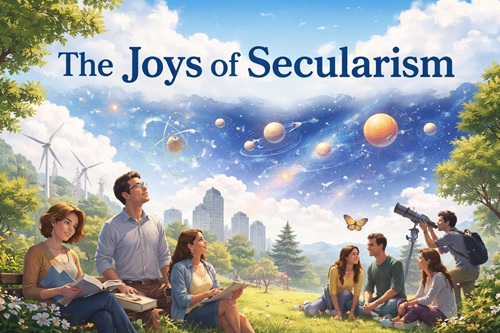 In recent years, a curious intellectual and cultural trend has re-emerged: the call for “re-enchantment.” Disenchanted with what they perceive as the sterility of modern, secular life, various thinkers, spiritual entrepreneurs, and cultural critics argue for a return to a world imbued with meaning, mystery, and transcendence. Whether framed in terms of revived animism, post-materialist metaphysics, or updated forms of idealism, the underlying impulse is the same: reality, they claim, must be more than the cold, indifferent universe described by science. Yet this critique rests on a profound misreading of what secularism actually offers. Far from being a bleak, flattened worldview, secularism—properly understood—is a source of intellectual liberation, existential honesty, and even a distinctive form of joy. It does not impoverish life; it clarifies it. Disenchantment as Intellectual AchievementThe concept of “disenchantment” was famously articulated by Max Weber, who described the gradual removal of magical and supernatural explanations from our understanding of the world. This process is often portrayed as a loss. But it is equally a gain—arguably one of humanity's greatest achievements. To see the world as governed by consistent, discoverable laws rather than hidden spirits or divine whims is to gain explanatory power. It allows us to predict, manipulate, and understand phenomena in ways that were previously impossible. Modern medicine, technology, and science are not incidental byproducts of disenchantment; they are its direct consequences. The re-enchantment movements, in contrast, often seek to reintroduce ambiguity where clarity has been hard-won. They trade explanatory rigor for metaphysical comfort, blurring the line between what is known and what is merely hoped for. Freedom from Cosmic SurveillanceOne of the quieter joys of secularism is the liberation from cosmic oversight. In a religious or enchanted worldview, human life is often lived under the gaze of divine judgment or within a moral order dictated by unseen forces. Every action is potentially charged with eternal significance. Secularism removes this burden. It situates morality within human relationships rather than supernatural command. Ethical systems become matters of negotiation, empathy, and reason—not obedience. This does not lead to moral nihilism, as critics often claim. On the contrary, it places responsibility squarely where it belongs: on us. Without divine arbitration, we cannot defer moral dilemmas to higher authorities. We must think, deliberate, and take ownership of our choices. This is not a loss of meaning, but a maturation of it. The Beauty of an Unscripted UniverseRe-enchantment narratives often assume that meaning must be built into the fabric of the universe. A purposeless cosmos, they argue, is inherently bleak. But this confuses given meaning with created meaning. In a secular framework, the universe does not come preloaded with intention. It simply exists. Stars burn, galaxies collide, life evolves—not because they are meant to, but because physical processes unfold as they do. Paradoxically, this makes the emergence of life, consciousness, and culture more—not less—remarkable. That blind processes could give rise to beings capable of reflection, art, and love is a source of genuine wonder. There is no need to embellish reality with metaphysical narratives when reality itself is already astonishing. The night sky loses none of its beauty because it is governed by astrophysics rather than mythology. If anything, understanding its workings deepens the awe. Against the Temptation of Metaphysical InflationMany re-enchantment movements share a tendency toward what might be called metaphysical inflation: the impulse to posit hidden dimensions, higher planes, or cosmic purposes to compensate for perceived existential lack. This is evident in contemporary forms of idealism, panpsychism, and neo-spiritual synthesis. While often presented in sophisticated philosophical language, these frameworks frequently reintroduce elements of pre-modern thought under new labels. The problem is not that such ideas are imaginative; it is that they often lack empirical grounding while claiming explanatory authority. They function less as theories and more as narratives—stories that satisfy psychological needs rather than withstand critical scrutiny. Secularism, by contrast, imposes a discipline: claims about reality must be justified by evidence and coherent reasoning. This constraint is not a limitation but a safeguard against self-deception. Existential Honesty and Human SolidarityPerhaps the deepest joy of secularism lies in its commitment to existential honesty. It refuses to soften the harsh edges of reality with comforting illusions. Death is final. The universe is indifferent. There is no guaranteed justice beyond what we create ourselves. This can be unsettling. But it also fosters a unique kind of solidarity. If there is no cosmic safety net, then human relationships become all the more significant. Compassion, cooperation, and mutual care are not divinely mandated—they are human achievements. In this light, secularism does not strip life of meaning; it relocates meaning to the sphere where it can be most authentically realized: between people. The Courage to Remain DisenchantedRe-enchantment movements are, at bottom, expressions of discomfort. They reflect a desire to reintroduce mystery in the face of uncertainty, to find hidden purpose in a universe that offers none explicitly. But there is another path: the courage to remain disenchanted. This does not mean rejecting wonder or depth. It means grounding them in reality rather than projecting them onto it. It means accepting that meaning is not given, but made. And it means recognizing that clarity, however stark, is preferable to illusion, however comforting. The joys of secularism are subtle but profound. They lie in intellectual integrity, moral autonomy, and the quiet awe of a universe that needs no embellishment. In an age tempted by re-enchantment, these are achievements worth defending.
Widget is loading comments...
|