|
TRANSLATE THIS ARTICLE
Integral World: Exploring Theories of Everything
An independent forum for a critical discussion of the integral philosophy of Ken Wilber
  Frank Visser, graduated as a psychologist of culture and religion, founded IntegralWorld in 1997. He worked as production manager for various publishing houses and as service manager for various internet companies and lives in Amsterdam. Books: Ken Wilber: Thought as Passion (SUNY, 2003), and The Corona Conspiracy: Combatting Disinformation about the Coronavirus (Kindle, 2020). Frank Visser, graduated as a psychologist of culture and religion, founded IntegralWorld in 1997. He worked as production manager for various publishing houses and as service manager for various internet companies and lives in Amsterdam. Books: Ken Wilber: Thought as Passion (SUNY, 2003), and The Corona Conspiracy: Combatting Disinformation about the Coronavirus (Kindle, 2020).
Check out my other conversations with ChatGPT The Illusion of InsightA Critical Examination of the Course in Miracles MovementFrank Visser / ChatGPT
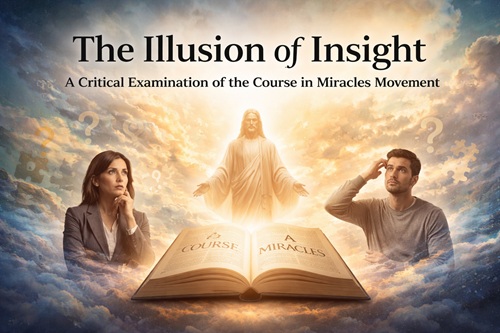 A Private Revelation as Universal DoctrineAt the core of the movement lies A Course in Miracles, published in 1976 and scribed by Helen Schucman, who claimed it was dictated by an inner voice identified as Jesus. This origin story immediately situates the text in an epistemologically unstable position. Unlike classical religious revelations embedded in communal validation and historical continuity, ACIM depends entirely on a private experience. Its authority is therefore not socially negotiated or empirically grounded, but psychologically granted by each reader. This raises a fundamental question: on what basis should such a claim be accepted as universally binding truth? Metaphysics Without ArgumentACIM proposes a radical form of idealism: the material world is an illusion generated by the ego, while only divine love is real. This resembles non-dual traditions, yet lacks their philosophical scaffolding. There is no sustained argumentation, no engagement with counterpositions, and no attempt to resolve classical problems in metaphysics. Instead, its assertions are presented as self-evident truths. Crucially, the text reframes skepticism as a function of ego-resistance, thereby preemptively neutralizing critique. This rhetorical structure renders the system effectively unfalsifiable and places it outside the domain of rational discourse. Forgiveness as Ontological DenialOne of the Course's central practices is forgiveness, but it departs sharply from conventional moral frameworks. Forgiveness here does not involve acknowledging wrongdoing and releasing resentment; rather, it entails recognizing that no real harm has occurred because the world itself is illusory. While this can yield psychological relief, it introduces ethical ambiguity. If suffering is ultimately unreal, then the moral weight of actions becomes attenuated. In practice, this can foster a form of spiritual bypassing, where genuine harm is reinterpreted as mere misperception. Decentralization and Soft AuthorityThe movement lacks formal hierarchy, operating through informal study groups and independent teachers. Yet this decentralization does not eliminate authority; it redistributes it. Influential interpreters such as Marianne Williamson play a significant role in shaping how the Course is understood. Often, they soften its more extreme metaphysical claims, translating them into the language of personal growth and emotional healing. This creates a dual structure: a rigid doctrinal core alongside a more accessible, adaptive outer layer. The Paradox of Practical UseA persistent tension runs through the movement. ACIM insists that the world is unreal and ultimately insignificant, yet its adherents frequently apply its teachings to improve their lived experience—relationships, well-being, even professional success. This results in a conceptual contradiction: a worldview that denies the reality of the world is simultaneously employed as a pragmatic toolkit for navigating it. The Course thus oscillates between metaphysical negation and psychological utility without resolving the inconsistency. A Modern Gnostic PatternSociologically, ACIM fits within a broader trend of individualized spirituality. It retains Christian imagery while discarding institutional frameworks, appealing to those who seek meaning without dogma. In this respect, it resembles modern forms of gnosticism: the world is illusory, truth is hidden, and salvation comes through a shift in perception rather than engagement with external reality. This inward turn aligns well with contemporary therapeutic culture but distances the movement from both empirical inquiry and communal religious life. Conclusion: Comfort Over CoherenceThe enduring appeal of the Course in Miracles movement lies in its promise of inner peace through perceptual transformation. It addresses a genuine psychological need by reframing suffering as a cognitive error rather than an existential fact. Yet this strength is also its weakness. By prioritizing emotional reassurance over epistemic rigor, the system avoids the demands of critical scrutiny. Its practices may offer subjective benefits, but its metaphysical claims remain unsubstantiated and its conceptual framework internally strained. As such, it is better understood as a psychologically effective narrative than as a credible account of reality.
Comment Form is loading comments...
|