|
TRANSLATE THIS ARTICLE
Integral World: Exploring Theories of Everything
An independent forum for a critical discussion of the integral philosophy of Ken Wilber
  Frank Visser, graduated as a psychologist of culture and religion, founded IntegralWorld in 1997. He worked as production manager for various publishing houses and as service manager for various internet companies and lives in Amsterdam. Books: Ken Wilber: Thought as Passion (SUNY, 2003), and The Corona Conspiracy: Combatting Disinformation about the Coronavirus (Kindle, 2020). Frank Visser, graduated as a psychologist of culture and religion, founded IntegralWorld in 1997. He worked as production manager for various publishing houses and as service manager for various internet companies and lives in Amsterdam. Books: Ken Wilber: Thought as Passion (SUNY, 2003), and The Corona Conspiracy: Combatting Disinformation about the Coronavirus (Kindle, 2020).
Check out my other conversations with ChatGPT Ken WilberArchitect of the Integral CosmosFrank Visser / ChatGPT
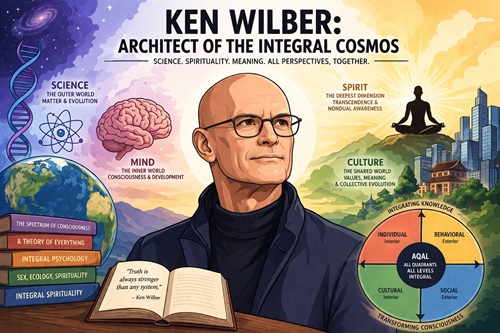
The Drive to Synthesize EverythingTo profile Ken Wilber is to encounter a thinker defined by intellectual ambition on a civilizational scale. Wilber is not content to contribute to a field; he attempts to unify all fields. Psychology, philosophy, religion, and science are not, in his view, separate domains but partial perspectives awaiting integration into a higher-order framework. This synthesizing impulse is the core of his identity. He operates less as a specialist than as a system-builder, constructing a conceptual map of reality itself. System Over EvidenceWilber's method is fundamentally architectonic. He begins with large-scale conceptual structures—most notably his AQAL model (“all quadrants, all levels”)—and then situates empirical findings within that pre-existing grid. This reverses the standard scientific procedure, where models emerge from data and remain subject to revision. In Wilber's case, the framework tends to remain stable while the evidence is selectively interpreted. The result is a system that is internally coherent and rhetorically compelling, but often resistant to falsification. The Centrality of Development and HierarchyA defining feature of Wilber's thought is his commitment to developmental hierarchy. Reality unfolds through stages—psychological, cultural, and spiritual—culminating in nondual awareness. This gives his work a directional logic: evolution is not neutral but progressive, moving toward greater depth and integration. The concept of “higher” and “lower” becomes indispensable, structuring not only his descriptive models but also his implicit value judgments. This hierarchical vision resonates with readers seeking orientation and meaning, yet it also invites criticism. The risk is that descriptive claims about development slide into normative assertions about superiority, without sufficient empirical grounding. The Ambiguous Role of ScienceWilber's engagement with science is strategic rather than systematic. Throughout his career, he has drawn on developmental psychology, systems theory, and evolutionary biology, but often in a way that serves his overarching metaphysical narrative. Scientific concepts are incorporated when they align with his model and sidelined when they do not. This pattern is particularly visible in his treatment of evolution. His notion of “Eros in the Kosmos”—a drive toward increasing complexity and consciousness—functions as a teleological principle. While evocative, it lacks clear empirical support and sits uneasily with mainstream evolutionary theory, which explains complexity without invoking intrinsic directionality. Spiritual Advocacy Disguised as TheoryWilber is not a neutral observer of consciousness; he is an advocate for its highest forms. His work carries a normative charge, presenting advanced spiritual states—especially nondual realization—as both more real and more valuable. This transforms his framework into something more than a descriptive model. It becomes a guide to transcendence, implicitly urging readers toward spiritual development. In this sense, Wilber operates within a long tradition of philosophical spirituality, where metaphysics and soteriology are intertwined. The map of reality doubles as a path to liberation. Style: Between Clarity and InflationWilber's writing reflects the dual nature of his project. At times, he is clear, systematic, and pedagogically effective, capable of organizing complex material into accessible ????es. At other times, his prose becomes inflated, dense with terminology, and prone to repetition. Particularly in his later work, conceptual proliferation can outpace explanatory precision, creating an impression of depth that is not always matched by analytical rigor. Influence Without Academic IntegrationDespite being one of the most translated American authors on consciousness, Wilber occupies a marginal position in academia. His influence is strongest in interdisciplinary and spiritually oriented communities—coaching, leadership theory, and integral practice—rather than in peer-reviewed scholarship. This marginality reflects both institutional skepticism and substantive issues. Wilber's work crosses disciplinary boundaries but does not consistently meet the methodological standards of any single discipline. As a result, it circulates widely outside academia while remaining largely excluded from its core debates. A Metaphysician in a Post-Metaphysical AgeThe most revealing way to understand Wilber is as a contemporary metaphysician. At a time when much of philosophy and science has become cautious and specialized, he revives the grand project of describing the structure and purpose of reality as a whole. His work responds to a genuine demand: the desire for a worldview that integrates knowledge and restores meaning. Yet this ambition also exposes a fundamental tension. By reintroducing sweeping ontological claims without corresponding empirical constraints, Wilber risks reproducing the very speculative excesses that modern critical thought sought to overcome. Conclusion: Vision Versus VerificationWilber's intellectual profile is defined by the tension between scope and substantiation. He is a thinker of rare ambition, constructing comprehensive models that attempt to unify disparate domains of knowledge. His work inspires precisely because it reaches beyond fragmentation toward coherence. At the same time, the foundations of his system remain open to question. The integration he proposes is often achieved conceptually rather than empirically, and the resulting structure, while impressive, does not always withstand critical scrutiny. He stands, therefore, as a builder of grand intellectual architectures—structures that command attention and invite exploration, but whose ultimate stability depends less on their internal elegance than on their capacity to engage, and be tested by, the resistant realities they seek to explain.
Comment Form is loading comments...
|