|
TRANSLATE THIS ARTICLE
Integral World: Exploring Theories of Everything
An independent forum for a critical discussion of the integral philosophy of Ken Wilber
  Frank Visser, graduated as a psychologist of culture and religion, founded IntegralWorld in 1997. He worked as production manager for various publishing houses and as service manager for various internet companies and lives in Amsterdam. Books: Ken Wilber: Thought as Passion (SUNY, 2003), and The Corona Conspiracy: Combatting Disinformation about the Coronavirus (Kindle, 2020). Frank Visser, graduated as a psychologist of culture and religion, founded IntegralWorld in 1997. He worked as production manager for various publishing houses and as service manager for various internet companies and lives in Amsterdam. Books: Ken Wilber: Thought as Passion (SUNY, 2003), and The Corona Conspiracy: Combatting Disinformation about the Coronavirus (Kindle, 2020).
Check out my other conversations with ChatGPT The Integral Vision RevisitedA Critical ReviewFrank Visser / ChatGPT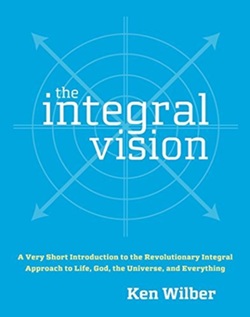
A Pop Introduction to a Grand TheoryPublished as a compact, visually engaging introduction to Wilber's sprawling philosophy, The Integral Vision aims to distill decades of theoretical work into an accessible, almost “coffee-table” format. With its diagrams, color graphics, and simplified language, the book functions less as a sustained argument and more as a guided tour through what Wilber calls his “integral approach to life, God, the universe, and everything.” This accessibility is both its primary strength and its most significant liability. The Appeal: Conceptual Compression and Systemic AmbitionAt its best, The Integral Vision succeeds in presenting a highly compressed version of Wilber's core framework—especially the AQAL model (“all quadrants, all levels”). The now-familiar four quadrants—subjective (“I”), intersubjective (“we”), objective (“it”), and interobjective (“its”)—offer a neat heuristic for avoiding one-sided explanations of reality. The book also introduces developmental stages (from egocentric to “Kosmocentric”), multiple lines of intelligence, and the integration of science, psychology, and spirituality into a single meta-framework. The underlying promise is intellectually seductive: nothing essential is left out; all perspectives are “true but partial.” For newcomers, this produces a sense of conceptual mastery. Complex domains—ethics, culture, biology, mysticism—are mapped into a single grid. The appeal is obvious: clarity replaces fragmentation, and intellectual pluralism is given a structured home. The Problem of OversimplificationYet this same compression comes at a cost. In reducing an already controversial and intricate system into digestible visuals and slogans, Wilber risks turning a speculative meta-theory into something resembling a universal template for all knowledge. Critics have noted that such presentations can feel “condescending” and overly schematic, offering an “all-purpose framework” that glosses over nuance and disagreement. The quadrants, levels, and lines are presented less as hypotheses to be tested and more as givens to be adopted. This produces a paradox: a theory designed to honor complexity ends up flattening it. The world is not merely organized—it is pre-organized. A System Without FrictionMore fundamentally, The Integral Vision lacks epistemic resistance. Competing frameworks—whether from philosophy of mind, evolutionary biology, or cultural theory—are rarely engaged on their own terms. Instead, they are quickly “included” within the integral model, often without demonstrating why such inclusion is justified. This tendency reflects a broader critique of Wilber's work: that it integrates disciplines synthetically rather than analytically, sometimes distorting or selectively interpreting them to fit a pre-existing schema. The result is a system that appears comprehensive but is insufficiently constrained by empirical or disciplinary rigor. It explains everything—too easily. The Spiritual Gradient and Its AssumptionsA central feature of the book is its developmental ladder culminating in transpersonal or spiritual realization. While presented as a universal structure of human growth, this hierarchy embeds strong metaphysical assumptions—particularly the privileging of mystical awareness as the highest form of knowing. Critics have long argued that this move imports a perennialist worldview under the guise of developmental psychology. Mysticism is not merely one mode of experience among others; it becomes the telos toward which all development implicitly aims. In The Integral Vision, this assumption is not argued so much as illustrated. The reader is shown the ladder, but not invited to question whether it exists. The Aestheticization of TheoryAnother striking feature is the book's design. Its polished visuals and diagrammatic clarity give the impression of scientific legitimacy, even when the underlying claims remain speculative. The medium reinforces the message: what is mapped so cleanly must be real. But diagrams can obscure as much as they reveal. By translating contested philosophical claims into tidy graphics, the book risks aestheticizing theory—turning debate into design. Between Inspiration and Ideology To its credit, The Integral Vision can inspire readers to think more holistically. It pushes against reductionism and encourages the recognition of multiple dimensions of reality—subjective, cultural, and systemic. In this sense, it functions effectively as a pedagogical gateway. However, as an introduction, it also subtly indoctrinates. The framework is presented not as one interpretive lens among many, but as the lens that subsumes all others. This can create what one critic called a “canned integral program” rather than a genuinely critical engagement with complexity. Conclusion: A Vision Too Neatly PackagedThe Integral Vision is best understood as a promotional artifact for Wilber's broader system—a visually compelling synopsis rather than a rigorous argument. It succeeds in communicating the ambition and scope of integral theory, but fails to adequately defend its assumptions or confront its weaknesses. For sympathetic readers, it offers a powerful sense of coherence. For critical readers, it raises familiar concerns: overreach, lack of empirical grounding, and the quiet smuggling of metaphysics into what presents itself as a neutral map of reality. In the end, the book exemplifies both the brilliance and the limitation of Wilber's project: a sweeping synthesis that promises to include everything, but in doing so risks explaining too much—and questioning too little.
Comment Form is loading comments...
|