|
TRANSLATE THIS ARTICLE
Integral World: Exploring Theories of Everything
An independent forum for a critical discussion of the integral philosophy of Ken Wilber
  Frank Visser, graduated as a psychologist of culture and religion, founded IntegralWorld in 1997. He worked as production manager for various publishing houses and as service manager for various internet companies and lives in Amsterdam. Books: Ken Wilber: Thought as Passion (SUNY, 2003), and The Corona Conspiracy: Combatting Disinformation about the Coronavirus (Kindle, 2020). Frank Visser, graduated as a psychologist of culture and religion, founded IntegralWorld in 1997. He worked as production manager for various publishing houses and as service manager for various internet companies and lives in Amsterdam. Books: Ken Wilber: Thought as Passion (SUNY, 2003), and The Corona Conspiracy: Combatting Disinformation about the Coronavirus (Kindle, 2020).
Check out my other conversations with ChatGPT A Brief History of Everything RevisitedA Critical ReviewFrank Visser / ChatGPT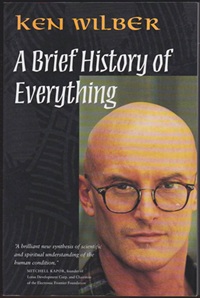
Ken Wilber's A Brief History of Everything (1996) is often presented as the most accessible entry point into his sprawling “integral” philosophy—a distilled, conversational version of Sex, Ecology, Spirituality. Written in a dialogue format, it aims to map nothing less than the evolution of cosmos, life, mind, and spirit into a single, unified framework. That ambition is both the book's central appeal and its most persistent liability. The Seduction of Total VisionWilber's project is unmistakably grand: to integrate science, psychology, religion, philosophy, and cultural history into a single explanatory scheme. He presents reality as a nested hierarchy of “holons”—entities that are both wholes and parts—culminating in the realization of nondual Spirit. At a rhetorical level, this is compelling. Few thinkers attempt such breadth, and fewer still manage to communicate it in a relatively approachable format. The Q&A style softens the density of the material and gives the impression of clarity and dialogue. The book also touches on a wide range of contemporary issues—ecology, feminism, multiculturalism—embedding them within a developmental narrative of human consciousness. But this “theory of everything” comes at a cost: the more total the vision, the less accountable it becomes to the standards of any single discipline. The Problem of OverreachThe most immediate weakness is structural. The book attempts to synthesize too much, too quickly. Critics have noted that this results in a lack of depth and precision across domains, with complex traditions reduced to schematic summaries. Wilber moves effortlessly from quantum physics to Buddhist metaphysics to developmental psychology—but this fluency often masks a lack of methodological rigor. Scientific theories are treated as if they seamlessly support spiritual claims, while religious traditions are selectively interpreted to fit an overarching evolutionary narrative. The result is not integration so much as assimilation: disparate fields are subsumed under a pre-existing metaphysical framework rather than genuinely synthesized. Evolution as Metaphysical NarrativeAt the heart of the book lies Wilber's central thesis: evolution is not merely biological but spiritual—the unfolding of Spirit coming to know itself. This is where the project shifts from speculative philosophy into metaphysical assertion. The developmental sequence from matter to life to mind to Spirit is presented less as a hypothesis than as an interpretive certainty. The language of evolution is co-opted to support what is essentially a neo-Hegelian, quasi-mystical worldview. From a critical standpoint, this raises a fundamental issue: Wilber blurs the boundary between empirical description and spiritual teleology. Evolutionary biology becomes a narrative vehicle for metaphysical purpose—without the evidential grounding such a claim would require. The Closed System ProblemPerhaps the most serious philosophical concern is the self-sealing nature of Wilber's framework. Because his model incorporates developmental stages of consciousness, disagreement can be reinterpreted as evidence of a critic's “lower” stage of development. This introduces a circular dynamic: the theory explains everything, including opposition to itself. In epistemological terms, it becomes difficult—if not impossible—to falsify. A system that cannot, even in principle, be proven wrong risks collapsing into ideological insulation. Cultural and Hierarchical BiasWilber's developmental schema has also drawn criticism for implicitly ranking cultures and worldviews. By placing modern, rational consciousness above “mythic” or “magical” stages, the model can reproduce a hierarchical ordering that echoes older, Eurocentric narratives of progress. Although Wilber attempts to incorporate postmodern pluralism, his framework ultimately subordinates it within a larger hierarchy—one that he himself defines. This tension between inclusivity and ranking is never fully resolved. Style: Accessible but RepetitiveIronically, a book designed to simplify Wilber's ideas often ends up reiterating them. Readers frequently report a sense of repetition and conceptual recycling, as the same core ideas—holons, quadrants, levels—are applied across different domains. The conversational format helps, but it also allows for a certain discursiveness. Precision is often sacrificed for rhetorical flow, and key distinctions remain underdeveloped. Final AssessmentA Brief History of Everything is best understood not as a rigorous philosophical argument, but as a grand interpretive vision. It is a map—ambitious, imaginative, and deeply flawed. Its strengths lie in its scope and integrative intent. Wilber is undeniably a gifted synthesizer, capable of drawing connections across domains that are usually kept apart. For readers seeking a sweeping, spiritually infused narrative of evolution, the book can be exhilarating. But its weaknesses are equally pronounced. The synthesis is often superficial, the metaphysics ungrounded, and the system resistant to critique. What presents itself as a unification of knowledge risks becoming a totalizing worldview that explains too much and justifies itself too easily. In the end, A Brief History of Everything reveals both the allure and the danger of “theories of everything”: they promise coherence, but often achieve it by smoothing over the very complexities they claim to honor.
Widget is loading comments...
|