|
TRANSLATE THIS ARTICLE
Integral World: Exploring Theories of Everything
An independent forum for a critical discussion of the integral philosophy of Ken Wilber
  Frank Visser, graduated as a psychologist of culture and religion, founded IntegralWorld in 1997. He worked as production manager for various publishing houses and as service manager for various internet companies and lives in Amsterdam. Books: Ken Wilber: Thought as Passion (SUNY, 2003), and The Corona Conspiracy: Combatting Disinformation about the Coronavirus (Kindle, 2020). Frank Visser, graduated as a psychologist of culture and religion, founded IntegralWorld in 1997. He worked as production manager for various publishing houses and as service manager for various internet companies and lives in Amsterdam. Books: Ken Wilber: Thought as Passion (SUNY, 2003), and The Corona Conspiracy: Combatting Disinformation about the Coronavirus (Kindle, 2020).
Check out my other conversations with ChatGPT Transformations of Consciousness RevisitedA Critical ReviewFrank Visser / ChatGPT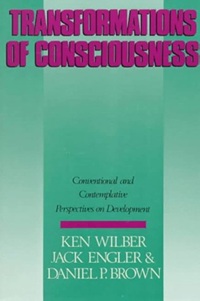
A critical review of Transformations of Consciousness has to begin by recognizing what the book actually is: not a single-author manifesto, but a hybrid academic volume in which Ken Wilber collaborates with Jack Engler and Daniel P. Brown to fuse Western developmental psychology with Eastern contemplative traditions. It is, in many ways, the most “serious” and academically anchored of Wilber's early works—and also one that most clearly exposes the structural problems of his entire project. The Promise: A Full-Spectrum PsychologyThe central ambition of the book is to construct a “full-spectrum” model of human development, integrating Freud, Piaget, and other Western theorists with meditative traditions such as Buddhism and Vedanta. This synthesis aims to extend conventional developmental psychology upward into “transpersonal” or “transrational” stages—states of consciousness associated with mystical realization. Wilber's contribution in particular elaborates a hierarchical “ladder” of development, where each level transcends and includes the previous one. The book distinguishes between: • Basic structures (enduring capacities) • Transitional structures (temporary developmental configurations) • The self-system navigating these levels This framework is theoretically elegant. It offers clinicians and theorists a vocabulary for integrating psychopathology, ego development, and contemplative practice into a single developmental arc. At its best, the book achieves something rare: it treats meditation not as an exotic add-on, but as a developmental variable continuous with psychology. The Core Problem: A Single Developmental AxisThe elegance comes at a cost. As noted by Susan Blackmore, the book largely assumes that development follows a single, universal trajectory. This assumption is never adequately defended—it is simply built into the model. That move has far-reaching consequences. It allows Wilber to: • Rank spiritual traditions as stages on a single scale • Interpret diverse contemplative experiences as points along one path • Treat “higher” as intrinsically “better” in a quasi-teleological sense But this collapses pluralism into hierarchy. Instead of comparing different forms of subjectivity, the model absorbs them into a predetermined ladder. What looks like integration becomes reduction. From a contemporary developmental or cross-cultural perspective, this is a major theoretical liability. It ignores the possibility that different traditions cultivate qualitatively distinct modes of consciousness, not merely higher or lower ones. Psychology Meets Metaphysics—QuietlyA second issue is methodological. The book presents itself as an integration of psychology and contemplative science, but it quietly imports metaphysical assumptions from Eastern traditions—particularly the idea of higher ontological levels of reality. Wilber's hierarchy is not merely descriptive; it is implicitly normative and ontological. The “higher” stages are not just more complex—they are closer to ultimate reality. This creates a category error. Psychological development (an empirical domain) is fused with metaphysical claims (a philosophical or religious domain) without a clear boundary. The result is a model that looks scientific but functions as a spiritual worldview. Later critics of Wilber would repeatedly identify this move as a core weakness: an inability to distinguish between phenomenology (what is experienced) and ontology (what exists). Clinical Insight vs. Grand SynthesisTo the book's credit, the contributions by Engler and Brown often display more empirical restraint than Wilber's system-building. Their clinical work—especially around meditation-induced pathology and the need for ego strength before transcendence—remains valuable. This is captured in Engler's famous insight: one must “have a self before one can transcend it.” While the book does not reduce to that slogan, it is arguably its most enduring contribution. Yet even here, the tension is visible. The clinical material suggests a complex, nonlinear developmental landscape, while Wilber's overarching framework insists on a clean, ascending order. The synthesis never fully resolves this contradiction. An Overextended Integrative AmbitionIn retrospect, Transformations of Consciousness reveals both the strength and the fatal flaw of Wilber's project. The strength is obvious: few thinkers have attempted such a sweeping integration of psychology and spirituality, and fewer still with this level of conceptual clarity. The flaw is equally clear: the integration is achieved by systematic overreach. Diverse theories are not so much reconciled as subsumed into a pre-existing hierarchical template. This tendency—already visible here—would later expand into the more elaborate architectures of Integral Theory. Critics have often noted that Wilber's work is prone to “totalizing assumptions” and overgeneralization. This book is an early, disciplined example of that tendency. Conclusion: A Transitional Work in More Ways Than OneTransformations of Consciousness is best understood as a transitional text—not just in its subject matter, but in Wilber's intellectual trajectory. It stands at the point where: • Transpersonal psychology still aspires to academic legitimacy • Wilber's system is still relatively restrained • The balance between psychology and metaphysics has not yet fully tipped For readers sympathetic to integrative ambitions, it remains a serious and sometimes insightful work. For critical readers, it already contains the seeds of Wilber's later excesses: hierarchical inflation, metaphysical smuggling, and a persistent conflation of developmental description with spiritual prescription. In that sense, the book succeeds as a map—but one that quietly redraws the territory to fit its own legend.
Widget is loading comments...
|