|
TRANSLATE THIS ARTICLE
Integral World: Exploring Theories of Everything
An independent forum for a critical discussion of the integral philosophy of Ken Wilber
  Frank Visser, graduated as a psychologist of culture and religion, founded IntegralWorld in 1997. He worked as production manager for various publishing houses and as service manager for various internet companies and lives in Amsterdam. Books: Ken Wilber: Thought as Passion (SUNY, 2003), and The Corona Conspiracy: Combatting Disinformation about the Coronavirus (Kindle, 2020). Frank Visser, graduated as a psychologist of culture and religion, founded IntegralWorld in 1997. He worked as production manager for various publishing houses and as service manager for various internet companies and lives in Amsterdam. Books: Ken Wilber: Thought as Passion (SUNY, 2003), and The Corona Conspiracy: Combatting Disinformation about the Coronavirus (Kindle, 2020).
Check out my other conversations with ChatGPT Spiritual Choices RevisitedA Critical ReviewFrank Visser / ChatGPT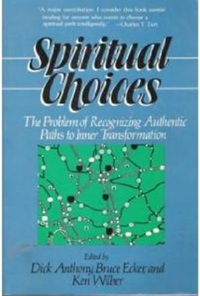
Context and Aim of the BookSpiritual Choices: The Problems of Recognizing Authentic Paths to Inner Transformation (1987), co-edited by Ken Wilber, Dick Anthony, and Bruce Ecker, occupies an interesting but somewhat neglected niche in Wilber's oeuvre. Unlike his more systematic works, it is an edited volume bringing together sociological, psychological, and philosophical perspectives on a shared concern: how to distinguish authentic spiritual transformation from pseudo-spiritual or manipulative movements. This framing is both the book's strength and its limitation. It sets up a real and pressing problem, but does not fully deliver a coherent solution. A Diagnostic Rather Than Constructive ProjectThe core ambition of Spiritual Choices is diagnostic rather than constructive. It maps the confusing landscape of new religious movements, therapies, and spiritual groups that proliferated in the 1970s and 1980s. Contributors examine guru-centered traditions, human potential movements, and therapeutic communities, asking whether they foster genuine transformation or merely provide psychological comfort. Wilber's own contribution introduces a distinction that would become central to his later work: the difference between legitimacy (social coherence and functionality) and authenticity (capacity for genuine developmental transformation). This remains one of the book's more durable conceptual tools. Lack of Theoretical IntegrationAs an edited collection, the book suffers from fragmentation. Sociological case studies sit alongside clinical reflections and philosophical arguments without being integrated into a unified framework. The result is a thematic anthology rather than a cumulative argument. Wilber's later AQAL model would attempt to provide such integration, but here the material remains loosely connected. The reader is left to infer coherence where little is explicitly constructed. The Problem of Unexamined HierarchiesA central weakness lies in the criteria used to define “authentic transformation.” The book relies on a hierarchical model of consciousness—drawn from perennial philosophy and developmental psychology—where higher stages correspond to deeper spiritual realization. However, this hierarchy is largely assumed rather than argued for. The perennialist premise—that diverse mystical traditions converge on a common higher truth—functions as an implicit axiom. This creates a circular logic: movements are judged authentic insofar as they conform to the model, and the model is validated by its ability to identify authentic movements. Cultural Bias and SelectivityThe evaluation of spiritual movements reflects the biases of its intellectual milieu. While attempting to avoid simplistic “cult vs. religion” dichotomies, the book privileges certain forms of spirituality—typically contemplative, introspective, and aligned with Eastern traditions. Charismatic, devotional, or emotionally expressive movements are often interpreted as “pre-rational” and therefore less developed. This reflects Wilber's broader tendency to filter religious phenomena through a developmental hierarchy that may oversimplify complex traditions. The Pre/Trans Fallacy in PracticeThe book implicitly applies what Wilber later termed the “pre/trans fallacy,” meant to distinguish regression from genuine transcendence. In practice, however, this becomes a classificatory shortcut. Experiences or movements that do not fit the “trans-rational” model can be dismissed as regressive without sustained analysis. This risks turning the framework into a gatekeeping device rather than an open-ended tool of inquiry. Uneven Empirical GroundingGiven its focus on “recognizing” authentic paths, the empirical basis of the book is surprisingly inconsistent. Some chapters provide detailed sociological insights, while others rely on anecdotal evidence or theoretical speculation. There is little methodological rigor in comparing movements, and the selection of examples appears somewhat arbitrary. The standards of evidence do not match the ambition of the book's evaluative claims. A Valuable but Incomplete ContributionDespite its flaws, Spiritual Choices addresses a real and important issue: not all spiritual paths are equally beneficial, and some may be psychologically regressive or socially harmful. The attempt to develop criteria for discernment remains relevant, particularly in today's pluralistic spiritual marketplace. The book also captures a transitional moment in Wilber's intellectual development, where he engages more directly with concrete social and psychological phenomena rather than purely abstract metaphysics. Final AssessmentSpiritual Choices raises the right question but offers a prematurely settled answer. Its conceptual distinctions—especially between legitimacy and authenticity—are insightful, but the framework in which they operate lacks sufficient epistemological grounding. In the end, the book exemplifies a recurring pattern in Wilber's work: strong analytical ambition coupled with insufficient critical scrutiny of its own assumptions. It invites the reader to evaluate spiritual paths, but does not adequately justify the criteria by which such evaluations are made. Widget is loading comments...
|