|
TRANSLATE THIS ARTICLE
Integral World: Exploring Theories of Everything
An independent forum for a critical discussion of the integral philosophy of Ken Wilber
  Frank Visser, graduated as a psychologist of culture and religion, founded IntegralWorld in 1997. He worked as production manager for various publishing houses and as service manager for various internet companies and lives in Amsterdam. Books: Ken Wilber: Thought as Passion (SUNY, 2003), and The Corona Conspiracy: Combatting Disinformation about the Coronavirus (Kindle, 2020). Frank Visser, graduated as a psychologist of culture and religion, founded IntegralWorld in 1997. He worked as production manager for various publishing houses and as service manager for various internet companies and lives in Amsterdam. Books: Ken Wilber: Thought as Passion (SUNY, 2003), and The Corona Conspiracy: Combatting Disinformation about the Coronavirus (Kindle, 2020).
Check out my other conversations with ChatGPT Integral Spirituality RevisitedA Critical ReviewFrank Visser / ChatGPT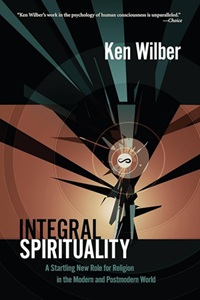
A critical review of Integral Spirituality has to begin by acknowledging what the book is trying to do, because its ambition is both its strength and its central weakness. Published in 2006, it represents Wilber's attempt to bring his mature “AQAL” framework (All Quadrants, All Levels) to the domain of religion and spirituality, offering what he sees as a post-metaphysical reconstruction of spiritual life for the modern and postmodern world. At its best, the book is a synthetic tour de force. At its worst, it is a conceptual overreach resting on shaky epistemic ground. The promise: a “post-metaphysical” spiritualityWilber's core move in Integral Spirituality is to argue that traditional religion fails because it confuses states (temporary experiences of consciousness) with stages (structural levels of development). Enlightenment, in his model, is not enough; one must also “grow up,” not just “wake up.” This distinction—between states and stages—is one of the book's genuinely clarifying contributions, and it has influenced both contemplative discourse and psychological approaches to spirituality. He further proposes “Integral Methodological Pluralism,” an attempt to legitimize multiple ways of knowing—scientific, phenomenological, cultural, and contemplative—within a single framework. In principle, this pluralism is attractive: it promises to dissolve the stale opposition between science and spirituality by situating them in different but equally valid domains. The book also offers a practical program—Integral Life Practice (ILP)—which integrates body, mind, spirit, and shadow work into a kind of cross-training regimen for human development. This practical orientation gives the book a quasi-manual quality, making it more than just abstract theory. So far, so compelling. The conceptual inflation problemThe difficulty is that Wilber's integrative ambition far exceeds his argumentative discipline. The AQAL framework is presented less as a hypothesis to be tested than as a master schema into which all data must fit. Critics have long noted that this leads to a kind of “theory first, evidence later” methodology, where empirical findings are selectively interpreted to confirm the model. In Integral Spirituality, this tendency becomes particularly visible in the treatment of developmental psychology and spirituality. Wilber frequently asserts correlations—such as meditation accelerating stage development—without providing robust empirical backing or clear references. The result is a veneer of scientific legitimacy that is not consistently supported by the standards of academic research. Moreover, the book's claim to be “post-metaphysical” is questionable. While Wilber rejects traditional metaphysical systems, he replaces them with a quasi-structural metaphysics of levels, lines, and quadrants. These categories function as ontological commitments, even if they are framed as methodological tools. In practice, AQAL behaves like a metaphysical system in disguise. A failure of integration on its own termsIronically, a book dedicated to “integral” thinking often fails to integrate the very domains it claims to unify. While Wilber insists that interior (subjective) and exterior (objective) perspectives are equally important, the actual discussion is heavily skewed toward interior, phenomenological, and spiritual concerns. Scientific perspectives—especially neuroscience and evolutionary biology—are invoked but rarely engaged in depth. The relationship between brain processes and spiritual experience is asserted rather than analyzed. As one critic notes, this results in a “lost opportunity” to produce a genuinely interdisciplinary account. This imbalance exposes a deeper issue: Wilber's system integrates maps of disciplines more than it integrates the methods and findings of those disciplines. The result is a conceptual synthesis that floats above the empirical ground it claims to include. Polemic tone and intellectual insularityAnother striking feature of Integral Spirituality is its increasingly polemical tone, especially in the appendices. Wilber criticizes a wide range of thinkers—from Daniel Goleman to Fritjof Capra—for failing to meet his integral criteria, often in dismissive or ad hominem terms. This is not merely a stylistic issue. It reveals a structural problem: the AQAL framework becomes a gatekeeping device. Those who agree are “integral”; those who do not are “partial” or developmentally limited. This risks turning the theory into a closed system that immunizes itself against critique. Such intellectual insularity undermines the pluralism Wilber claims to champion. A genuinely pluralistic approach would allow competing frameworks to stand on their own terms, rather than subordinating them to a single meta-framework. Ambiguity at the core: what is “spirituality”?Perhaps the most fundamental weakness of the book is its failure to clearly define its central concept. Wilber offers multiple meanings of spirituality—states, stages, lines, and attitudes—but does not decisively settle on one. This ambiguity allows the concept to expand and contract as needed, accommodating different arguments without being pinned down. From a critical standpoint, this is problematic. A theory that explains everything too easily risks explaining nothing in a falsifiable way. The elasticity of “spirituality” in Wilber's system makes it difficult to evaluate empirically or philosophically. Conclusion: a grand synthesis with fragile foundationsIntegral Spirituality is an impressive intellectual construction, but it is closer to a conceptual architecture than a rigorously grounded theory. Its strengths lie in its integrative vision, its useful distinctions (especially states vs. stages), and its attempt to rehabilitate spirituality in a modern context. Its weaknesses, however, are systemic: overgeneralization, insufficient empirical grounding, conceptual ambiguity, and a tendency toward self-sealing argumentation. In the end, the book exemplifies both the appeal and the danger of “theories of everything.” It offers a compelling map—but one that often mistakes its own elegance for explanatory power.
Widget is loading comments...
|