|
TRANSLATE THIS ARTICLE
Integral World: Exploring Theories of Everything
An independent forum for a critical discussion of the integral philosophy of Ken Wilber
  Frank Visser, graduated as a psychologist of culture and religion, founded IntegralWorld in 1997. He worked as production manager for various publishing houses and as service manager for various internet companies and lives in Amsterdam. Books: Ken Wilber: Thought as Passion (SUNY, 2003), and The Corona Conspiracy: Combatting Disinformation about the Coronavirus (Kindle, 2020). Frank Visser, graduated as a psychologist of culture and religion, founded IntegralWorld in 1997. He worked as production manager for various publishing houses and as service manager for various internet companies and lives in Amsterdam. Books: Ken Wilber: Thought as Passion (SUNY, 2003), and The Corona Conspiracy: Combatting Disinformation about the Coronavirus (Kindle, 2020).
Check out my other conversations with ChatGPT A Theory of Everything RevisitedA Critical ReviewFrank Visser / ChatGPT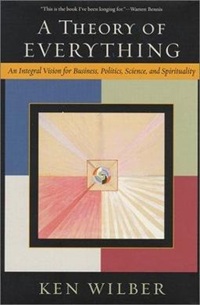
A Theory of Everything is often presented as Ken Wilber's most accessible entry point into his Integral Theory—a compact synthesis meant to unify science, psychology, culture, and spirituality into a single explanatory framework. At under 200 pages, it functions less as a rigorous argument than as a manifesto: a confident sketch of what Wilber calls an “integral vision” of reality, grounded in the idea that all domains of knowledge can be harmonized within a single meta-framework. What follows is a critical assessment of that ambition, its execution, and its underlying assumptions. The Promise of Total IntegrationWilber's central claim is disarmingly bold: reality can only be properly understood when viewed through multiple irreducible perspectives—subjective, objective, intersubjective, and interobjective—organized into his well-known AQAL model (all quadrants, all levels, etc.). The book's appeal lies precisely in this synthetic ambition. It attempts to reconcile domains typically kept separate: physics and mysticism, developmental psychology and ethics, economics and spirituality. At a rhetorical level, this is effective. The framework is simple enough to grasp and expansive enough to feel profound. It offers what many readers intuitively want: a way out of fragmentation, relativism, and disciplinary silos. As even sympathetic reviewers note, Wilber's project is “comprehensive, balanced, [and] inclusive” in aspiration. But this very inclusiveness is also where the problems begin. The Illusion of Explanatory PowerWilber's “theory of everything” is not a theory in the scientific sense. It does not generate testable predictions, specify causal mechanisms, or constrain empirical outcomes. Instead, it functions as a classificatory schema—a way of organizing phenomena after the fact. Critics have long pointed out that such frameworks risk becoming tautological: everything fits because the categories are flexible enough to accommodate anything. The AQAL model does not so much explain phenomena as redescribe them in its own vocabulary. This leads to a familiar problem in grand systems: apparent comprehensiveness substitutes for actual explanatory depth. More bluntly, the theory is difficult to falsify. Any counterexample can be absorbed by invoking another “quadrant,” “level,” or “line.” This immunizes the system against criticism but at the cost of intellectual rigor. Spiritual Metaphysics Smuggled in as SynthesisA more substantive issue is Wilber's metaphysical commitment to “Spirit” as the underlying ground of reality. While presented as a unifying hypothesis, this move effectively reintroduces a premodern, quasi-theological ontology under the guise of integration. The problem is not that metaphysics is illegitimate, but that Wilber blurs the boundary between empirical knowledge and spiritual interpretation. Scientific theories are treated as partial truths that require completion by contemplative traditions. This creates an asymmetry: science is expected to accommodate spirituality, but spirituality is rarely subjected to the same evidential scrutiny. Critics have therefore argued that the “integration” is not neutral but directional—it elevates mystical insight as the final arbiter of reality. What appears as synthesis is, in practice, a hierarchical subsumption of science under spiritual metaphysics. The Problem of Developmental Grand NarrativesWilber's reliance on stage theories of development—drawn from figures like Jean Gebser or Lawrence Kohlberg—introduces another layer of difficulty. These models are presented as universal, quasi-evolutionary progressions toward higher consciousness. Yet such stage theories are highly contested. They often rely on limited datasets, culturally biased assumptions, and normative judgments about what counts as “higher” or “more evolved.” When Wilber maps these onto global culture and history, the result can feel speculative at best and ideological at worst. His critique of “Boomeritis,” for instance, exemplifies this tendency: entire generations are pathologized as developmentally deficient. Even sympathetic readers have found this tone polemical and reductive. Style: Clarity at the Cost of PrecisionOne of the book's strengths—its accessibility—is also a liability. By simplifying his broader system, Wilber often trades precision for readability. Complex debates in philosophy of mind, sociology, or evolutionary theory are compressed into sweeping generalizations. This creates an impression of mastery without the burden of detailed argumentation. Specialists in any given field are likely to find the treatment superficial or outdated. As some reviewers note, the book can feel “overly abstract… and lacking in scientific rigor.” In effect, the text operates at a meta-level that floats above disciplinary constraints—impressive in scope, but thin in substance. The Appeal: Why It Still WorksDespite these criticisms, the book's enduring popularity is not accidental. It satisfies a genuine intellectual and psychological demand: the desire for coherence in a fragmented epistemic landscape. Wilber offers a map that reassures readers that nothing important is left out—that science, ethics, art, and spirituality all have their place in a larger whole. For non-specialists, this can be deeply compelling. It provides orientation rather than explanation, meaning rather than mechanism. In that sense, the book functions less as a theory of everything than as a worldview of everything. Final AssessmentA Theory of Everything is best understood as a grand integrative narrative rather than a genuine explanatory framework. Its strengths lie in its scope, ambition, and heuristic value; its weaknesses lie in its lack of empirical grounding, conceptual looseness, and metaphysical overreach. Wilber succeeds in diagnosing a real problem—the fragmentation of knowledge—but his solution replaces fragmentation with an equally problematic totalization. The result is a system that feels comprehensive without being genuinely explanatory, and profound without always being precise. For readers already sympathetic to integral or spiritual perspectives, the book will likely feel illuminating. For those approaching it with a demand for analytical rigor, it will read more like an elegant synthesis of assumptions than a defensible theory. In short: it is a powerful vision, but not a convincing theory of everything.
Widget is loading comments...
|