|
TRANSLATE THIS ARTICLE
Integral World: Exploring Theories of Everything
An independent forum for a critical discussion of the integral philosophy of Ken Wilber
  Frank Visser, graduated as a psychologist of culture and religion, founded IntegralWorld in 1997. He worked as production manager for various publishing houses and as service manager for various internet companies and lives in Amsterdam. Books: Ken Wilber: Thought as Passion (SUNY, 2003), and The Corona Conspiracy: Combatting Disinformation about the Coronavirus (Kindle, 2020). Frank Visser, graduated as a psychologist of culture and religion, founded IntegralWorld in 1997. He worked as production manager for various publishing houses and as service manager for various internet companies and lives in Amsterdam. Books: Ken Wilber: Thought as Passion (SUNY, 2003), and The Corona Conspiracy: Combatting Disinformation about the Coronavirus (Kindle, 2020).
Check out my other conversations with ChatGPT Boomeritis RevisitedA Critical ReviewFrank Visser / ChatGPT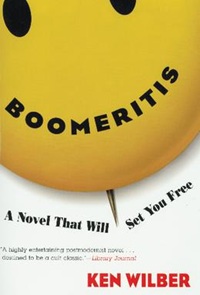
A useful way to approach Boomeritis: A Novel That Will Set You Free is to begin by stating the obvious: it is not really a novel. It is a polemical vehicle disguised as fiction, and that mismatch between form and intent defines both its ambition and its failure. A novel in name onlyWilber frames the book as a postmodern satire: a young MIT student named “Ken Wilber” navigates lectures, relationships, and intellectual debates while gradually discovering Integral Theory. What unfolds, however, is less a narrative than a scaffolding for extended didactic exposition. The “plot” is skeletal, the characters are thinly veiled mouthpieces, and the dramatic arc is repeatedly interrupted by long seminar-style lectures. This structural imbalance has been widely noted. Even sympathetic reviewers concede that the book is “little more than a thinly veiled attempt” to present Wilber's theory, with minimal narrative coherence. In effect, the fictional frame collapses under the weight of its philosophical payload. The concept of “boomeritis”At the core lies Wilber's diagnosis of a cultural pathology: “boomeritis,” a blend of postmodern relativism and narcissistic self-absorption, supposedly characteristic of the Baby Boomer generation and its cultural legacy. This is arguably the book's strongest—and most provocative—idea. Wilber identifies a genuine tension within late modern culture: the shift toward pluralism and egalitarianism can, under certain conditions, slide into epistemic relativism and performative individualism. Yet the critique is overstated and poorly calibrated. “Boomeritis” becomes a catch-all pathology, absorbing everything Wilber dislikes about postmodern culture—identity politics, anti-hierarchical thinking, cultural relativism—without sufficiently distinguishing between legitimate critiques of modernity and pathological excesses. The concept functions more as a rhetorical weapon than as a nuanced sociological category. Satire that reproduces what it attacksWilber claims the book is a parody of postmodernism, deliberately mimicking its irony, fragmentation, and self-referentiality as a reductio ad absurdum. But this strategy is double-edged. Instead of transcending postmodern style, the book often becomes indistinguishable from it. The excessive irony, the self-insertion of the author as protagonist, and the deliberately chaotic narrative do not so much critique postmodernism as embody its worst tendencies. The reader is left wondering whether the confusion is intentional satire or simply failed execution. In that sense, the book risks collapsing into the very “noetic flatness” it claims to diagnose. The problem of tone: polemic and indulgenceA persistent criticism—difficult to dismiss—is the book's tone. Wilber's disdain for “green meme” pluralism frequently slides into caricature. Opposing viewpoints are rarely engaged at their strongest; instead, they are flattened into symptoms of narcissism. This produces a curiously closed intellectual system: dissent is preemptively pathologized. Compounding this is the notorious inclusion of explicit sexual passages, which many readers find gratuitous and distracting. Critics have argued that these sections do not deepen the satire but instead undermine the philosophical seriousness of the work. Rather than functioning as meaningful literary devices, they often read like adolescent provocations inserted into an already unstable narrative. Integral theory as implicit conclusionAs in much of Ken Wilber's work, the argument is teleological: postmodernism is a necessary but pathological stage, to be overcome by the “integral” worldview. The lectures embedded in the novel systematically guide the reader toward this conclusion. But here the limitations of Wilber's broader framework become especially visible. The developmental schema—modern → postmodern → integral—is asserted rather than demonstrated. Alternative interpretations of postmodernism (as a corrective rather than a pathology) are not seriously entertained. The result is a narrative of inevitable ascent that mirrors the very grand narratives postmodernism sought to critique. Where the book succeedsDespite its flaws, Boomeritis is not without value. It offers a compressed and, at times, vivid presentation of Wilber's critique of contemporary culture. The central intuition—that pluralism can devolve into self-referential relativism—is worth grappling with. The book also provides insight into Wilber's self-understanding: he positions himself as both diagnostician and transcendence of the cultural malaise he describes. In that sense, Boomeritis functions best not as literature but as intellectual artifact—a revealing document of Wilber's attempt to engage (and outmaneuver) postmodern thought on its own terrain. Final assessmentAs a novel, Boomeritis fails: it lacks narrative discipline, convincing characters, and stylistic coherence. As satire, it is uneven and often indistinguishable from what it seeks to parody. As philosophy, it is provocative but overstated, relying heavily on caricature and developmental assumptions that are insufficiently argued. What remains is a hybrid work that illustrates both the ambition and the limitations of Wilber's project. It is a book that wants to transcend postmodernism—but ends up entangled in it. Widget is loading comments...
|