|
TRANSLATE THIS ARTICLE
Integral World: Exploring Theories of Everything
An independent forum for a critical discussion of the integral philosophy of Ken Wilber
  Frank Visser, graduated as a psychologist of culture and religion, founded IntegralWorld in 1997. He worked as production manager for various publishing houses and as service manager for various internet companies and lives in Amsterdam. Books: Ken Wilber: Thought as Passion (SUNY, 2003), and The Corona Conspiracy: Combatting Disinformation about the Coronavirus (Kindle, 2020). Frank Visser, graduated as a psychologist of culture and religion, founded IntegralWorld in 1997. He worked as production manager for various publishing houses and as service manager for various internet companies and lives in Amsterdam. Books: Ken Wilber: Thought as Passion (SUNY, 2003), and The Corona Conspiracy: Combatting Disinformation about the Coronavirus (Kindle, 2020).
Check out my other conversations with ChatGPT The Silence That Flatters BackHow Neuroscience Smuggles Mysticism Through the Back DoorFrank Visser / ChatGPT
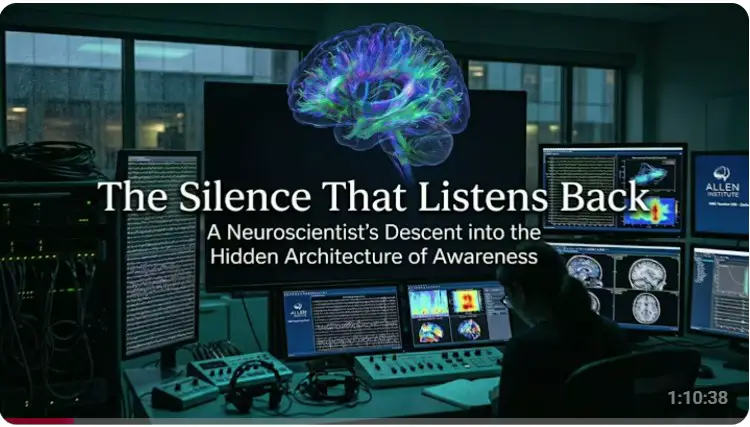 David Lane's "The Silence That Listens Back" is an impressive piece of writing. It is also a textbook example of how easily disciplined thought can slide into metaphysical indulgence—provided the slide is gradual, well-written, and emotionally compelling. Let's be clear at the outset: nothing in this story demonstrates that consciousness exists beyond the brain. What it demonstrates—quite effectively—is how certain experiences can make that conclusion feel irresistible. And that, precisely, is the problem. The Slow SeductionLane does not argue his case so much as he engineers it. The story begins in familiar territory: neuroscience labs, EEG readouts, predictive processing, careful skepticism. The tone is sober, empirical, and trustworthy. The reader relaxes into the authority of science. Then come the meditative anomalies: the fading of self, the strange “reciprocity” of silence, the unsettling sense of being observed. Still, the narrative remains cautious. Hypotheses are proposed, alternatives considered. The scientist remains in control. And then—almost imperceptibly—the ground shifts. What began as the modest claim that “the self is constructed” quietly transforms into the far more ambitious suggestion that “awareness is not produced by the brain,” and finally into the insinuation that consciousness may be fundamentally non-local. At no point is this transition explicitly argued. It simply unfolds, carried along by narrative momentum. The Old Trick in New LanguageThe key conceptual move is dressed up in contemporary jargon: “neurons don't produce consciousness—they produce privacy.” It sounds profound. It is, in fact, a rebranding of a very old idea. We have encountered this before in various guises: the filter theory of the brain, Huxley's Mind at Large, the non-dualism of Advaita Vedanta. Lane's innovation is stylistic rather than conceptual. He replaces incense with EEG caps, metaphysical speculation with computational models. But changing the vocabulary does not strengthen the argument. It merely makes an old intuition sound scientifically respectable. The Illusion of DepthThe most telling moment in the story is also the one that undermines it. When the sense of self dissolves, awareness appears impersonal, unowned, and even strangely “other.” From this, the narrative flirts with the idea that awareness might not be individual at all. Yet the story itself already provides the more parsimonious explanation: the brain, deprived of its usual self-model, misclassifies its own reflexive processes as external. The system, built to detect agency, generates the impression of “otherness” when its internal reference collapses. There is no need to invoke cosmic consciousness. The silence does not listen back. The brain, momentarily disoriented, listens to itself and fails to recognize the voice. The Romance of the GapWhat drives the entire narrative is a familiar intellectual temptation. Where explanation falters, meaning rushes in. The hard problem of consciousness—why subjective experience exists at all—remains unresolved. Into that gap, Lane inserts a possibility: perhaps awareness is not produced by the brain but merely localized by it. This sounds bold, even revolutionary. But it explains nothing. It does not clarify how awareness interacts with neural processes, why brain damage alters consciousness so systematically, or why anesthesia can extinguish it. Instead, it sidesteps these questions. Ignorance is quietly upgraded into ontology. The Coupling FantasyThe story's dramatic centerpiece—a moment of apparent synchronization between two subjects—is presented with just enough ambiguity to seem suggestive. But stripped of narrative framing, the phenomenon admits far simpler explanations: shared experimental context, synchronized expectations, and well-documented forms of physiological entrainment. From this, however, the reader is gently nudged toward a more extravagant interpretation: that consciousness itself may be shared or interconnected. This is not demonstrated. It is implied. Lane, the seasoned critic of spiritual overreach, here reenacts the very move he has long opposed: taking coincidence, wrapping it in mystery, and hinting at transcendence. The Real Insight—and Its BetrayalTo be fair, the story contains a genuinely valuable insight. The self is not the subject of consciousness but a construct imposed upon it. This aligns with contemporary neuroscience and serious contemplative traditions alike. But instead of stopping at this defensible and illuminating conclusion, the narrative overreaches. It cannot resist the next step: if the self is constructed, then awareness must be something larger, more fundamental, perhaps even universal. This does not follow. It is an unwarranted extrapolation, driven more by intuition than by argument. Why This MattersOne might object that this is merely speculative fiction. But such narratives do cultural work. They blur the boundary between science and metaphysics, lending scientific authority to spiritual intuitions and encouraging readers to mistake powerful experiences for deep truths. In this way, they re-enchant the world without doing the philosophical labor required to justify that enchantment. The Simpler ExplanationThere is, in fact, a far less glamorous account of everything described in the story. The brain constructs a self-model. Meditation can weaken that model. When it weakens, awareness feels impersonal. The mind, wired for social cognition, may interpret this as “other.” Under certain conditions, individuals can even become physiologically synchronized. No mystery is required. No metaphysical leap is necessary. Just a complex biological system behaving in unusual but intelligible ways. Conclusion: The Silence Does Not FlatterLane's story is beautifully written, and that is precisely why it is so persuasive. It flatters the reader into feeling that they have glimpsed something profound, something beyond ordinary explanation. But what they have actually encountered is a carefully staged transition from science to speculation. The silence in meditation can feel deep, even uncanny. It can strip away the sense of self and leave something that appears vast, impersonal, and intimate all at once. But feeling is not evidence. The silence does not listen. It does not observe. It does not belong to everyone or no one. It is what remains when the brain briefly suspends its most persistent narrative: that everything happening is happening to “me.” Stripped of metaphysical ornament, that insight is already profound enough. Widget is loading comments...
|