|
TRANSLATE THIS ARTICLE
Integral World: Exploring Theories of Everything
An independent forum for a critical discussion of the integral philosophy of Ken Wilber
  Frank Visser, graduated as a psychologist of culture and religion, founded IntegralWorld in 1997. He worked as production manager for various publishing houses and as service manager for various internet companies and lives in Amsterdam. Books: Ken Wilber: Thought as Passion (SUNY, 2003), and The Corona Conspiracy: Combatting Disinformation about the Coronavirus (Kindle, 2020). Frank Visser, graduated as a psychologist of culture and religion, founded IntegralWorld in 1997. He worked as production manager for various publishing houses and as service manager for various internet companies and lives in Amsterdam. Books: Ken Wilber: Thought as Passion (SUNY, 2003), and The Corona Conspiracy: Combatting Disinformation about the Coronavirus (Kindle, 2020).
Check out my other conversations with ChatGPT The Hidden Costs of Every Alternative, A Critique of the Three Scales of MindA Critical Response to John Abramson's 'The Direction That Matters'A response to John Abramson's critique of David Lane and Frank VisserFrank Visser / Claude
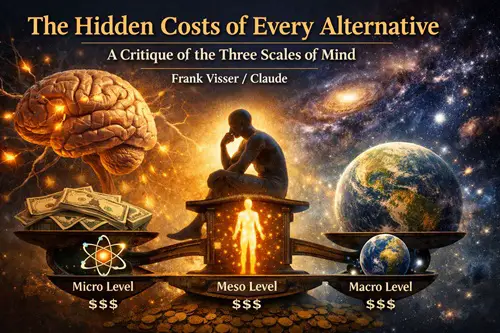 Every serious attempt to explain consciousness costs something. The materialist who reduces mind to neural firing buys simplicity at the price of explanatory adequacy—the hard problem of consciousness, why there is something it is like to be a brain state at all, remains untouched by any account of mechanism. Recognizing this, a variety of alternatives have emerged. They are often presented as liberations from the poverty of reductionism. They are not. Each purchases its explanatory gain with currency that is rarely disclosed at the point of sale. This essay examines the three positions organized by the scale at which they locate the primary subject of experience: the micro-level of fundamental particles, the meso-level of individual organisms or souls, and the macro-level of the cosmos as a whole. The aim is not to vindicate materialism but to establish that the alternatives carry debts that their proponents are sometimes reluctant to itemize. micro - Panpsychism: consciousness all the way downMicro-panpsychism holds that experiential or proto-experiential properties are intrinsic to the fundamental constituents of nature. The electron does not merely have charge and spin; it has, in however primitive a form, something like interiority. David Chalmers and Philip Goff have each offered versions of this view with admirable rigor, and its initial appeal is real: if experience exists at the macro-level, and macro-level things are composed entirely of micro-level things, then the cleanest solution is to locate experience at the base. The alternative—emergence from wholly non-experiential matter—seems, on inspection, no less mysterious than the original hard problem. The first undisclosed cost is what Goff himself calls the combination problem. If electrons have proto-experience and neurons are made of particles, how do billions of micro-experiences combine into the unified, perspectival experience of reading this sentence? This is not a technical puzzle awaiting a clever solution; it is arguably as hard as the original problem it was meant to dissolve. We have no coherent account of experiential aggregation. Two pains do not sum to a more painful pain; two visual fields do not merge into a wider field. Experience is not additive in any way that resembles physical composition. The micro-panpsychist has moved the mystery rather than eliminated it. The second cost is a quiet violation of parsimony that tends to be obscured by the view's apparent elegance. Parsimony is not simply minimizing the number of substances or categories; it also demands that the properties we posit do real explanatory work proportionate to their ontological extravagance. Attributing experiential properties to particles explains nothing about chemistry, quantum mechanics, or molecular biology. The proto-experiences of electrons play no role in any physical theory. They are passengers in a vehicle that does not need them and was not built for them. Far from offering a parsimonious unification of the mental and the physical, micro-panpsychism adds a vast layer of invisible inner life to every particle in the universe—a layer that earns its existence by solving one problem while generating another of equal depth. Third, and less often noted, micro-panpsychism inherits a problem from physics itself. The entities it attributes experience to—particles, fields, strings—are not the stable, bounded individuals the view seems to require. A quark does not have a fixed location or a continuous trajectory. The notion of an inner life requires, at minimum, something like a subject: a locus of experience with some continuity over time. It is far from obvious that the entities described by quantum field theory are the right kinds of things to bear even proto-experiential properties. meso - Emergentism and the transmission theory: mind at the organismThe meso-scale position locates consciousness at the level of the individual organism. It comes in two quite different flavors, but both share the structural feature of treating the individual human mind as the natural unit of analysis—neither dissolving it into the cosmos nor dispersing it across particles. The first flavor is emergentism: consciousness arises from sufficiently complex neural organization and is not present below that threshold. The second is the transmission or filter theory, sometimes associated with William James and Henri Bergson, which holds that the brain does not produce consciousness but rather constrains and focuses a consciousness that exists independently—the organism is a receiver, not a generator. Emergentism's undisclosed problem is that it borrows the language of solution while leaving the debt of the hard problem entirely unpaid. To say that consciousness emerges from complexity is to offer a redescription of the phenomenon, not an explanation. The word "emerges" is doing extraordinary labor here: it must span the gap between quantitative increase in neural complexity and the qualitative appearance of experience. Wetness emerging from hydrogen and oxygen is explicable because we can give a complete molecular account of the macroscopic behavior—no residue is left over. Consciousness is precisely the residue that no functional or structural account touches. Strong emergence—the kind required here, where a property appears that is genuinely novel and irreducible to its base—is not merely unexplained but arguably incoherent within a physicalist framework. If the physical facts fix all the facts, there is no room for a truly novel property to appear; if they do not fix all the facts, physicalism is already abandoned. Emergentism also faces a quiet problem of arbitrariness. What degree of complexity is sufficient? The threshold between non-conscious and conscious systems is left unspecified, and any attempt to specify it is vulnerable to the charge that the line has been drawn to fit our intuitions about which systems are conscious, rather than derived from any principled theory. This is not an incidental problem; it goes to the heart of what the theory claims to explain. The transmission theory avoids the combination problem and sidesteps strong emergence, but it does so by introducing a commitment far more metaphysically extravagant than is usually acknowledged. If consciousness exists independently and the brain merely filters it, we require an account of what this independent consciousness is, where it comes from, how it is related to physical processes in any principled way, and why different brains produce different experiential characters. The theory typically answers these questions by gesturing at a vast cosmic consciousness that is then individuated by neural structure—but this move slides quietly into the macro position discussed below, inheriting all of its problems. When the transmission theory is kept strictly at the meso level—positing individual souls that pre-exist brains—it becomes a form of substance dualism, and substance dualism's problems are well-documented: how does a non-physical soul interact with a physical brain? What units does soul-force come in? Why does brain damage alter personality and experience if the brain is only a filter? The filter can be damaged so thoroughly that it lets almost nothing through, which looks suspiciously like the brain producing experience rather than transmitting it. Both meso positions share one further structural problem: they are fundamentally reactive. They are defined by what they resist—the inadequacy of reduction—rather than by positive theoretical commitments that generate novel predictions. A theory of consciousness should in principle tell us which systems are conscious, to what degree, and why. Neither emergentism nor the transmission theory, as standardly developed, does this. macro - Cosmopsychism: consciousness as the ground of the cosmosCosmopsychism reverses the explanatory direction of micro-panpsychism. Rather than building up from proto-experiential particles to cosmic mind, it begins with a single, whole, experiential cosmos and derives individual minds as limitations or aspects of it. The universe has one vast experience; what we call individual consciousness is a kind of focalization or self-distinction within that whole. This view has respectable roots in Schelling and Schopenhauer and has been revived in contemporary analytic philosophy by thinkers such as Itay Shani and, in modified form, by Philip Goff's panpsychist cosmology. The view's genuine advantage is that it dissolves the combination problem: if the whole is prior, there is no combination of parts to explain. Individual minds are decompositions rather than compositions. But it immediately generates a decomposition problem that is just as severe. How does a single, undivided cosmic consciousness give rise to the distinct, bounded, perspectival experiences of billions of separate individuals, each with its own private access and its own point of view? The step from unity to multiplicity is no more transparent than the step from multiplicity to unity. In trading the combination problem for the decomposition problem, cosmopsychism has not solved anything—it has renamed it. The parsimony violation here is the most flagrant of the three positions. Micro-panpsychism adds experiential properties to every particle; cosmopsychism does something bolder—it attributes to the universe as a whole a unified experience more complex and fundamental than any physical property we know of. This is a single extraordinary posit rather than a distributed one, but its magnitude is unmatched. The cosmos-as-subject has no empirical handle whatsoever. It is, by construction, invisible to any experiment, since any experiment is conducted within it rather than on it. It is, in other words, a theoretical entity that cannot in principle be tested, which places cosmopsychism in a strange epistemic position: it aspires to explain the most intimate feature of reality—that it is experienced—by positing the most remote and unverifiable entity imaginable. There is also a problem of individuation that cosmopsychism tends to wave past. If the cosmos has experience, it presumably has it in a single, undivided way. But human experience is thoroughly perspectival: I experience from here, not there; I experience this rather than that; my experience is bounded by my skin and my moment. The cosmic experience, if it is to ground these features, must somehow contain spatial and temporal structure, finitude, and the asymmetry of self and world. But these are precisely the features that make individual experience what it is, and attributing them pre-emptively to the whole seems to smuggle in what was supposed to be derived. The unity of cosmic consciousness dissolves, on examination, into something that looks very much like the plurality it was meant to explain. The common threadAcross all three scales, a pattern recurs: the hard problem of consciousness is displaced rather than solved. Micro-panpsychism moves it to the combination of elementary experiences. Emergentism restates it as the mystery of strong emergence. The transmission theory moves it to the interaction of soul and body, or to the individuation of cosmic mind at the meso level. Cosmopsychism moves it to the decomposition of a cosmic subject into finite perspectives. In each case, what the view offers is a different location for the mystery, often accompanied by a rhetoric of solution that the underlying structure does not support. The honest position may be that we do not yet have the conceptual vocabulary to solve the hard problem, and that premature theoretical commitment—whether to particles with inner lives, emergent souls, or a dreaming cosmos—obscures this fact. Each alternative to materialism trades one kind of unintelligibility for another, and the trade is frequently conducted without full disclosure. Acknowledging this is not despair. It is the beginning of intellectual honesty about one of the hardest questions we have ever asked.
Comment Form is loading comments...
|