|
TRANSLATE THIS ARTICLE
Integral World: Exploring Theories of Everything
An independent forum for a critical discussion of the integral philosophy of Ken Wilber
  Frank Visser, graduated as a psychologist of culture and religion, founded IntegralWorld in 1997. He worked as production manager for various publishing houses and as service manager for various internet companies and lives in Amsterdam. Books: Ken Wilber: Thought as Passion (SUNY, 2003), and The Corona Conspiracy: Combatting Disinformation about the Coronavirus (Kindle, 2020). Frank Visser, graduated as a psychologist of culture and religion, founded IntegralWorld in 1997. He worked as production manager for various publishing houses and as service manager for various internet companies and lives in Amsterdam. Books: Ken Wilber: Thought as Passion (SUNY, 2003), and The Corona Conspiracy: Combatting Disinformation about the Coronavirus (Kindle, 2020).
Check out my other conversations with ChatGPT The Achilles Heel of Ken WilberWhy the architect of the most ambitious map of consciousness may have built on shaky groundFrank Visser / Claude
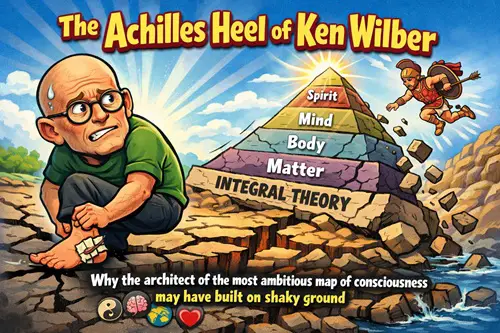 Ken Wilber is arguably the most ambitious synthesizer in the history of modern philosophy. His AQAL framework—All Quadrants, All Levels, All Lines, All States, All Types—represents a genuine attempt to weave together the hard sciences, phenomenology, developmental psychology, contemplative traditions, and social theory into a single coherent map of reality. For admirers, it is nothing less than a theory of everything. For critics, that very ambition is the tell. No single mind, however prodigious, can actually integrate everything—and Wilber's attempt, examined closely, reveals a structural flaw deep enough to be called an Achilles heel: the unacknowledged tension between his pretension to a view from nowhere and the very located, very particular cultural and philosophical tradition from which he actually speaks. The grandeur of the projectTo be fair, Wilber's achievement is real. Before AQAL, most serious thinkers operated within silos: scientists dismissed the interior life as epiphenomenal noise, humanists treated empirical findings as irrelevant to meaning, and spiritual traditions spoke past secular philosophy entirely. Wilber walked through these walls. He reminded neuroscientists that first-person experience cannot simply be reduced to third-person correlates. He reminded mystics that their experiences occur in people who also develop psychologically, socially, and cognitively—and that not all spiritual claims are equally valid simply because they feel profound. That corrective work was necessary, and much of it holds up. His concept of the pre/trans fallacy—the distinction between pre-rational magical thinking and post-rational transpersonal insight—remains one of the sharper analytical tools in the philosophy of religion. His insistence that development is not merely cognitive but spreads across multiple relatively independent lines—moral, emotional, interpersonal, spiritual—reflects genuine psychological sophistication. And his quadrant model, however criticized in its details, usefully reminds us that any phenomenon has both interior and exterior dimensions, individual and collective expressions, all of which are partially irreducible to the others. Yet it is precisely the grandeur of the project that creates the vulnerability. The higher you build, the more the quality of the foundation matters. The view from everywhere that pretends to be nowhereWilber presents AQAL as an integral meta-theory, a framework neutral enough to include all valid partial perspectives. He frequently invokes the idea that every view is correct as far as it goes—each tradition, discipline, and culture captures something real, and integration means including all of these partial truths in a larger whole. In principle, this is an admirable epistemological humility. "Every view is correct as far as it goes"—but someone still has to decide how far each view goes, which views are worthy of inclusion, and where each sits in the developmental hierarchy. That someone is Wilber. In practice, however, someone must decide which perspectives count as valid partial truths, how they rank relative to one another, and what the master framework looks like that encompasses them all. That someone, inevitably, is Wilber himself. And Wilber's own perspective is not neutral. It is deeply shaped by a particular convergence: Western analytic and continental philosophy, evolutionary metaphysics in the tradition of Hegel and Whitehead, and a spiritual orientation drawn primarily from Vedantic and Tibetan Buddhist sources, inflected by the American human potential movement of the 1970s and 80s. This is a real and interesting tradition—but it is a tradition, not a view from above all traditions. Indigenous knowledge systems, Daoist philosophy, African communitarian ethics, feminist epistemology, and non-Western political thought are not absent from Wilber's synthesis, but they typically appear already translated into his framework—slotted into pre-existing levels, quadrants, and developmental stages. The framework itself, the grid through which all of these are filtered, remains unexamined as a culturally particular product. This is the epistemological Achilles heel: the meta-theory is not as meta as it claims. The developmental ladder and its hidden politicsNowhere is this vulnerability more exposed than in Wilber's use of developmental stage theory. Drawing on Piaget, Kohlberg, Graves (Spiral Dynamics), Cook-Greuter, and others, Wilber constructs a hierarchy of psychological and cultural development running from archaic and magic-mythic stages up through rational, pluralistic, and integral levels. This hierarchy does real explanatory work. It clarifies why a child reasons differently than an adult, why rigid ethnocentrism differs structurally from mature cosmopolitanism, why dogmatic fundamentalism and postmodern relativism—though superficially very different—share a common incapacity for genuinely dialectical thinking. But the hierarchy also carries political and cultural freight that Wilber tends to underexamine. Traditional religious communities, whose worldviews Wilber codes as "amber" on the Spiral Dynamics color scheme, are placed below the "orange" rational-scientific and "green" pluralist stages that characterize educated secular modernity. This is not arbitrary—there is developmental research supporting the distinction between ethnocentric and worldcentric moral reasoning. But the mapping of entire cultures and religious traditions onto these stages slides easily from developmental psychology into cultural ranking, and the ranking system happens to place Wilber's own cohort—educated, Western, post-conventional, spiritually eclectic—near the top. Critics like Jeff Meyerhoff, Frank Visser, and Mark Edwards have pressed on this extensively. Meyerhoff's book-length critique argues that Wilber's scholarship is frequently careless—that he reads thinkers selectively, overstates the degree of consensus supporting his developmental claims, and that the empirical base for a universal hierarchy of consciousness is far thinner than Wilber acknowledges. Wilber has largely responded to such critics with dismissal rather than engagement, which is itself a symptom: a truly integral thinker should be the most aggressive interrogator of his own framework. Wilber's problematic relationship to sciencePerhaps nowhere is Wilber's intellectual vulnerability more concretely demonstrable than in his engagement with evolutionary biology—a field that sits at the very center of his worldview, yet one he has approached with striking carelessness. As Integral World founder Frank Visser has documented across dozens of essays and a peer-reviewed paper in Integral Review (2020), Wilber's treatment of evolutionary science is marked by a recurring three-part maneuver: first, he asserts that mainstream science cannot explain major transformations in evolution; second, he selectively enlists scientists whose work seems to gesture toward cosmic creativity; and third, he advances his own concept of "Eros-in-the-Kosmos"—Spirit as an active evolutionary drive—as what he has called "the only theory that can actually explain the mysteries of evolution." Each step of this maneuver is problematic. The first claim—that science fails to explain complexity—systematically underestimates what evolutionary biology, complexity science, and thermodynamics actually say. Wilber often invokes the appearance of eyes, wings, and major body plans as evidence that chance mutation cannot account for life's elaboration. But this framing misrepresents the modern evolutionary synthesis, which encompasses not just random mutation but natural selection, genetic drift, gene flow, developmental constraints, niche construction, and an expanding extended synthesis that includes epigenetics and multilevel selection. Wilber's critique lands on a caricature of Darwinism, not the living discipline. Invoking Spirit to solve problems that science is actively and successfully working on is not integration—it is premature closure dressed in metaphysical language. The second maneuver—selectively citing scientists—is equally revealing. Wilber has invoked figures like Erich Jantsch and Ilya Prigogine to suggest that complexity science implicitly supports his vision of a self-organizing cosmos driven by something like Eros. But as Visser has carefully shown, the scientific language of self-organization describes emergent order arising from energy flows and physical laws—it does not posit a directional spiritual impulse. The gap between "the universe exhibits increasing complexity under certain conditions" and "therefore Eros is guiding evolution" is not bridged by citation; it is simply assumed. More troublingly, Wilber has cited Michael Behe's intelligent design arguments as fellow-travelers in questioning Darwinian orthodoxy—an alignment that, as Visser notes, associates integral theory with a position decisively rejected by mainstream biology and the courts. The third claim—that Wilber's own theory is the uniquely adequate explanation of evolutionary mysteries—is the most audacious and the least defensible. A metaphysical postulate about Spirit-in-action is not a scientific theory. It makes no testable predictions, identifies no mechanisms, and cannot in principle be falsified. Calling it the "only" explanation is not intellectual confidence; it is the closure of inquiry masquerading as its completion. As Visser puts it, this is the "God of the gaps" strategy: find the places where science has not yet fully explained something, insert Spirit, and declare the problem solved. What makes this particularly ironic is that Wilber is, in other respects, a sharp critic of the "scientism" that reduces all reality to what third-person methods can measure. That critique has merit. But it cuts both ways: just as science should not colonize the interior life, spiritual philosophy should not colonize scientific questions by declaring them essentially solved once you accept the right metaphysics. Wilber wants science to stay in its lane while simultaneously driving his own vehicle across the median. A genuinely integral approach to evolution would require deep engagement with the actual literature—not sketchy paragraphs followed by the invocation of Eros, but a sustained reckoning with what molecular biology, paleontology, and evolutionary ecology have to say, in their own terms, before asking what a spiritual supplement might still be needed for. That engagement has never arrived. Despite decades of pointed criticism from Visser and others, Wilber has not produced a rigorous response to the evolutionary biology objections. The integral community has largely followed his lead in treating the critique as coming from thinkers operating at an insufficiently elevated developmental level—which is, of course, exactly the self-insulating move that makes the framework unfalsifiable from within. The science problem is not a peripheral embarrassment. It sits at the structural core of AQAL, because Wilber's entire account of development—cosmic, biological, psychological, cultural—depends on the claim that evolution is a spiritually directional process. Pull that thread, and much of the tapestry loosens. The problem of shadow and the irony of self-exemptionWilber is sophisticated about what Jungian psychology calls the shadow—the disowned aspects of the self that are projected outward or repressed downward. He has written about the importance of shadow work, of integrating the disowned lower levels rather than merely transcending them. Yet there is a notable irony in how Wilber has conducted himself as a public intellectual. His responses to serious philosophical criticism have often been contemptuous rather than curious. His concept of "Boomeritis"—the pathological narcissism he attributes to green-level pluralists—is described with such detail and relish that it functions less as clinical diagnosis than as polemic. He has, at various points, described critics as insufficiently evolved, trapped at lower developmental stages, unable to see what those at higher altitudes can perceive. This is the move that a developmental hierarchy makes possible and that genuine integral thinking must refuse: using the ladder to dismiss the person on the rung below rather than to understand them. The irony deepens when we note that Wilber explicitly identifies the pathology of the rational-orange level as the belief that its perspective is the final and objective truth, and the pathology of the integral-turquoise level as spiritual narcissism—the sense that one has achieved a view so comprehensive that criticism from below is merely the resentment of the not-yet-awakened. Wilber describes these pathologies with precision. His own public behavior has, on multiple occasions, illustrated them. Nonduality as both crown jewel and category problemAt the apex of Wilber's system sits nondual awareness—the recognition, available in deep contemplative practice, that subject and object are not ultimately separate, that consciousness and the world arising within it are expressions of a single nondual ground. This is the "suchness" of Zen, the rigpa of Dzogchen, the turiya of Vedanta. Wilber takes these claims seriously as reports of genuine insight, not mere subjective experience, and he argues that they must be included in any complete account of mind and reality. This is one of Wilber's most important contributions and also the site of his deepest philosophical difficulty. When nondual awareness is placed at the top of a developmental hierarchy, several problems arise simultaneously. First, many contemplative traditions—particularly Zen and Dzogchen—explicitly resist the notion that nonduality is a developmental achievement. It is described as the ever-present ground, already the case, not a state to be reached by climbing a ladder. Placing it at the apex of AQAL may actually distort the very teaching it means to honor, translating a post-developmental insight into the language of development. Second, if nondual awareness is genuinely the recognition that all perspectives arise within a single undivided awareness, then the entire apparatus of levels, quadrants, and hierarchies—Wilber's life's work—must itself appear as a kind of superimposition on that ground. Wilber is aware of this tension and addresses it, but the resolution he offers (the relative world of development is real within the absolute ground of nonduality) has always struck his more philosophically rigorous critics as a sleight of hand. You cannot both climb the ladder to the roof and simultaneously claim that the ladder and the roof were never separate from the ground. What remains standingNone of this demolishes Wilber's project. The quadrant model remains a useful heuristic for preventing reductionism. The pre/trans fallacy is a genuine contribution. The insistence that consciousness and culture develop—that not all views are equally differentiated or integrated—resists the leveling impulse of postmodern relativism in a way that matters philosophically and practically. But AQAL is not the view from everywhere. It is a view from somewhere—a specific cultural, philosophical, and spiritual somewhere that needs to be acknowledged as such. The framework's greatest insights emerge not when it is treated as the final integral meta-theory, complete and self-validating, but when it is held as one powerful and partial lens among others, subject to revision, falsification, and genuine dialogue with the traditions and critics it has too often merely annexed. Achilles, recall, was invulnerable everywhere except the heel—and it was precisely his invulnerability that made him reckless. Wilber's genius is real. But the theory's claim to have transcended the need for external critique is the tendon that holds the whole structure aloft, and the one that, struck cleanly, brings the hero down.
Widget is loading comments...
|