|
TRANSLATE THIS ARTICLE
Integral World: Exploring Theories of Everything
An independent forum for a critical discussion of the integral philosophy of Ken Wilber
  Frank Visser, graduated as a psychologist of culture and religion, founded IntegralWorld in 1997. He worked as production manager for various publishing houses and as service manager for various internet companies and lives in Amsterdam. Books: Ken Wilber: Thought as Passion (SUNY, 2003), and The Corona Conspiracy: Combatting Disinformation about the Coronavirus (Kindle, 2020). Frank Visser, graduated as a psychologist of culture and religion, founded IntegralWorld in 1997. He worked as production manager for various publishing houses and as service manager for various internet companies and lives in Amsterdam. Books: Ken Wilber: Thought as Passion (SUNY, 2003), and The Corona Conspiracy: Combatting Disinformation about the Coronavirus (Kindle, 2020).
Check out my other conversations with ChatGPT The Hidden Life of Jiddu KrishnamurtiLove, Occultism, and the Paradox of TransparencyFrank Visser / ChatGPT
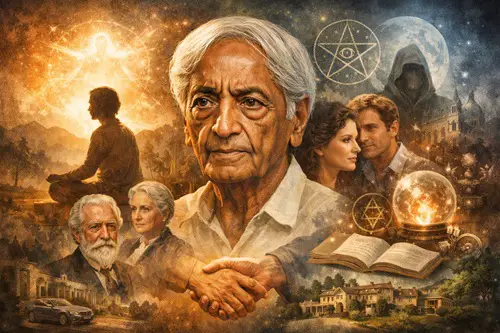 Introduction: The Myth of the Transparent SageJiddu Krishnamurti (1895-1986) is widely remembered as a teacher who rejected all authority, denounced organized religion, and insisted on radical psychological transparency. His public message was one of freedom from illusion, conditioning, and dependency. Yet behind this austere philosophical stance lies a far more complex and, at times, contradictory personal life—one that includes romantic entanglements, esoteric experiences, and a lifelong tension between the rejection and persistence of the mystical.This essay explores that hidden dimension—not to sensationalize, but to contextualize the man behind the message. Early Occult Formation: The Theosophical MatrixKrishnamurti�s early life was steeped in occultism. Discovered on a beach in Adyar by Charles Webster Leadbeater, he was declared to be the future “World Teacher” by leaders of the Theosophical Society, including Annie Besant. His upbringing was orchestrated within a framework of clairvoyance, Masters, subtle bodies, and cosmic evolution. He was trained to embody a messianic role through the Order of the Star in the East, an organization created to prepare the world for his teaching mission. During this period, Krishnamurti reportedly underwent various occult initiations and was believed by his mentors to be in contact with higher spiritual beings, often referred to as the “Masters of Wisdom.” Yet in 1929, in a dramatic and historically pivotal moment, he dissolved the Order, declaring that “truth is a pathless land.” This marked a decisive break with organized occultism—but not necessarily with the domain of inner experience itself. The “Process”: Mystical or Neurological?
Throughout his life, Krishnamurti underwent a series of intense physical and psychological episodes known as “the process.” These began in the 1920s and continued intermittently for decades. They involved severe bodily pain, altered states of consciousness, a sense of sacred presence, and sometimes apparent dissociation. Observers described these states in quasi-mystical terms: Krishnamurti would speak of an immense “otherness,” a benediction, or a vast intelligence operating through him. At times, he appeared to enter trance-like conditions or exhibit behaviors reminiscent of possession or overshadowing. The interpretive frameworks vary: • Theosophical view: These were signs of spiritual overshadowing by a higher being (initially the Maitreya). • Mystical interpretation: A form of enlightenment or contact with the sacred. • Psychological/neurological view: Possibly psychosomatic episodes, trauma responses, or atypical neurological events. Krishnamurti himself resisted all explanations. He neither affirmed nor denied their metaphysical significance, maintaining instead that the experience was “sacred” but beyond interpretation. The Hidden Love Affair: A Challenge to Detachment
Perhaps the most controversial aspect of Krishnamurti�s private life is his long-term romantic relationship with Rosalind Rajagopal, the wife of his close associate and publisher Desikacharya Rajagopal. This relationship reportedly lasted for over two decades, beginning in the 1930s. It remained secret during his lifetime and only became widely known after his death, particularly through revelations in biographies such as those by Mary Lutyens and later by Radha Rajagopal Sloss. The implications are significant: • Krishnamurti publicly advocated freedom from attachment, desire, and psychological dependence. • Privately, he sustained a deeply personal and emotionally complex relationship that involved secrecy and, arguably, betrayal. This has led critics to accuse him of hypocrisy, while defenders argue that his teachings were descriptive rather than prescriptive, and that he never claimed moral perfection. Still, the dissonance between teaching and behavior remains a central tension in assessing his legacy. Celibacy, Sexuality, and SilenceKrishnamurti rarely spoke directly about his own sexuality. In public dialogues, he addressed desire, pleasure, and attachment in abstract psychological terms, often emphasizing observation without suppression. He did not advocate traditional celibacy, nor did he promote indulgence. Instead, he framed sexuality as one expression of the human condition—neither to be condemned nor glorified. Yet the secrecy surrounding his own intimate life suggests that, despite his emphasis on openness, certain aspects of his experience remained deliberately concealed. This raises questions about the limits of his much-celebrated transparency. Relationships with Power and WealthAnother less-discussed aspect of Krishnamurti�s life is his proximity to wealth and influence. He maintained close relationships with affluent patrons and operated within a network of foundations that managed schools, properties, and publications. While he personally lived relatively simply, the institutional structure around him was substantial. Conflicts—especially with Rajagopal—led to legal disputes over publishing rights and control of his teachings. These episodes reveal a pragmatic, even strategic side to Krishnamurti, contrasting with the image of a detached, world-renouncing sage. The Final Paradox: Anti-Guru as GuruDespite his rejection of spiritual authority, Krishnamurti became a global figure whose words were treated with near-scriptural reverence. He spoke from platforms, gathered devoted audiences, and was surrounded by an aura of uniqueness. Figures such as David Bohm engaged him in deep philosophical dialogues, often treating him as an intellectual equal—or even a kind of sage. This raises a structural paradox: can one truly reject authority while functioning as an authority? Krishnamurti�s life suggests that this is far more difficult than his rhetoric implies. Conclusion: Human, All Too HumanThe hidden life of Krishnamurti does not invalidate his teachings, but it complicates them. It reveals a man shaped by extraordinary expectations, navigating intense inner experiences, and entangled in very human relationships. His legacy, therefore, is not one of pure transcendence, but of tension: • Between occult origins and rational critique • Between detachment and intimacy • Between transparency and secrecy • Between anti-authority and inevitable influence In this sense, Krishnamurti may be most interesting not as a perfected sage, but as a case study in the difficulty of living what one teaches—especially when those teachings aim at nothing less than total psychological freedom.
Comment Form is loading comments...
|