|
TRANSLATE THIS ARTICLE
Integral World: Exploring Theories of Everything
An independent forum for a critical discussion of the integral philosophy of Ken Wilber
  Frank Visser, graduated as a psychologist of culture and religion, founded IntegralWorld in 1997. He worked as production manager for various publishing houses and as service manager for various internet companies and lives in Amsterdam. Books: Ken Wilber: Thought as Passion (SUNY, 2003), and The Corona Conspiracy: Combatting Disinformation about the Coronavirus (Kindle, 2020). Frank Visser, graduated as a psychologist of culture and religion, founded IntegralWorld in 1997. He worked as production manager for various publishing houses and as service manager for various internet companies and lives in Amsterdam. Books: Ken Wilber: Thought as Passion (SUNY, 2003), and The Corona Conspiracy: Combatting Disinformation about the Coronavirus (Kindle, 2020).
Check out my other conversations with ChatGPT Truth Without a Subject?Krishnamurti and the Paradox of Contentless AwarenessFrank Visser / ChatGPT
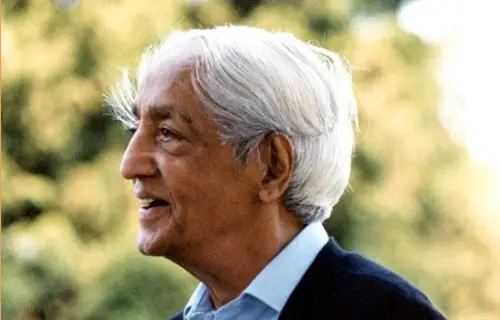 The Problem of “Capital-T Truth”When Jiddu Krishnamurti spoke of Truth with a capital T, he was not referring to factual correctness, scientific propositions, or even psychological insight. He pointed instead to an unconditioned reality that lies beyond thought, language, and belief. Truth, in this sense, is not something that can be known, formulated, or transmitted. It is not an object among other objects, nor a conclusion reached through inquiry. It is what remains when the entire machinery of thought comes to an end. This already places his notion of Truth outside conventional epistemology. It is neither propositional nor experiential in the ordinary sense. It cannot be accumulated, remembered, or verified. It is, as he famously put it, “a pathless land”—something that cannot be approached through systems, disciplines, or spiritual techniques. From Thought to AwarenessKrishnamurti's central move is to distinguish sharply between thought and direct perception. Thought, for him, is always conditioned. It is the response of memory, shaped by culture, language, and past experience. Therefore, anything produced by thought is inherently old, repetitive, and limited. In contrast, he points to a form of awareness that is immediate and non-conceptual. This awareness is not mediated by categories or interpretations. It is often described in negative terms: it is choiceless, non-judgmental, and free of the observer-observed split. At this stage, his account begins to resemble what many traditions and philosophical frameworks call “pure awareness” or “contentless consciousness.” The mind becomes still, thought subsides, and what remains appears to be a kind of silent, open presence. Is This Just Contentless Awareness?This is where a critical question arises: is Krishnamurti's “Truth” simply a refined form of contentless awareness—a minimal state of consciousness in which the mind is empty but awareness persists? At first glance, the answer might seem to be yes. His descriptions align closely with reports of states in which mental content is drastically reduced or absent. However, this interpretation risks oversimplifying his position. The key issue lies in the structure of experience itself. If “contentless awareness” still implies that someone is aware of that emptiness—however subtle or attenuated—then the duality between subject and object remains intact. There is still an observer who registers the absence of content. For Krishnamurti, this residual observer is precisely the problem. The Collapse of the ObserverA defining feature of his teaching is the claim that “the observer is the observed.” This is not a mystical slogan but a precise psychological assertion. The observer—the sense of an inner self who experiences, judges, or witnesses—is itself a construct of thought, built from memory and identification. As long as this observer persists, even in highly refined or “spiritual” forms, one remains within the field of conditioning. The statement “I am aware of emptiness” still contains the structure of duality. It presupposes a center that owns or reports the experience. Krishnamurti's notion of Truth requires the complete dissolution of this structure. What remains is not awareness for a subject, but awareness without a center. Not an experience had by someone, but the ending of the experiencer altogether. In this sense, calling it “self-experience” is, for him, a contradiction. The very term reintroduces the self he is attempting to eliminate. Phenomenology and the Minimal SelfFrom the standpoint of phenomenology, this raises a difficult issue. Many phenomenologists distinguish between the “narrative self” (the constructed identity over time) and the “minimal self” (the immediate sense of being a subject of experience). Even in highly reduced states of consciousness, some form of minimal selfhood is often thought to persist. Krishnamurti appears to go further than this tradition. He is not merely dismantling the narrative self, but also the minimal self. His claim implies the possibility of awareness that is not anchored in any subject whatsoever—a non-egological field of perception. This is a far more radical—and controversial—position. It challenges the assumption that experience necessarily entails a subject. The Critical Objection: Is Subjectless Awareness Coherent?Critics argue that the idea of awareness without a subject may be incoherent. After all, the very concept of awareness seems to imply that there is something it is like for someone. If there is no subject, in what sense can we still speak of awareness? Moreover, any report of such a state appears to require a retrospective subject who remembers and describes it. The claim “there was pure awareness” seems to presuppose a continuity of consciousness that includes a self capable of recollection. From this perspective, Krishnamurti's “Truth” risks collapsing into either paradox or unverifiability. It may describe a limit case of introspection, but one that cannot be cleanly articulated without reintroducing the very structures it seeks to transcend. Psychological Reduction or Radical Insight?A further line of critique interprets “contentless awareness” in psychological rather than metaphysical terms. On this view, what is being described is a particular altered state of consciousness—characterized by low cognitive activity, reduced self-referential processing, and a sense of calm or stillness. Such states are well-documented and can be induced through various practices. The question then becomes whether Krishnamurti is simply elevating one such state to the status of ultimate Truth. Defenders, however, argue that this misses the point. Krishnamurti is not describing a state to be achieved or repeated, but a transformation in the structure of perception itself. His language is necessarily paradoxical because it attempts to point beyond the limits of conceptual thought. Conclusion: A Productive ParadoxThe identification of Krishnamurti's Truth with “contentless awareness” is both illuminating and misleading. It captures the phenomenological flavor of what he describes—the silence of thought, the absence of conceptual content—but fails to account for his insistence on the total dissolution of the self. If there remains a subject who experiences that awareness, then for Krishnamurti, one has not yet touched Truth. But if one insists that awareness without a subject is incoherent, then his entire project appears to rest on a conceptual impossibility. This tension is not easily resolved. It marks the boundary between psychological description and metaphysical speculation, between experiential report and philosophical analysis. Whether one sees in Krishnamurti a profound insight or a subtle confusion depends largely on how one answers a single, persistent question: Can there be awareness without anyone who is aware? Appendix: Three Levels of TruthTo better situate Krishnamurti's notion of Truth, it is useful to distinguish three progressively deeper senses of “truth,” each operating within a different epistemic domain. 1. Propositional or Factual TruthThis is truth in its most familiar sense: statements that accurately describe states of affairs. Examples include scientific laws, empirical observations, and everyday claims (“water boils at 100°C,” “this is a tree”). These truths are: • Publicly verifiable • Linguistically expressible • Open to correction and refinement They belong to the domain of thought and representation. Their validity depends on correspondence, coherence, or pragmatic success within shared frameworks. Krishnamurti accepts this level but considers it limited to the functional and practical aspects of life. 2. Psychological or Insightful TruthAt a deeper level lies truth as self-understanding. This involves insight into one's own mental processes—seeing fear as it arises, recognizing patterns of attachment, or becoming aware of conditioning. These truths are: • First-person and experiential • Context-dependent and dynamic • Vulnerable to distortion by bias or interpretation Here, thought begins to observe itself. There is a reflexive dimension: the mind becomes both subject and object. While this represents a significant deepening beyond mere factual knowledge, it still operates within the structure of the observer observing. Krishnamurti places great emphasis on this level as a necessary step—but not the final one. 3. Radical or Unconditioned TruthThis is what Krishnamurti designates as Truth with a capital T. It is not a statement, nor an insight, nor an experience in the usual sense. It is: • Non-conceptual and non-representational • Independent of thought and memory • Free from the subject-object division At this level, the very structure of knowing collapses. There is no observer who knows, no object that is known. Therefore, it cannot be described, transmitted, or verified in conventional terms. This is why Krishnamurti insists that Truth cannot be sought, taught, or systematized. Any attempt to do so reduces it to the first or second level, where it becomes another object of thought. Final Note on the Threefold DistinctionThe tension in Krishnamurti's philosophy arises precisely at the transition from the second to the third level. While the first two levels are intelligible within standard epistemology and psychology, the third introduces a rupture: a claim to a form of “truth” that lies entirely outside the structures that make truth claims possible. Whether this third level represents a genuine breakthrough or a conceptual overreach remains the central point of contention in interpreting his work.
Widget is loading comments...
|