|
TRANSLATE THIS ARTICLE
Integral World: Exploring Theories of Everything
An independent forum for a critical discussion of the integral philosophy of Ken Wilber
  Frank Visser, graduated as a psychologist of culture and religion, founded IntegralWorld in 1997. He worked as production manager for various publishing houses and as service manager for various internet companies and lives in Amsterdam. Books: Ken Wilber: Thought as Passion (SUNY, 2003), and The Corona Conspiracy: Combatting Disinformation about the Coronavirus (Kindle, 2020). Frank Visser, graduated as a psychologist of culture and religion, founded IntegralWorld in 1997. He worked as production manager for various publishing houses and as service manager for various internet companies and lives in Amsterdam. Books: Ken Wilber: Thought as Passion (SUNY, 2003), and The Corona Conspiracy: Combatting Disinformation about the Coronavirus (Kindle, 2020).
Check out my other conversations with ChatGPT The Spectrum of Opinion on Large Language ModelsPromise, Peril, and the Shape of Human KnowledgeFrank Visser / ChatGPT
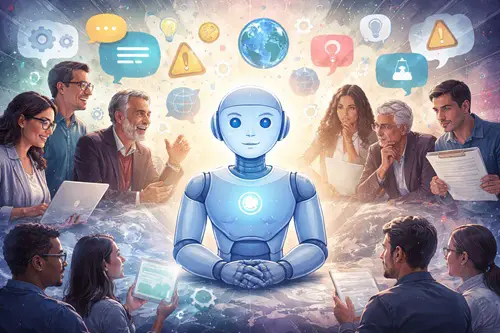 The rapid emergence of large language models (LLMs), exemplified by systems such as ChatGPT, Claude, and Gemini, has catalyzed a remarkably diverse spectrum of opinion. These systems, trained on vast corpora of human-generated text, are not merely technical artifacts; they are epistemic instruments, cultural agents, and economic disruptors. As such, reactions to them range from utopian enthusiasm to existential alarm. Understanding this spectrum requires situating LLMs within broader debates about knowledge, labor, creativity, and human autonomy. The Technological Optimists: Augmentation and AccelerationAt one end of the spectrum stand the technological optimists, who view LLMs as a profound extension of human cognitive capacity. Figures such as Sam Altman and Satya Nadella have framed these systems as “copilots” for thought—tools that enhance productivity, democratize expertise, and accelerate innovation. From this perspective, LLMs function as generalized interfaces to knowledge. They reduce the friction of accessing information, translating languages, generating code, and synthesizing complex material. In professional domains—law, medicine, programming—they promise to compress time-intensive cognitive labor into interactive dialogue. Optimists argue that this does not replace human intelligence but amplifies it, much as earlier technologies extended physical labor. There is also a strong egalitarian narrative: LLMs can provide high-quality educational support to anyone with internet access, potentially narrowing global knowledge gaps. In this view, the historical asymmetry between expert and layperson begins to dissolve. The Pragmatic Middle: Tool, Not OracleA more measured position treats LLMs as powerful but fallible tools. Researchers like Emily Bender have emphasized that these systems are fundamentally statistical models of language, not engines of understanding. They generate plausible text by predicting patterns, not by grounding statements in reality. From this standpoint, the central issue is calibration. LLMs are useful when their limitations are well understood: they can assist with drafting, brainstorming, and summarization, but they require human oversight. The phenomenon of “hallucination”—confidently presented falsehoods—illustrates the epistemic risk of overreliance. This middle position often advocates for institutional integration with safeguards. In education, for example, LLMs may be incorporated as study aids rather than banned outright. In journalism and research, they might assist in preliminary synthesis while leaving verification to human experts. The pragmatic view thus resists both hype and panic. It treats LLMs as instruments within a broader socio-technical system, whose value depends on governance, literacy, and context of use. The Critical Voices: Epistemic and Cultural DegradationMoving further along the spectrum, critics argue that LLMs may degrade the quality of knowledge and discourse. Thinkers such as Noam Chomsky have dismissed these systems as sophisticated forms of “stochastic parroting,” incapable of genuine reasoning or insight. The concern here is not merely technical but cultural. If LLM-generated text becomes ubiquitous, the distinction between original thought and algorithmic recombination may blur. This raises the specter of an epistemic feedback loop: models trained on human text generate new text that in turn becomes training data, potentially leading to homogenization and loss of intellectual diversity. There is also anxiety about the outsourcing of cognition. If individuals increasingly rely on LLMs for writing, analysis, and even decision-making, their own cognitive capacities may atrophy. This critique echoes earlier worries about calculators, search engines, and GPS—but at a higher level of abstraction, touching on language itself as the medium of thought. The Labor Perspective: Displacement and TransformationAnother axis of debate concerns labor and economic structure. LLMs are uniquely positioned to automate not manual tasks but cognitive and creative ones—copywriting, customer support, coding, even elements of scientific research. Some analysts foresee widespread job displacement, particularly in sectors that rely on routine language production. Others argue for a more nuanced transformation: roles will not disappear but will be reconfigured, with humans supervising, curating, and refining AI outputs. This debate mirrors earlier technological transitions but with a crucial difference: LLMs encroach on domains previously considered uniquely human. The question is not only how many jobs will be lost or gained, but how the meaning of work itself may shift when linguistic competence is no longer a scarce resource. The Ethical and Existential Concerns: Alignment and ControlAt the far end of the spectrum lie concerns about long-term risks and existential implications. Researchers like Eliezer Yudkowsky warn that increasingly capable AI systems could become misaligned with human values, leading to unintended and potentially catastrophic outcomes. While current LLMs are far from autonomous agents, their rapid improvement raises questions about trajectory. If future systems integrate reasoning, planning, and real-world action, the challenge of ensuring alignment becomes acute. Governance, transparency, and international coordination emerge as critical issues. Even short of existential risk, there are immediate ethical concerns: bias in training data, misuse for disinformation, erosion of privacy, and concentration of power among a few technology companies. These issues situate LLMs within broader debates about digital capitalism and regulatory oversight. The Philosophical Undercurrent: What Is Understanding?Underlying all these positions is a deeper philosophical question: what does it mean to understand? LLMs challenge traditional distinctions between syntax and semantics, imitation and comprehension. If a system can generate coherent essays, answer complex questions, and simulate dialogue across domains, does it “understand,” or is it merely performing understanding? The answer depends on one's theoretical commitments—whether one adopts a functionalist view of cognition or insists on grounding in embodiment, intentionality, or consciousness. This debate is not merely academic. It shapes how society interprets the outputs of LLMs: as authoritative knowledge, probabilistic suggestion, or something in between. Conclusion: A Technology That Reflects Its InterpretersThe spectrum of opinion on LLMs is not simply a disagreement about technology; it is a reflection of differing assumptions about human nature, knowledge, and progress. Optimists see amplification, pragmatists see tools, critics see degradation, and alarmists see risk. What is striking is that LLMs themselves are, in a sense, mirrors of this spectrum. Trained on the totality of human discourse, they reproduce not only our knowledge but our contradictions. Their role in society will ultimately depend less on their intrinsic properties than on how they are integrated, regulated, and interpreted. In that sense, the debate over LLMs is also a debate about ourselves—our epistemic habits, our institutional structures, and our willingness to confront the consequences of our own creations.
Widget is loading comments...
|