|
TRANSLATE THIS ARTICLE
Integral World: Exploring Theories of Everything
An independent forum for a critical discussion of the integral philosophy of Ken Wilber
  Frank Visser, graduated as a psychologist of culture and religion, founded IntegralWorld in 1997. He worked as production manager for various publishing houses and as service manager for various internet companies and lives in Amsterdam. Books: Ken Wilber: Thought as Passion (SUNY, 2003), and The Corona Conspiracy: Combatting Disinformation about the Coronavirus (Kindle, 2020). Frank Visser, graduated as a psychologist of culture and religion, founded IntegralWorld in 1997. He worked as production manager for various publishing houses and as service manager for various internet companies and lives in Amsterdam. Books: Ken Wilber: Thought as Passion (SUNY, 2003), and The Corona Conspiracy: Combatting Disinformation about the Coronavirus (Kindle, 2020).
Check out my other conversations with ChatGPT Crown or TwigReframing Humanity's Place in NatureFrank Visser / ChatGPT
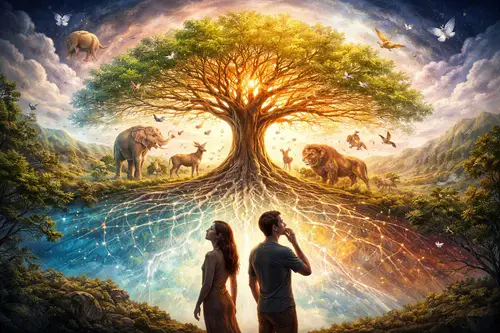 The Inherited Myth of Human CentralityFor much of human history, the idea that we occupy a privileged position in the cosmos has been almost self-evident. Religious cosmologies, especially within the Abrahamic traditions, cast humanity as the culmination of creation—a species uniquely endowed with reason, moral awareness, and often a divine mandate. The phrase “Crown of Creation” captures this sentiment succinctly: we are not just part of nature, but its purpose. This view was not merely theological; it shaped early scientific thinking as well. The so-called “Great Chain of Being” arranged all entities in a hierarchical order, from inanimate matter to plants, animals, humans, angels, and ultimately God. In this schema, humans occupied a middle but pivotal position—bridging the material and the spiritual. Even today, traces of this hierarchical thinking persist, often in subtle forms. The assumption that evolution is a progressive march toward greater complexity or consciousness reflects an implicit anthropocentrism. We see ourselves not just as one species among many, but as the measure by which all others are judged. Darwin and the Collapse of the LadderThe intellectual earthquake came with Charles Darwin and the theory of evolution by natural selection. Darwin did not merely propose a new mechanism for biological change; he dismantled the entire metaphysical scaffolding that supported human exceptionalism. In Darwin's vision, life is not arranged on a ladder but on a branching tree. Species diverge from common ancestors, adapting to local environments through blind, undirected processes. There is no inherent drive toward complexity, intelligence, or moral awareness. These traits emerge when—and only when—they confer a survival advantage. The implications are profound. Homo sapiens is not the endpoint of evolution, but one contingent outcome among millions. If we were to rewind the tape of life and let it play again, there is no guarantee that anything like humans would reappear. Our existence is not necessary, but accidental. This shift from necessity to contingency undermines the “Crown” metaphor at its core. Evolution has no foresight, no goals, and no hierarchy beyond what we impose on it. The Tree of Life is not oriented toward us; we are simply one of its many branches. The Tree of Life: A Radical DecenteringModern biology reinforces this decentering in multiple ways. Genetic research reveals deep continuities between humans and other organisms. We share a significant portion of our DNA with species as diverse as mice, fruit flies, and even plants. The boundaries between species, once thought to be rigid, are now understood as fluid and historically contingent. Moreover, when measured by ecological success, humans are far from dominant in any straightforward sense. Microorganisms, for example, have existed for billions of years, inhabit virtually every environment on Earth, and outnumber us by orders of magnitude. From a strictly biological perspective, bacteria are far more “successful” than humans. The Tree of Life metaphor captures this reality with brutal clarity. It has no top, no center, no privileged direction. Every extant species is equally “evolved,” having survived the same unbroken chain of ancestry. To call ourselves the crown is to project a human value system onto a process that is fundamentally indifferent to such valuations. The Persistence of Human ExceptionalismAnd yet, the story does not end there. Despite the leveling force of evolutionary theory, the intuition that humans are somehow special refuses to disappear. This is not merely cultural inertia; it reflects genuine differences that are difficult to ignore. Humans possess a suite of cognitive and cultural capacities that are unparalleled in the known biological world. Language allows us to transmit information across generations with high fidelity. Culture accumulates, leading to exponential growth in knowledge and technology. We build institutions, create art, formulate ethical systems, and explore the fundamental laws of the universe. Perhaps most strikingly, we are capable of self-reflection. We can step back from our immediate experience and ask questions about our origins, our nature, and our destiny. We do not merely participate in evolution; we theorize about it, critique it, and increasingly, intervene in it through biotechnology. This introduces a qualitative distinction that is hard to dismiss. While evolution may not aim at producing self-aware beings, it has, in at least one instance, done so. The emergence of reflective consciousness represents a new kind of phenomenon—one that cannot be fully captured by the language of genes and selection alone. Emergence Without TeleologyHow, then, should we interpret this uniqueness? One tempting response is to reintroduce teleology through the back door: to argue that evolution, while appearing blind, is in fact oriented toward the emergence of consciousness. This view is common in various philosophical and spiritual traditions, and finds contemporary expression in thinkers who speak of an “evolutionary drive” or “cosmic Eros.” However, this move is scientifically problematic. There is no empirical evidence that evolution has goals or directions beyond local adaptation. The appearance of progress is largely a retrospective illusion, shaped by our tendency to focus on lineages that lead to us. A more defensible position is that human capacities are emergent properties of complex systems. Given the right conditions—large brains, social structures, environmental pressures—certain forms of intelligence and culture can arise. But emergence does not imply inevitability. It is compatible with contingency and does not require any overarching purpose. In this sense, humans are not the intended outcome of evolution, but a remarkable byproduct. Our uniqueness is real, but it does not confer cosmic centrality. The Reflexive UniverseIf the “Crown” metaphor fails as a literal description, it may still hold metaphorical value when reinterpreted. Humans are the only known beings capable of understanding the processes that produced them. Through science, philosophy, and art, the universe has, in a sense, become aware of itself. This idea has been expressed in various ways by thinkers such as Carl Sagan, who famously described humans as “a way for the cosmos to know itself.” While poetic, this formulation captures something significant. Self-awareness introduces a new dimension into the natural world—one that allows for reflection, evaluation, and intentional action. But this reflexivity is a double-edged sword. The same capacities that enable us to understand the world also allow us to manipulate it on an unprecedented scale. We have become a geological force, altering ecosystems, climates, and even the genetic makeup of other species. Our position on the Tree of Life is no longer purely passive; it is increasingly active and interventionist. Between Arrogance and NihilismThe tension between “Crown” and “Twig” reflects a deeper philosophical dilemma. If we emphasize our specialness, we risk arrogance—seeing ourselves as entitled to dominate and exploit the natural world. This attitude has contributed to ecological crises that now threaten the stability of the very systems we depend on. On the other hand, if we emphasize our insignificance, we risk nihilism. If we are just another species, with no special significance, why should anything we do matter? This perspective can undermine ethical responsibility and reduce human life to a trivial episode in a vast, indifferent universe. Neither extreme is satisfactory. A more balanced view recognizes both our embeddedness in nature and our distinctive capacities. We are products of evolution, subject to the same constraints as all other organisms. But we are also agents capable of understanding those constraints and, to some extent, reshaping them. A Modest ReframingSo, are we the Crown of Creation or a twig on the Tree of Life? The most defensible answer is: neither, and both. We are not the crown in any literal, teleological sense. Evolution does not culminate in us, nor does it assign us any privileged status. But neither are we just an inconsequential twig. We are a branch that has developed the capacity for self-awareness, culture, and technological transformation. A more precise formulation might be this: humans are a contingent, emergent, and reflexive node within the Tree of Life. Our significance is not given from above, but generated from within—through our capacity to understand, evaluate, and act. This reframing carries an implicit ethical challenge. If we are not the crown by right, we might become something like it by responsibility. Not as rulers of nature, but as its stewards—aware of our power, conscious of our limitations, and accountable for the consequences of our actions. In the end, the question is less about what we are and more about what we choose to become.
Comment Form is loading comments...
|