|
TRANSLATE THIS ARTICLE
Integral World: Exploring Theories of Everything
An independent forum for a critical discussion of the integral philosophy of Ken Wilber
  Frank Visser, graduated as a psychologist of culture and religion, founded IntegralWorld in 1997. He worked as production manager for various publishing houses and as service manager for various internet companies and lives in Amsterdam. Books: Ken Wilber: Thought as Passion (SUNY, 2003), and The Corona Conspiracy: Combatting Disinformation about the Coronavirus (Kindle, 2020). Frank Visser, graduated as a psychologist of culture and religion, founded IntegralWorld in 1997. He worked as production manager for various publishing houses and as service manager for various internet companies and lives in Amsterdam. Books: Ken Wilber: Thought as Passion (SUNY, 2003), and The Corona Conspiracy: Combatting Disinformation about the Coronavirus (Kindle, 2020).
Check out my other conversations with ChatGPT The Relevance of Jiddu Krishnamurti in a Post-Ideological AgeFrank Visser / ChatGPT
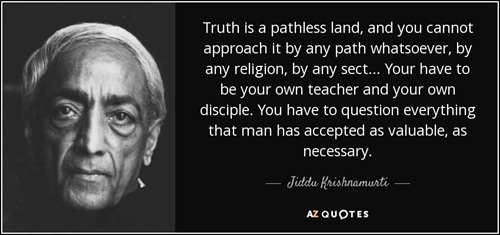 A Guru Who Rejected GurushipThe 20th century produced no shortage of spiritual teachers, but few were as radically anti-authoritarian as Jiddu Krishnamurti. Dissolving the Order of the Star in 1929—the very movement built to proclaim him a world teacher—he rejected not only organized religion but also the psychological need for gurus, systems, and metaphysical assurances. This act alone situates him as a singular figure: a “guru” who denied the legitimacy of guruship. The question, then, is not merely whether Krishnamurti is still relevant, but whether his uncompromising message has become more relevant in an age saturated with competing ideologies, identities, and digital noise. Truth as a “Pathless Land”At the core of Krishnamurti's teaching lies a simple but destabilizing proposition: truth is a pathless land. Unlike the structured spiritual systems of Helena Blavatsky or later integral syntheses such as those proposed by Ken Wilber, Krishnamurti refused all frameworks that promise gradual ascent, hidden knowledge, or evolutionary destiny. His critique cuts deeper than doctrinal disagreement; it targets the psychological machinery that produces belief itself. For Krishnamurti, the human mind is conditioned by culture, memory, and fear, and any attempt to transcend this conditioning through method only reinforces it. Psychological Conditioning in the Digital AgeThis radical psychological minimalism has striking contemporary relevance. In an era defined by algorithmic echo chambers and ideological tribalism, Krishnamurti's insistence on observing thought without identification offers a counterpoint to the compulsive need to belong, to affirm, to react. Social media environments reward precisely the kind of conditioned responses he warned against: immediate judgment, emotional reactivity, and the reinforcement of identity through opposition. His teaching anticipates what cognitive science now describes in terms of bias, heuristics, and narrative self-construction—though he arrived at these insights through introspective inquiry rather than empirical research. Choiceless Awareness vs. Self-OptimizationYet Krishnamurti's relevance is not confined to critique. His notion of “choiceless awareness” proposes a form of attention that is neither controlled nor directed toward a goal. This runs counter to modern self-help culture, which is saturated with techniques, optimization strategies, and instrumentalized mindfulness. Even practices derived from Siddhartha Gautama are often reframed as tools for productivity or stress reduction. Krishnamurti would likely regard such uses as subtle extensions of the self's desire for continuity and enhancement. His approach demands something far less comfortable: the direct perception of one's own psychological fragmentation without the refuge of method. The Paradox of the “No-Path” as ConditioningA less frequently acknowledged tension in Krishnamurti's teaching is that the rejection of all paths can itself crystallize into a path-like stance. The assertion that “there is no method” may be intellectually liberating, but psychologically it can harden into a new form of identity: the one who follows no system, who rejects all authority, who prides himself on radical freedom. In this way, the “no-path” risks becoming an inverted doctrine—a negative theology of practice. This paradox is not merely theoretical. Listeners and readers of Krishnamurti often internalize his language and posture: a vigilant suspicion of technique, a reflexive dismissal of structured approaches, and even a subtle aversion to disciplined practice. What begins as a critique of conditioning can thus become a new conditioning—defined less by belief than by negation. One becomes conditioned against being conditioned. From a psychological standpoint, this reflects a broader dynamic: the mind's tendency to convert insight into memory, and memory into pattern. Even the insight that “the observer is the observed” can be stored, repeated, and wielded as a conceptual shield rather than seen afresh. In such cases, Krishnamurti's teaching is not being lived but imitated, turning a radical inquiry into a stylized discourse. This raises a difficult question: can a teaching that denies method avoid becoming methodologized? Krishnamurti's own response would likely be that the danger lies not in the words but in the listener's relationship to them. Yet this places a considerable burden on the individual, who must detect not only conventional conditioning but also the subtler conditioning that arises from exposure to anti-conditioning rhetoric itself. In this sense, the true challenge of Krishnamurti's message may be recursive: to observe not only thought, but the appropriation of teachings about thought. The “pathless land” must remain perpetually unclaimed—even by those who declare allegiance to its pathlessness. The Charge of ImpracticalityCritics have often argued that Krishnamurti's teaching is impractical, even nihilistic. Without a path, how does one proceed? Without authority, how does one avoid confusion? These objections reveal the depth of the very conditioning he sought to expose. Krishnamurti does not offer a program because he questions the premise that transformation can be systematized. In this sense, his work resonates with certain strands of existentialism, particularly in its rejection of externally imposed meaning. However, unlike figures such as Jean-Paul Sartre, Krishnamurti does not replace lost metaphysical certainties with an ethic of self-creation. He goes further, questioning the coherence of the self that would undertake such a project. A Corrective to Modern SpiritualityIn the context of contemporary spirituality, Krishnamurti stands as a corrective to both traditional religion and its modern alternatives. The resurgence of interest in psychedelics, non-duality teachings, and integrative frameworks often reintroduces, in subtler form, the promise of transcendence or special insight. Krishnamurti's relentless deconstruction of experience itself—his warning that the experiencer is inseparable from the experienced—undermines even these refined spiritual ambitions. This places him at odds with both mystical romanticism and scientistic reductionism, occupying a difficult but intellectually rigorous middle ground. Dialogue with Science: The Bohm ConnectionHis influence, while diffuse, can be traced in the work of thinkers and educators who emphasize inquiry over doctrine. His dialogues with physicist David Bohm, for instance, explored the relationship between thought, language, and reality, anticipating later discussions in philosophy of mind and systems theory. Yet Krishnamurti resists assimilation into any intellectual tradition; to systematize his insights would be, in his view, to betray them. Conclusion: Clarity Without ComfortUltimately, Krishnamurti's relevance lies in his refusal to offer comfort. In a cultural landscape driven by certainty—whether scientific, political, or spiritual—he demands that individuals confront the instability of their own minds without mediation. This is not a message that scales easily, nor one that lends itself to institutionalization. But precisely for that reason, it retains a subversive power. Where others offer meaning, Krishnamurti offers clarity; where others construct systems, he dismantles them. If the 21st century is marked by an overload of information and a fragmentation of shared reality, then Krishnamurti's call for direct perception—free from the distortions of belief, ideology, and authority—may be less a spiritual option than a cognitive necessity. Appendix: The Tragedy of a Reluctant GuruThe life of Jiddu Krishnamurti can be read not only as a philosophical project but as a deeply human drama—one marked by a tension between projection and refusal, expectation and negation. Discovered as a boy on the beaches of Adyar by leading figures of the Theosophical Society, he was identified—most notably by Charles Leadbeater and later championed by Annie Besant—as the future vehicle of the “World Teacher.” His childhood and adolescence were shaped by an extraordinary narrative imposed upon him: that he was to become a spiritual savior for humanity. From early on, Krishnamurti appeared to resist this role, though not always explicitly. His famous dissolution of the Order of the Star in 1929 is often celebrated as an act of liberation—an unequivocal rejection of spiritual authority and messianic expectation. “Truth is a pathless land,” he declared, severing himself from the elaborate Theosophical framework that had elevated him. Yet this act, while dissolving the institutional structure, did not dissolve the projection itself. The world continued to listen. Audiences gathered. Books were published. Dialogues were held. A following, however loosely defined, persisted. Here lies the paradox: Krishnamurti rejected the role of guru, yet functionally became one. Not by intention, but by inevitability. His authority derived precisely from his denial of authority. His refusal to offer a method became, for many, a teaching more compelling than any structured path. In dismantling the apparatus of spiritual hierarchy, he inadvertently created a new kind of center—one defined by radical negation rather than affirmative doctrine. This dynamic carries a tragic dimension. Krishnamurti spent decades articulating the necessity of direct perception, of freedom from conditioning, of seeing without the interference of thought. Yet near the end of his life, he is reported to have expressed deep frustration, even despair, that no one had truly understood him. The teachings had been heard, repeated, circulated—but not, in his view, realized. The “immense energy” that had animated his inquiry, which he sometimes described in quasi-impersonal terms, seemed not to have ignited a corresponding transformation in others. One could interpret this as a failure of communication, but it may point to something more structural. If Krishnamurti's message is that truth cannot be transmitted, systematized, or followed, then the very act of teaching it is fraught with contradiction. Language inevitably codifies; listeners inevitably interpret; insight becomes memory. The teacher who denies teaching is caught in a recursive bind: to speak is already to risk misunderstanding. There is also the psychological cost of such a life. To be cast, from childhood, as a vessel for transcendent purpose is to be deprived of an ordinary identity. To later reject that role is not to erase its imprint. Krishnamurti's lifelong insistence on freedom from the self may, in part, reflect a biographical necessity: the need to dismantle a self that had been constructed for him by others. Yet the persistence of public expectation ensured that he could never fully step outside the role he had repudiated. In this light, Krishnamurti's final reflections acquire a poignant ambiguity. When he lamented that no one had understood him, was this a judgment on his audience, or an acknowledgment of the inherent limits of his enterprise? And when he spoke of an immense, almost sacred energy that had been present in him, was this a metaphysical claim, or a retrospective attempt to make sense of a life lived under extraordinary pressure? The tragedy, then, is not simply that a boy was chosen to be a guru against his will. It is that even in rejecting that destiny, he could not escape it. His life illustrates the tenacity of projection—how deeply the human need for authority, meaning, and guidance can reassert itself, even in the face of its most articulate critique. In the end, Krishnamurti may have succeeded in exposing illusion, but not in preventing its return. That, perhaps, is the final and inescapable irony of his legacy.
Comment Form is loading comments...
|