|
TRANSLATE THIS ARTICLE
Integral World: Exploring Theories of Everything
An independent forum for a critical discussion of the integral philosophy of Ken Wilber
  Frank Visser, graduated as a psychologist of culture and religion, founded IntegralWorld in 1997. He worked as production manager for various publishing houses and as service manager for various internet companies and lives in Amsterdam. Books: Ken Wilber: Thought as Passion (SUNY, 2003), and The Corona Conspiracy: Combatting Disinformation about the Coronavirus (Kindle, 2020). Frank Visser, graduated as a psychologist of culture and religion, founded IntegralWorld in 1997. He worked as production manager for various publishing houses and as service manager for various internet companies and lives in Amsterdam. Books: Ken Wilber: Thought as Passion (SUNY, 2003), and The Corona Conspiracy: Combatting Disinformation about the Coronavirus (Kindle, 2020).
Check out my other conversations with ChatGPT
A CONVERSATION WITH RUPERT SHELDRAKE
Rupert Sheldrake and the Evo-Devo Revolution Rupert Sheldrake, Morphogenetic Fields, Reply to Frank Visser Sheldrake Revisited, More on Sounds, Fields and the Origin of Form Science, Sheldrake, and the Battle Over Morphogenesis Three Theories of Morphogenesis: A Critical Appraisal of Sheldrake's Framing Morphic Resonance or Rhetorical Resonance?, A Critical Evaluation Three Theories of MorphogenesisA Critical Appraisal of Sheldrake's FramingFrank Visser / ChatGPT
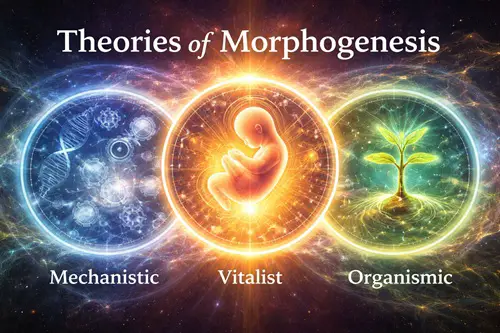 Introduction: A Familiar Critique with Strategic FramingIn the essay "Three Theories of Morphogenesis (Mechanistic, Vitalist and Organismic)", Rupert Sheldrake revisits a long-standing theme in his work: the alleged explanatory inadequacy of mechanistic biology and the need for a more holistic, field-based understanding of morphogenesis. While the text is presented as a balanced overview of three traditions—mechanistic, vitalist, and organismic—it is, in substance, a carefully structured argument designed to destabilize confidence in mainstream biology and reopen conceptual space for his own morphic resonance hypothesis (though not yet fully introduced in the excerpt). The essay is rhetorically effective, historically informed, and conceptually ambitious. However, it exhibits several recurring weaknesses: selective skepticism toward mechanistic explanations, asymmetrical standards of evidence, and a tendency to conflate “currently unexplained” with “in principle inexplicable.” These issues become increasingly evident as the argument unfolds. The Construction of the “Problem” of MorphogenesisSheldrake begins by emphasizing that morphogenesis remains “one of the great unsolved problems of biology.” This is technically correct but rhetorically loaded. By stressing phenomena such as regeneration, regulation, and the emergence of form, he frames development as deeply mysterious and resistant to reductionist explanation. However, this framing glosses over the substantial progress made in developmental biology over the past decades. Fields such as evolutionary developmental biology (evo-devo), systems biology, and bioelectric signaling (ironically including work by Michael Levin, whom Sheldrake cites) have provided increasingly detailed mechanistic accounts of pattern formation. These accounts do not yet yield a fully predictive theory, but they do not leave the field in the explanatory vacuum Sheldrake suggests. The key move here is epistemic inflation: unsolved problems are presented as fundamentally intractable, thereby justifying the exploration of alternative paradigms. Mechanistic Biology: A Straw Man with Technical DepthThe section on mechanistic theories is the most detailed and, at first glance, the most balanced. Sheldrake accurately describes gene regulation, protein synthesis, and morphogen gradients, demonstrating familiarity with molecular biology. However, the critique that follows relies on a subtle but crucial shift. He argues that: • Genetic similarity (e.g., humans and chimpanzees) undermines gene-based explanations of form. • Identical DNA in different body parts implies that genes cannot explain patterning. • The leap from protein synthesis to large-scale structure remains unexplained. These points are not trivial, but they are framed misleadingly. Modern developmental biology does not claim that DNA alone determines form in a simple, one-to-one manner. Rather, it emphasizes regulatory networks, gene expression dynamics, epigenetic factors, and multi-scale interactions. The “genetic program” metaphor, which Sheldrake critiques, is already considered an oversimplification within the field itself. Thus, the critique largely targets an outdated or naïve version of mechanistic biology, not its current systems-level formulations. The “house builds itself” analogy is rhetorically powerful but analytically weak. It ignores the fact that self-organization, far from being a hand-waving concept, is a rigorously studied phenomenon in physics and biology, with well-defined principles (e.g., reaction-diffusion systems, attractor dynamics, and nonlinear feedback loops). The Genome Wager: Rhetoric over RelevanceThe discussion of the “Genome Wager” is presented as a decisive challenge to mechanistic biology. Sheldrake frames the inability to predict a full organism from its genome as evidence against the mechanistic paradigm. This is a category error. No serious biologist claims that genome sequence alone, in isolation from environmental and developmental context, is sufficient for full prediction. Development is inherently a dynamical process involving initial conditions, stochasticity, and multi-level interactions. The wager thus functions more as a rhetorical device than a scientifically meaningful test. It sets up an unrealistic benchmark and then treats its non-fulfillment as evidence of theoretical failure. Vitalism: Rehabilitated but Not RedeemedSheldrake's treatment of vitalism, particularly Hans Driesch's concept of entelechy, is more sympathetic than one might expect. He acknowledges its dualistic nature but emphasizes its attempt to account for regulation and wholeness. The key problem remains: entelechy is explicitly non-physical and causally opaque. Even with appeals to quantum indeterminacy, the mechanism of interaction between entelechy and physical processes remains unspecified. Sheldrake himself concedes that this “action of unlike on unlike” is conceptually unsatisfactory. What is notable is that vitalism is not rejected on empirical grounds but on metaphysical discomfort. This leaves the door open for its reintroduction under a different conceptual guise—precisely what happens in the transition to organismic theories. Organicism: Productive Ambiguity or Conceptual Evasion?The organismic approach, centered on morphogenetic fields, is presented as a middle path between mechanistic reductionism and vitalist dualism. Sheldrake highlights its intellectual lineage (Gurwitsch, Spemann, Waddington, Thom) and its compatibility with modern developments. However, the central issue is repeatedly acknowledged but never resolved: the nature of these fields remains undefined. Are they physical, informational, mathematical, or something else entirely? This ambiguity is framed as a strength—allowing openness and flexibility—but it also undermines explanatory power. A concept that “could be any, or all or none” of several possibilities risks becoming unfalsifiable. Sheldrake is aware of this tension. He notes that if morphogenetic fields are fully reducible to known physics, they add nothing; if they are not, they require new principles. Yet he does not specify what these principles are or how they could be empirically tested. This is the critical juncture where the essay transitions from critique to implicit advocacy. The inadequacies of existing frameworks are emphasized, while the alternative remains suggestive rather than concrete. Teleology ReintroducedA recurring theme is the reintroduction of teleology—development directed toward goals or attractors. While modern dynamical systems theory does employ concepts like attractors, these are not teleological in the classical sense; they do not imply foresight or purpose, only stability within a system's phase space. Sheldrake blurs this distinction, aligning organismic theories with goal-directed processes in a stronger sense. This move subtly reopens the door to metaphysical interpretations while maintaining a quasi-scientific vocabulary. Conclusion: A Strategic Critique with Asymmetric StandardsSheldrake's essay is best understood not as a neutral survey but as a strategic intervention. It performs three key moves: • It amplifies the unresolved aspects of mechanistic biology while downplaying its successes. • It rehabilitates historically marginalized alternatives (vitalism and organicism) by presenting them as responses to genuine problems. • It prepares the conceptual ground for a non-standard explanatory framework—presumably morphic resonance—without yet fully articulating it. The central weakness lies in the asymmetry of standards. Mechanistic biology is criticized for its current limitations, while alternative frameworks are evaluated primarily for their conceptual appeal rather than their empirical rigor. In effect, the essay operates more as a philosophical provocation than a scientific argument. It raises legitimate questions about form, organization, and development, but its proposed direction remains speculative and underdetermined. For readers already inclined toward holistic or non-reductionist perspectives, it will be persuasive. For those grounded in contemporary developmental biology, it will appear as a sophisticated but ultimately unconvincing critique that underestimates the explanatory trajectory of the mechanistic paradigm.
Widget is loading comments...
|