|
TRANSLATE THIS ARTICLE
Integral World: Exploring Theories of Everything
An independent forum for a critical discussion of the integral philosophy of Ken Wilber
 Jan Krikke is a former Japan correspondent for various media and former managing editor of Asia 2000 in Hong Kong. He pioneered the study of axonometry, the Chinese equivalent of European linear perspective overlooked by Jean Gebser. He is the author of several books, including Leibniz, Einstein, and China, and the editor of The Spiritual Imperative, a macrohistory based on the Indian Varna system by feminist futurist Larry Taub. Jan Krikke is a former Japan correspondent for various media and former managing editor of Asia 2000 in Hong Kong. He pioneered the study of axonometry, the Chinese equivalent of European linear perspective overlooked by Jean Gebser. He is the author of several books, including Leibniz, Einstein, and China, and the editor of The Spiritual Imperative, a macrohistory based on the Indian Varna system by feminist futurist Larry Taub.
The View From SomewhereA Reply to Frank Visser on consciousness and intelligenceJan Krikke / Qwen
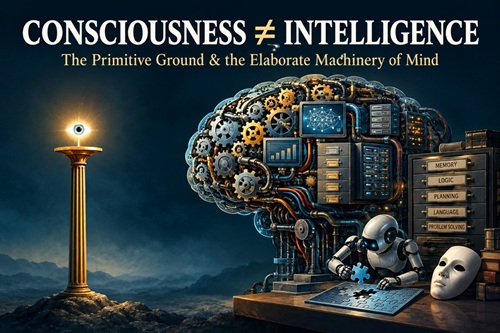 Frank Visser's essay "Consciousness and Intelligence," written with ChatGPT, is careful and fair.[1] It separates two meanings of "primitive": cognitively elementary and ontologically fundamental. It notes that the immediacy of experience can hide complex mechanisms. It warns that an unsolved problem is not a license to treat its subject as ultimate reality. It ends by asking for neither a "dismissive label" nor a "universal spiritual explanation." I agree with much of that caution. My concern lies elsewhere. The essay presents its case as a scientific approach. On inspection it is an argument conducted inside one intellectual tradition, the Western analytic philosophy of mind, in which phenomenal consciousness, the hard problem and the contrast between first-person and third-person evidence set the terms.[2] Its vocabulary, its distinctions and its standards of proof come from that tradition. That origin does not make the essay wrong. It does shape which questions seem natural and which seem strange, and it matters when the target is "contemplative traditions" that never agreed to those terms. A reader from India or China would find several of the essay's questions unfamiliar as posed. I do not say they are unanswerable. I ask that each tradition be described as its own defenders would describe it before it is judged. The split inside the questionThe essay's key move is a pair of distinctions. One separates how we know the world from what the world is. The other separates first-person experience from third-person observation. "An epistemic starting point is not necessarily an ontological foundation," the essay says, and within its frame the point is sound. A distinction between knowing and being need not mean two substances, and careful philosophers do not draw it that way. Still, both distinctions frame the question as a subject facing a world. That picture runs from Descartes through Kant to modern philosophy of mind, and it is the picture Advaita Vedanta contests.[3] For Shankara, the knower, the known and the act of knowing are not three separate things. The apparent gap between them is the error to be corrected.[4] Neither side is excused from argument. Advaita must show why non-duality is the better starting point, and the analytic tradition must show the same for its own. Yogacara Buddhism, which rejects a permanent self, also denies that knower and known are separate, though by another route.[5] Chinese thought mostly did not build the gap into its basic terms. There were exceptions, such as Xunzi's separation of Heaven from humanity and the Mohist study of knowledge, but they did not become the dominant frame.[6] The word xin is usually translated "mind," but it means heart-mind. It thinks, feels, intends and judges in one organ. Mencius found the roots of moral perception in it, and the Neo-Confucian Wang Yangming taught that knowing and acting are one process.[7] Classical Chinese had no everyday word for "consciousness" in the modern sense. The Buddhist term yishi 意識 (Sanskrit manovijnana) existed for the sixth, thinking consciousness, but its modern use as the general word came through the Japanese translation of the Western term.[8] To ask a Chinese thinker whether consciousness is "primitive" or fundamental is to bring the problem along with the question. The essay's opponents inside the West, the idealists and panpsychists who treat consciousness as fundamental, seldom leave this frame either.[9] They keep the same terms, phenomenal consciousness and first-person versus third-person, and argue only about which comes first. The quarrel inside the West stays inside one picture. Therapy or knowledge?The essay sorts the contemplative traditions into two piles. Meditation yields "useful psychological insights." A "therapeutic or phenomenological insight does not automatically establish an ontological conclusion." The sorting is generous in tone, but the Western framework makes it, not the traditions. Indian philosophers argued about exactly this question, and with rigor. Their schools disputed which ways of knowing (pramana) are valid. Carvaka admitted only perception, Buddhist logicians treated testimony as a kind of inference, and Nyaya and Vedanta accepted testimony in its own right. Several schools also treated the direct seeing trained by yoga as a special kind of perception. Nyaya built a formal logic of debate. A tradition that spent centuries refining its theory of knowledge did not mistake therapy for metaphysics.[10] It also produced detailed psychology. Buddhist Abhidharma breaks mental life into dozens of momentary factors and describes how they combine. Yogacara adds a model with eight layers of consciousness. Samkhya traces how matter unfolds first into intellect, then ego, mind, senses and the physical elements. These are theories of mind, built from observation and argued against rivals. They are not spiritual advice.[11] The irony is that the essay's own positive view reaches a conclusion close to one of them. It says the self is better understood as "a collection of interacting capacities and processes" than as a single, indivisible entity. That is close to the Buddhist five aggregates. The resemblance is probably independent, since Hume's bundle theory is usually treated as his own. But the Buddhist version came with a sustained program of contemplative training, which Hume's account lacked.[12] The witness that is not an objectThe section called "The Myth of the Inner Witness" argues that if we search for the observer "as though it were an object inside the mind," we find only more thoughts and sensations, and an infinite regress may follow. The essay adds that this "does not make the experience of witnessing unreal," which is a fair qualification. But the search does fail, and that does not show that the witness is absent. It also does not touch Advaita. Think of an eye. It sees everything except itself. Nobody concludes that the eye does not exist. Advaita says something similar of the witness. The Brihadaranyaka Upanishad says, in effect, that you cannot see the seer of seeing. The Kena Upanishad says, in effect, that what speech cannot express is that by which speech is expressed.[13] The witness is never found among objects because it is never an object. It is the one for whom there are objects. There is one difference. An eye can be seen in a mirror, but Advaita holds that awareness needs no mirror. It is self-evident and known by being itself, not by a further act of knowing.[14] The analogy only illustrates the logic. An eye has properties that can be checked from outside, and awareness has no such properties, so the analogy cannot show that a witness exists. So the tradition reaches the critic's premise by its own road and draws a different conclusion. The critic reads the failure to find the witness as a sign that nothing is there. Advaita reads it as what awareness is. That is why its teachers tell students to stop searching for an object and to notice the knowing itself. The essay's most natural target may be the popular nondual teaching that presents awareness as "the ever-present background of all experience." That version deserves the criticism. But "some forms of Advaita Vedanta" and "certain Buddhist meditation traditions" are named in one paragraph and then dropped, and a reader would not learn that those traditions already contain the objection. Whether Advaita is right is a separate question. Buddhists have long argued that awareness may be a stream of events with no one behind it, and that a self-luminous witness goes beyond what experience shows.[15] Advaita replies that events could not be known without a constant awareness in which they appear. The dispute is internal to Asian philosophy, not Western skepticism against Eastern insight. The regress argument does not settle it, because Advaita already agrees with it. Two terms, two traditionsEven the pairing of "consciousness" and "intelligence" is a Western framing. In the Indian map of the mind called the antahkarana, the "inner instrument," intelligence (buddhi) is one function of the mind, alongside manas, ahamkara and chitta. Awareness is not another function. The mind seems aware because it reflects awareness, as a mirror reflects light.[16] The essay's thesis that consciousness is not intelligence is therefore built into the tradition. Vedanta reaches it for a different reason and asks a different next question: what stands behind the instrument? The artificial intelligence section shows the difference. It asks, of a machine, "does anything appear to it from its own point of view?" That is the question of a subject with a perspective, and it assumes the picture described above.[17] In the Indian map, a language model looks like a very capable instrument. Whether an instrument is also a knower is not settled by how fluent it is. The essay also notes that "the capacity to suffer" may matter morally independently of intelligence. That is one Western route to moral standing.[18] Confucian thought starts from relationships.[19] A parent, a teacher or a neighbor has duties because of roles and ties, not because of a private inner state. A Confucian asking whether a care robot deserves consideration would ask what the relationship demands of the people around it. That is not a worse question. It is a different one, and it gives different answers. Four approaches side by sideThe columns name approaches, not civilizations, and each simplifies a tradition with many internal disputes.[20]
Samkhya is omitted for space. Chinese Buddhism, which carried Yogacara to China through Xuanzang's translations, belongs to both the second and fourth columns. Spinoza, Husserl and Merleau-Ponty do not fit the first. Where the burden fallsStarting points shape how each tradition reads new evidence, but they do not replace it. The essay says that the evidence from the brain "places a substantial burden" on theories that treat consciousness as entirely independent of biology. The evidence is real. Anesthesia, brain injury and sleep all change experience. A theory in which the brain is an instrument or channel for awareness can accommodate these facts, as William James suggested.[21] But such a theory must explain why particular injuries cause particular losses, and it owes predictions that tell it apart from the standard view. The Indian models treat the mind, not the brain, as the instrument, and they do not make James's claim. Compatibility is a starting point, not a victory. A fairer comparisonI do not claim that Visser's conclusions are mistaken. Consciousness may well depend on the brain, and the "universal spiritual explanation" he criticizes deserves criticism. My claim is narrower. Doing science and working inside the Western analytic framework are not the same thing, yet the essay often treats them as one. A fairer comparison would let each tradition answer in its own terms. Each would first be described as its own defenders would describe it, and only then criticized, by the others and by the evidence. It would ask what Abhidharma, Samkhya, Advaita and the Confucian account of xin each say about awareness, intelligence and the self, and where they disagree with each other. It would then ask what the Western tradition can test that the others cannot, and what the others have analyzed that it has not. No tradition comes out of that comparison as the neutral referee, and none is exempt from argument or evidence. Every view is a view from somewhere. The honest course is to say where, and then to defend it. Notes1. Frank Visser with ChatGPT, "Consciousness and Intelligence: The Primitive Ground and the Elaborate Machinery of Mind," Integral World, October 2026,. All quotations from Visser are from this essay. 2. David J. Chalmers, "Facing Up to the Problem of Consciousness," Journal of Consciousness Studies 2, no. 3 (1995): 200-219; Thomas Nagel, "What Is It Like to Be a Bat?," Philosophical Review 83, no. 4 (1974): 435-50; Ned Block, "On a Confusion about a Function of Consciousness," Behavioral and Brain Sciences 18, no. 2 (1995): 227-47. 3. René Descartes, Meditations on First Philosophy, in The Philosophical Writings of Descartes, vol. 2, trans. John Cottingham, Robert Stoothoff, and Dugald Murdoch (Cambridge: Cambridge University Press, 1984), Meditations 2 and 6; Immanuel Kant, Critique of Pure Reason, trans. Paul Guyer and Allen W. Wood (Cambridge: Cambridge University Press, 1998). 4. Eliot Deutsch, Advaita Vedanta: A Philosophical Reconstruction (Honolulu: East-West Center Press, 1969). 5. Dan Lusthaus, Buddhist Phenomenology: A Philosophical Investigation of Yogacara Buddhism and the Ch'eng Wei-shih lun (London: RoutledgeCurzon, 2002). 6. Xunzi, ch. 17, "Discourse on Heaven," in Xunzi: The Complete Text, trans. Eric L. Hutton (Princeton: Princeton University Press, 2014); A. C. Graham, Later Mohist Logic, Ethics and Science (Hong Kong: Chinese University Press; London: School of Oriental and African Studies, 1978). 7. Mencius 2A6 and 6A6, in Mencius, trans. D. C. Lau (London: Penguin, 1970); Wang Yangming, Instructions for Practical Living and Other Neo-Confucian Writings, trans. Wing-tsit Chan (New York: Columbia University Press, 1963). 8. 8. Han Cheng-hua 韓承樺, "Yishi: Cong 'xueshu' dao 'zhengzhi' changyu de gainian nuoyong, 1890–1940" 意識:從「學術」到「政治」場域的概念挪用 (1890–1940) [Consciousness: The appropriation of a concept from the academic to the political field, 1890–1940], Dongya guannianshi jikan 東亞觀念史集刊 [Journal of East Asian Conceptual History], no. 2 (June 2012): 129–78. For the older Buddhist usage, see Lusthaus, Buddhist Phenomenologygy. 9. Galen Strawson, "Realistic Monism: Why Physicalism Entails Panpsychism," Journal of Consciousness Studies 13, nos. 10-11 (2006): 3-31; Philip Goff, Galileo's Error: Foundations for a New Science of Consciousness (New York: Pantheon, 2019); Bernardo Kastrup, The Idea of the World: A Multi-Disciplinary Argument for the Mental Nature of Reality (Winchester: Iff Books, 2019). 10. Bimal Krishna Matilal, Perception: An Essay on Classical Indian Theories of Knowledge (Oxford: Clarendon Press, 1986); Stephen H. Phillips, Epistemology in Classical India: The Knowledge Sources of the Nyaya School (New York: Routledge, 2012). 11. Bhikkhu Bodhi, ed., A Comprehensive Manual of Abhidhamma (Kandy: Buddhist Publication Society, 1993); Lusthaus, Buddhist Phenomenology; Gerald J. Larson, Classical Samkhya: An Interpretation of Its History and Meaning, 2nd ed. (Delhi: Motilal Banarsidass, 1979). 12. David Hume, A Treatise of Human Nature (1739-40), bk. 1, pt. 4, sec. 6; Steven Collins, Selfless Persons: Imagery and Thought in Theravada Buddhism (Cambridge: Cambridge University Press, 1982); Alison Gopnik, "Could David Hume Have Known about Buddhism? Charles François Dolu, the Royal College of La Flèche, and the Global Entanglements of Enlightenment," Hume Studies 35, no. 1 (2009): 5-28. Gopnik argues for a possible route of transmission; the case remains debated. 13. Bṛhadāraṇyaka Upaniṣad 3.4.2; Kena Upaniṣad 1.4–5, in Upaniṣads, trans. Patrick Olivelle (Oxford: Oxford University Press, 1996). The text paraphrases these passages. 14. Deutsch, Advaita Vedanta, on the self-luminosity (svayamprakasha) of awareness. 15. Jay L. Garfield, trans., The Fundamental Wisdom of the Middle Way: Nagarjuna's Mulamadhyamakakarika (New York: Oxford University Press, 1995), ch. 3; Collins, Selfless Persons. 16. Sadananda, Vedantasara, trans. Swami Nikhilananda (Mayavati: Advaita Ashrama, 1931); Larson, Classical Sa?khya. 17. David J. Chalmers, "Could a Large Language Model Be Conscious?," Boston Review, August 9, 2023; Nagel, "What Is It Like to Be a Bat?" 18. Peter Singer, Animal Liberation (New York: New York Review/Random House, 1975). 19. Roger T. Ames, Confucian Role Ethics: A Vocabulary (Honolulu: University of Hawai'i Press, 2011); Mark Coeckelbergh, "Robot Rights? Towards a Social-Relational Justification of Moral Consideration," Ethics and Information Technology 12, no. 3 (2010): 209-21. 20. The table summarizes material cited in notes 3-19. 21. William James, Human Immortality: Two Supposed Objections to the Doctrine (Boston: Houghton, Mifflin, 1898). James's transmission theory is a different claim from the Indian instrument models.
|