|
TRANSLATE THIS ARTICLE
Integral World: Exploring Theories of Everything
An independent forum for a critical discussion of the integral philosophy of Ken Wilber
 Jan Krikke is a former Japan correspondent for various media and former managing editor of Asia 2000 in Hong Kong. He pioneered the study of axonometry, the Chinese equivalent of European linear perspective overlooked by Jean Gebser. He is the author of several books, including Leibniz, Einstein, and China, and the editor of The Spiritual Imperative, a macrohistory based on the Indian Varna system by feminist futurist Larry Taub. Jan Krikke is a former Japan correspondent for various media and former managing editor of Asia 2000 in Hong Kong. He pioneered the study of axonometry, the Chinese equivalent of European linear perspective overlooked by Jean Gebser. He is the author of several books, including Leibniz, Einstein, and China, and the editor of The Spiritual Imperative, a macrohistory based on the Indian Varna system by feminist futurist Larry Taub.
What the Pattern Made VisibleA Reply to Frank VisserJan Krikke / Claude
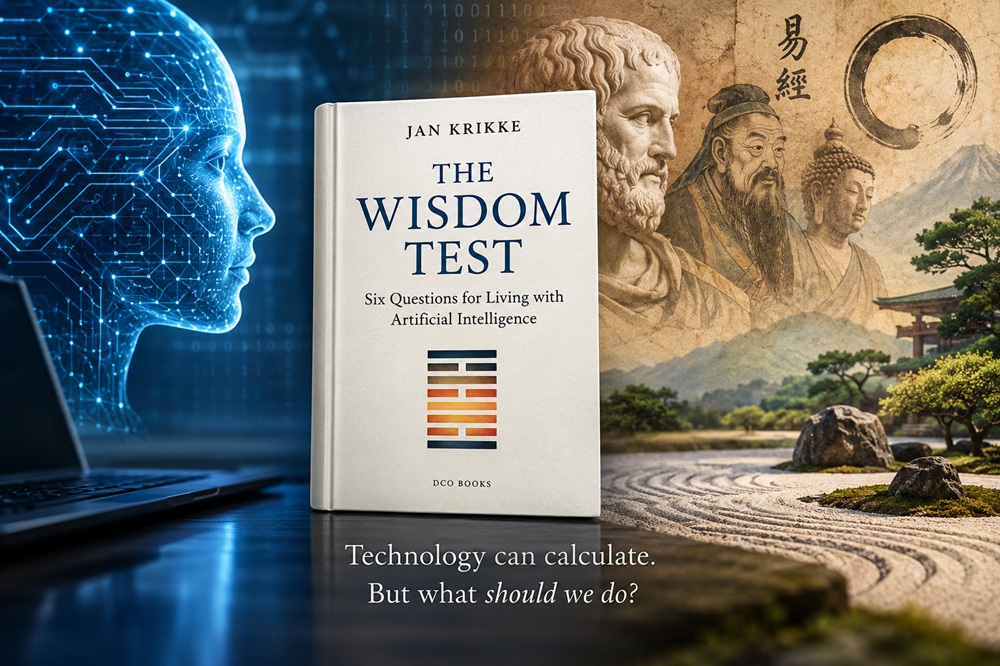 Frank Visser's review of The Wisdom Test is the kind of reading an author hopes for. It is generous where the book earns it and pointed where it is exposed. It also ends with a question worth taking seriously: if the book asks AI outputs to justify their patterns, shouldn't the book's own cross-cultural synthesis face the same test? I accept that challenge. I want to use it to sharpen two points in the review rather than simply defend the book. The first is that the book's architecture is not really organized along an East-West line. The second is that the review itself, credited to "Frank Visser / Claude," offers an unusually clean case study in exactly the problem it raises. First, what the review gets right. Visser identifies what I consider the book's core: the shift from asking what AI can do to asking who chose its goals, who bears its risks, and whether it leaves us more or less able to judge. He is persuaded by the arguments on skill atrophy and on the hollowness of a nominal "human in the loop." I am glad those landed. They are the parts of the book I most want readers to carry into their workplaces and institutions. Not East versus WestVisser's central criticism is that the book's architecture reproduces an East-West contrast it explicitly rejects. Part I tells how intelligence became calculation; Part II offers the "lost languages of wisdom." The effect, he argues, is a Western trajectory of calculation set against Eastern traditions that preserve alternatives. But look at who is in Part II. The first of the lost languages is Greek. Aristotle opens the section, and Visser himself calls that chapter the book's strongest resource. He is right that phronesis is not an Eastern corrective to Western rationalism but a major strand of Western thought. That is precisely why it sits where it does. The book's real axis is not geographic. It runs between modern computational culture, which treats judgment as something that can be specified and optimized, and older traditions of practical judgment, which treat it as something cultivated. Athens belongs on the same side of that line as Qufu and Varanasi. What Part I describes is not "the West" but one modern habit of mind, now shared by engineers in Shenzhen and Bangalore as much as in California. The harder question: what does "lost" mean?The review's title asks a sharper question than its body pursues: can wisdom really be recovered from the past? That is the vulnerability I would press if I were reviewing the book myself. The risk is not an East-West caricature but a romance of the premodern, the suggestion that older traditions were wise and we have fallen away. I do not believe that, and the book does not argue it. Confucian ritual hardened into hierarchy. Daoist non-action was invoked to excuse passivity. Aristotle's practical wisdom was reserved for free male citizens. No tradition in Part II is presented as a golden age. "Lost" in the book means something narrower. These traditions developed a vocabulary for judgment that our technical culture has largely stopped using: the fitting response to a particular person, the value of not forcing, the meaning of what is absent. The vocabulary is lost, not the wisdom. Recovering a vocabulary is a modest and practical project. It gives us words for what an optimizer leaves out. Leibniz and the I Ching: an encounter, not a genealogyOn the history, Visser and I agree. Leibniz had worked out binary arithmetic by 1679. Bouvet's hexagram diagrams reached him in 1701, and he published his binary essay in 1703, citing the hexagrams as a striking confirmation. Boole built his logic from algebra, not from Leibniz's binary. Nobody should come away thinking the hexagrams caused the digital computer, and the book says so. Why tell the story at all, then? Because the encounter is revealing about how each side read the same pattern. Leibniz saw a formal system and a proof of the universality of reason. The Chinese tradition saw a map of changing situations that demanded interpretation. The same six lines served opposite purposes. That contrast is the book's real subject: what happens when a pattern is lifted out of the practice of judgment that gave it meaning. Visser's point about rhetoric is fair. A narrative that moves from hexagram to Leibniz to Boole to Shannon can feel like a lineage even when each step is qualified. In a future edition I will check the connecting verbs and make the distinction between encounter and descent harder to miss. Calculation within a frameworkVisser proposes that the real distinction is not between calculation and value, but between calculation inside a chosen framework and the continuing human authority to set, revise and contest that framework. I accept this gladly. It states more precisely what the first of the six questions, "Who chose the goal?", is meant to protect. The book does not need wisdom to be a mysterious non-computational faculty. It needs something more ordinary: that the authority to question the objective stays with people who can be held answerable for it. An AI can help weigh values. It cannot be the party that answers to a displaced family for the twelve minutes saved on a commute. The same point answers his worry that the six questions expose value conflicts without resolving them. They are not designed to resolve them. The book calls it a test of the humans and institutions deploying AI, not of the machines, and Visser's own conclusion says as much. A test that makes the choice visible, and puts a name to who made it, is exactly what our systems currently lack. The witness and the naturalist frameVisser worries that the Indian chapter's language of the "witness" invites readers to slide from a phenomenological distinction into a metaphysical one. He notes, fairly, that I make no supernatural claim. His alternative is that a naturalistic account of cognitive self-monitoring can explain what the witness describes. Perhaps it can. But that is not a neutral starting point. It assumes that the right way to frame consciousness is the one our own scientific culture developed: a mechanism to be explained from the outside. The Indian traditions began elsewhere, with a disciplined first-person inquiry into what remains when thoughts are observed rather than followed. Whether that inquiry reveals something metaphysically distinct is an open question. That it reveals something that sounds different depending on the frame is not. The book's point in that chapter is practical, not metaphysical. An AI can produce information about grief without the experience of grief. Whatever one's theory of consciousness, that distinction matters for the chatbot companion, the grief bot and the robot priest. I am happy to draw the boundary more sharply in a later edition, but I would draw it around the claim, not around the tradition. The six questions, applied to an AI-assisted reviewVisser's sharpest point concerns method. I used AI while developing the book, and he asks how we know which of the connections it helped surface are genuinely illuminating and which merely sound illuminating. AI, he writes, can hallucinate intellectual significance. I agree, and it is the right question to ask of any AI-assisted work. It is also a question his review invites about itself. The essay is credited to "Frank Visser / Claude" and flagged as containing AI-generated content. I raise this not as a rebuttal but because the review offers a rare opportunity: two AI-assisted texts, one about the other, each open to the same test. So let me apply the six questions to the review, briefly and in good faith. • Who chose the goal? Visser did, and the review's naturalist reading reflects his long-standing commitments. That is as it should be. The goal is visible and owned. • What will it refuse to do? Here the answer is less clear. A fluent model rarely refuses a symmetrical structure. Several of the review's objections are raised and then answered in the next paragraph, and its conclusion concedes the book's main claim. • What does it attend to, and what does it make invisible? It attends closely to the text, including specific examples. What disappears is the point I made above: Greece sits in Part II. • Whose relationships does it strengthen? It opens a conversation between the integral community and comparative philosophy, and I am grateful for that. • Who bears the consequences when it is wrong? The named author does, which is the right arrangement for AI-assisted writing, his and mine alike. • Does it leave us more able to judge, or less? More, I think, precisely because it provokes a reply. That is the best case for AI-assisted criticism: not that it is right, but that a human then has to decide whether it is. After completionVisser closes with the cover of the book, Hexagram 63, "After Completion," and its warning that order is never permanent. He is right that it applies to the book as much as to AI. Any synthesis, mine included, can harden into a pattern that looks finished. But the I Ching does not end there. Hexagram 63 is followed by Hexagram 64, "Before Completion," the last in the sequence. The book of changes closes not on order achieved but on a situation still unfolding. That is how I would like The Wisdom Test to be read: not as a completed map of wisdom, but as an invitation to keep asking. Visser's review is a good example of that asking. His objections have made my argument clearer to me, and I am grateful for them. On his closing line we are in full agreement: the machine may calculate, and the tradition may illuminate, but somebody still has to decide what matters.
|