|
TRANSLATE THIS ARTICLE
Integral World: Exploring Theories of Everything
An independent forum for a critical discussion of the integral philosophy of Ken Wilber
  Frank Visser, graduated as a psychologist of culture and religion, founded IntegralWorld in 1997. He worked as production manager for various publishing houses and as service manager for various internet companies and lives in Amsterdam. Books: Ken Wilber: Thought as Passion (SUNY, 2003), and The Corona Conspiracy: Combatting Disinformation about the Coronavirus (Kindle, 2020). Frank Visser, graduated as a psychologist of culture and religion, founded IntegralWorld in 1997. He worked as production manager for various publishing houses and as service manager for various internet companies and lives in Amsterdam. Books: Ken Wilber: Thought as Passion (SUNY, 2003), and The Corona Conspiracy: Combatting Disinformation about the Coronavirus (Kindle, 2020).
Check out my other conversations with ChatGPT The Wisdom Test: Can Wisdom Really Be Recovered from the Past?Jan Krikke's six questions for an age of artificial intelligenceFrank Visser / ChatGPT
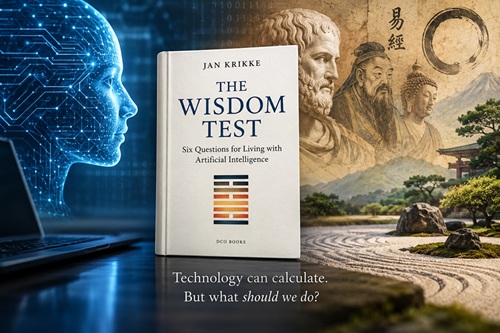 Jan Krikke's The Wisdom Test: Six Questions for Living with Artificial Intelligence begins with a deceptively simple distinction. Intelligence helps us achieve goals; wisdom asks whether those goals are worth pursuing in the first place. An artificial intelligence may be extraordinarily capable at finding an optimal route, predicting an outcome, generating a text, diagnosing a disease, or allocating resources. None of that, Krikke argues, automatically answers the prior question: should we be doing this at all? That is the central strength of the book. Rather than getting trapped in the increasingly familiar argument about whether artificial intelligence is “really intelligent,” Krikke changes the subject. The important question is not whether a machine can pass an intelligence test, but whether human beings are capable of using machine intelligence wisely. His proposed Wisdom Test consequently consists of six questions: • Who chose the goal? • What will it refuse to do? • What does it attend to, and what does it make invisible? • Whose relationships does it strengthen, and whose does it weaken? • Who bears the consequences when it is wrong? • Does it leave us more able to judge, or less? These questions are deliberately not converted into a numerical score. Krikke argues that doing so would reproduce precisely the reductionism the book is criticizing. This is a useful framework. But the intellectual journey by which Krikke arrives at it is more problematic. Intelligence versus wisdomKrikke's distinction between intelligence and wisdom is intuitively compelling, although it is not as clean as he sometimes makes it sound. His highway example illustrates the point well. An AI system might discover a route that saves commuters twelve minutes and costs less to build, while simultaneously displacing families and dividing an established neighborhood. The machine can calculate the consequences once the relevant variables have been specified. But it cannot, by calculation alone, determine whether twelve minutes of commuting time outweighs the destruction of a community. This is a legitimate and important observation. Optimization always takes place relative to an objective function, and objective functions embody choices about what counts as success. But there is a danger of turning this into a stronger philosophical claim than is warranted. AI systems can already be used to compare competing values, model ethical preferences, identify conflicting objectives, and participate in normative deliberation. Human beings themselves do not possess some mysterious non-computational faculty that simply receives “values” from outside the causal universe. Values emerge from human biological needs, emotions, social relationships, cultural traditions, learning and reflection. Krikke himself recognizes much of this when discussing Damasio and embodiment. The real distinction therefore need not be between calculation and value. It is between calculation performed within a specified normative framework and the continuing human or institutional authority to determine, revise and contest that framework. That is a more modest claim than saying that calculation cannot deal with values. It is also, paradoxically, a stronger one because it does not depend upon proving that wisdom is some fundamentally non-computational property. The I Ching and the origins of computationKrikke's most intriguing historical theme concerns the encounter between the Chinese I Ching and Leibniz's binary arithmetic. The book makes an important distinction. The broken and unbroken lines of the hexagrams resemble binary digits, but they originally operated within very different conceptual systems. In the I Ching, the patterns represent configurations of change and require interpretation; in binary arithmetic, zeroes and ones become formal symbols that can be manipulated according to rules. This is a fascinating comparison, and Krikke is careful enough not to claim that the Chinese invented modern computing. Indeed, he explicitly distinguishes the formal resemblance from an identity of purpose. Yet the larger narrative occasionally encourages the reader to see a historical transformation from an ancient relational worldview into modern computational thinking: from hexagram to binary code, from Leibniz to Boole, from Shannon to cybernetics and eventually artificial intelligence. As intellectual history, this is elegant. As intellectual causation, it is much less secure. A resemblance between two symbolic systems does not mean that one developed into the other. Leibniz already had his binary arithmetic. Bouvet's presentation of the I Ching provided him with an intriguing confirmation of a formal pattern, but the subsequent development of Boolean logic, switching circuits, information theory and digital computing cannot reasonably be understood as the unfolding of an ancient Chinese insight. Krikke generally knows this. The problem is rhetorical rather than strictly factual. The book's narrative architecture makes the connection feel more historically consequential than the evidence necessarily establishes. That is an important distinction in a book whose subject is precisely the danger of allowing an attractive pattern to become more meaningful than the underlying evidence warrants. The great East-West contrastThe most questionable feature of The Wisdom Test is its recurring contrast between Western calculation and Eastern relationality. To Krikke's credit, he explicitly rejects the simplistic proposition that “the East” is wise while “the West” is merely clever. He states that every tradition contains both insights and blind spots, and that none should be protected by cultural prestige. Nevertheless, the architecture of the book tends to recreate precisely this contrast in subtler form. Part I tells the story of intelligence becoming calculation. Part II then introduces the “lost languages of wisdom”: Greece, Confucius, Daoism, India and Japan. The effect is to make modern technological culture appear as the culmination of one historical trajectory while the older traditions preserve alternative possibilities. This is philosophically attractive but historically dangerous. There has never been a single “Western” tradition of calculation, any more than there has been a single “Eastern” tradition of wisdom. Greek philosophy itself contains skepticism about formal knowledge, cultivation of character, practical judgment and the limits of theoretical reason. Aristotle's phronesis is not a marginal Eastern corrective to Western rationalism; it is one of the major strands of Western philosophy. Conversely, Chinese, Indian and Japanese intellectual traditions contain sophisticated forms of categorization, calculation, hierarchy, metaphysics, formal argument and statecraft. They are not naturally immune to instrumental rationality. Krikke partly acknowledges this problem. His discussion of Aristotle is particularly effective because it shows that “Western” philosophy already contains a powerful critique of the reduction of judgment to technique. But that admission should have been pushed further. The book would have been stronger if it had presented its traditions not as successive cultural alternatives but as different resources within a much more complicated history of human thought. Aristotle is actually the book's strongest resourceThe chapter on Aristotle is among the most convincing sections because phronesis gives Krikke almost everything he needs without requiring an elaborate East-West dichotomy. Aristotle distinguishes episteme, techne and phronesis. The first concerns demonstrable knowledge; the second concerns making and accomplishing; the third concerns deciding what should be done in particular circumstances. This maps beautifully onto the AI problem. A medical AI can possess enormous amounts of medical information. It can perform technical tasks. It can identify statistical patterns and predict outcomes. But deciding whether a particular ninety-one-year-old patient should undergo an operation cannot be reduced to maximizing survival probability. The patient's own priorities, relationships and conception of a worthwhile remaining life enter into the decision. Here Krikke makes an important point: practical wisdom is not simply a better algorithm. It is a cultivated capacity to act responsibly under conditions of uncertainty. Even more importantly, he recognizes that judgment itself is a practice. Delegating decisions to AI can therefore produce “skill atrophy.” A professional may retain formal authority while gradually losing the ability to exercise that authority intelligently. This is arguably the book's most important contribution. The danger of AI may not primarily be that machines become wiser than humans. It may be that humans become less practiced at wisdom because machines increasingly perform the cognitive activities through which judgment is cultivated. The paradox of the human-in-the-loopKrikke develops this point into an excellent critique of the fashionable idea that keeping “a human in the loop” automatically solves the ethical problem. It does not. A human can technically remain responsible while lacking the time, information, expertise or institutional authority to disagree with the machine. Krikke observes that a physician, civil servant or manager is not meaningfully “in the loop” if the system effectively determines the decision and the human merely approves it. This is a much more concrete contribution than many philosophical discussions of AI wisdom. It shifts the question from metaphysics to institutional design. • Who has the right to override the system? • Who is required to investigate an error? • Who can appeal? • Who bears the costs? • Can the user understand the uncertainty? • Can the institution tolerate disagreement with the machine? • And, crucially, can people still perform the relevant task without the machine? These are excellent questions because they translate philosophical concerns about wisdom into practical requirements for organizations. Confucius and the relational selfThe Confucian chapter extends the argument in an interesting direction. Krikke uses the famous story of Confucius giving different advice to two students who asked the same question. One was encouraged to act; the other was restrained. The apparently contradictory answers made sense because the students themselves were different. This nicely illustrates a limitation of standardized decision systems. A recommendation may be statistically excellent for a population while inappropriate for an individual. Context matters, and context includes relationships. Krikke contrasts this with what he calls the “Cartesian orphan”: the abstract individual thinker detached from the relationships in which an actual human being exists. Again, the contrast is provocative but too broad. Descartes' methodological doubt does not imply that real human beings are isolated minds. Nor does Cartesian philosophy explain modern AI in any straightforward historical sense. The chapter risks turning Descartes into a convenient symbol for an entire civilization's supposed mistake. The Confucian insight itself is more interesting than this contrast. It suggests that intelligence cannot always be evaluated independently of the relationship between the decision-maker and the person affected by the decision. An AI tutor, doctor, bureaucrat or therapist is therefore not simply delivering information. It is entering an existing social relationship and potentially changing it. That is a powerful idea. Daoism and the problem of optimizationThe Daoist chapter supplies perhaps the most elegant metaphor in the book: Cook Ding cutting an ox. The expert cook does not simply apply greater force. He perceives the structure of the animal and allows his knife to pass through existing spaces. Wu wei, Krikke explains, does not mean literal inactivity but action without unnecessary forcing. This provides an excellent counterweight to the contemporary obsession with optimization. Modern technological culture tends to assume that if a problem exists, more intervention must be better. But complex systems often respond perversely to intervention. A system may have adapted to its circumstances in ways that are not visible to the optimizer. Sometimes the wise response is to intervene less. The Daoist contribution therefore does not need to be presented as evidence that ancient China possessed a superior alternative to Western rationality. Its value lies in providing a conceptual vocabulary for something modern optimization culture routinely forgets: not every problem is solved by maximizing an output. India and the danger of consciousness romanticismThe Indian chapter introduces another important distinction: the difference between information about experience and experience itself. An AI can describe grief, imitate the language of grief, predict how a grieving person might speak and generate sophisticated discussions of consciousness. None of this establishes that the system actually experiences grief. Krikke is admirably cautious here. He does not claim that machines can never become conscious. He explicitly says that the conclusion concerning present systems is provisional and that there is no accepted test for subjective experience in machines. This is the right epistemic position. Where the book becomes less secure is in its attraction to the language of the “witness” and contemplative awareness. The idea that consciousness involves an observing awareness distinct from the machinery of thought is philosophically significant, but it is not established by the mere fact that humans can introspect. A naturalistic account can explain the capacity to monitor one's own cognitive processes without requiring a metaphysically distinct witness. Krikke does not explicitly make a supernatural claim, which is important. But readers familiar with contemplative traditions may easily move from his phenomenological distinction to a stronger metaphysical conclusion. The book would benefit from drawing that boundary more sharply. Japan and the value of absenceThe Japanese discussion of ma is one of the book's most aesthetically appealing sections. Krikke describes the garden at Ryoan-ji and emphasizes that the empty space between the stones is not simply nothing. The interval creates relationships among the objects. The absence is structurally meaningful. This becomes a useful metaphor for AI. Modern systems tend to reward explicit representation. What cannot be represented is easily treated as irrelevant. Yet sometimes what matters is precisely what is absent from the dataset: a relationship, an exception, an unspoken concern, a social context, a human possibility. Here the Japanese concept of interval becomes genuinely useful without requiring any claim that Japanese civilization possesses a uniquely superior understanding of reality. The same applies to Krikke's discussion of artistic and craft traditions. AI can reproduce an artifact, but it cannot automatically reproduce the human practice through which the artifact was made meaningful to its practitioner. That is a subtler and more defensible point than simply asking whether AI can make art. The book's biggest blind spot: wisdom itselfThere is, however, one question Krikke does not sufficiently confront: How do we know wisdom when we see it? The six questions are useful precisely because they refuse to provide a formula. But this creates a problem. Suppose two groups disagree profoundly about what the proper goal is, which risks are acceptable, which relationships deserve priority and what consequences constitute harm. The Wisdom Test can expose the disagreement. It cannot necessarily resolve it. That is not necessarily a defect. Indeed, Krikke may be right that no algorithm can eliminate genuine value conflict. But then wisdom is not an alternative computational procedure. It is the name we give to responsible judgment under conditions where procedures cannot settle the matter. This raises the possibility that the deepest lesson of the book is more modest than its title suggests. There may be no “wisdom test” in the sense of a test that identifies wise systems. There may instead be a discipline of questioning that prevents us from pretending that difficult normative decisions have become merely technical. That is valuable—but it is a different proposition. The book's six questions are better than its grand narrativeThis distinction explains why the final part of The Wisdom Test is stronger than some of its historical scaffolding. When Krikke applies the six questions to concrete AI systems, the framework becomes genuinely practical. • Who selected the objective? • What boundaries exist? • What has been left out? • Which relationships are changed? • Who bears the risk? • What happens to human judgment after repeated delegation? These questions can be applied to medical AI, education, public administration, hiring, creative work and countless other domains. The highway example is particularly effective because the test does not produce an artificially simple answer. It exposes the competing interests and asks whether the decision can be publicly justified and to whom. This is much more useful than asking whether the algorithm is biased in the abstract. The final criterion—whether AI leaves us more able to judge or less—is especially important. A technology can produce better immediate results while simultaneously degrading the human capacity to produce those results independently. That is a genuine civilizational question. The irony of an AI-assisted book about human judgmentThere is also an intriguing meta-level irony. Krikke openly explains that AI played a substantial role in developing the book. He asked several large language models about cultural responses to technology, and subsequent exchanges helped reveal connections among subjects he had previously treated separately. He then used AI during the writing process to compare arguments, identify omissions and challenge one-sided accounts. But he insists that the selection of connections and final decisions remained his. This is almost a practical demonstration of his thesis. AI becomes useful precisely when it is treated neither as an oracle nor as an autonomous author. It expands the range of material available to a human thinker, while the human remains responsible for deciding what deserves inclusion. Yet this also raises a question the book might have explored more deeply. If an AI system helped generate the very historical and philosophical connections upon which the argument rests, how do we know which connections are genuinely illuminating and which merely sound illuminating? That is the central epistemological problem of generative AI. Fluency creates patterns. Humans then decide whether the patterns are meaningful. The danger is not merely that AI will hallucinate facts. It can also hallucinate intellectual significance. A beautifully constructed analogy can be false, exaggerated or historically irrelevant while remaining rhetorically irresistible. And The Wisdom Test is, at times, vulnerable to exactly this danger because its narrative is so elegantly constructed. A more naturalistic reading of the bookThe strongest version of Krikke's argument does not require an opposition between East and West, calculation and wisdom, or machines and consciousness. It can be stated much more simply. Human beings are biological organisms with limited knowledge, finite lives, competing values, emotional attachments and social relationships. We use tools to extend our cognitive capacities. Every powerful tool changes not only what we can accomplish but what we pay attention to, what skills we retain and how responsibility is distributed. AI therefore represents not simply an increase in intelligence but a transformation in the ecology of human judgment. That formulation fits remarkably well with the book's own best insights. The problem is not that machines calculate while humans possess some mysterious non-calculating essence. The problem is that humans are the creatures who have to live with the consequences. Machines do not need to be conscious to transform society. They do not need to be wise to be dangerous. And they do not need to be unwise to create a problem. They merely need to become sufficiently useful that humans begin surrendering capacities that they no longer exercise. The final paradoxThe cover of The Wisdom Test features Hexagram 63, “After Completion.” Krikke interprets its perfectly ordered structure as carrying a warning: completion is never permanent. Precisely when everything appears to be in its proper place, disorder may return. It is an apt metaphor for the entire project. AI systems are particularly good at producing the appearance of completion. A question receives an answer. A ranking appears. A recommendation is generated. A paragraph is written. A diagnosis is suggested. The form looks finished. But the human work may only be beginning. What assumptions produced the answer? What has disappeared from view? Who selected the objective? Who carries the risk? What happens if the answer is wrong? And, perhaps most importantly, are we still capable of answering those questions ourselves? Krikke's concluding formulation is therefore more convincing than his historical thesis. The Wisdom Test cannot finally be a test that machines pass. It is a test of the humans and institutions deploying them. The book explicitly rejects the idea that the six questions can be converted into a score and emphasizes that they must be asked repeatedly, before deployment, during use and after harm. That is the book's enduring insight. Conclusion: A useful book that should distrust its own patternsThe Wisdom Test is an intelligent, ambitious and unusually humane contribution to the literature on artificial intelligence. Its practical questions are considerably more valuable than the familiar debate about whether AI is “really intelligent.” Krikke is particularly persuasive on skill atrophy, institutional responsibility, the limitations of the human-in-the-loop model, and the danger of confusing optimization with justification. Its weakness lies elsewhere. The book sometimes constructs an overly tidy intellectual history in which Western thought gradually turns wisdom into calculation while Chinese, Indian and Japanese traditions preserve neglected alternatives. Krikke repeatedly warns against this East-West caricature, but the architecture of the book sometimes reproduces it anyway. The I Ching-Leibniz connection is intellectually fascinating but should be treated more as a revealing historical encounter than as a genealogy of computing. Descartes is too easily transformed into the representative of an entire Western conception of the self. And contemplative accounts of awareness require greater separation between phenomenological insight and metaphysical claims. There is also a deeper irony. A book warning us against mistaking elegant patterns for wisdom occasionally comes close to doing exactly that itself. Its great cultural synthesis is attractive because the pieces fit together so beautifully: I Ching, Leibniz, cybernetics, Aristotle, Confucius, Daoism, Vedanta, Japanese aesthetics and artificial intelligence. But perhaps the real wisdom test for such a synthesis is the same one Krikke recommends for AI: What has the pattern made visible—and what has it made invisible? Asked that way, The Wisdom Test becomes more interesting, not less. Its most important lesson is not that ancient traditions contain a lost wisdom that modern technology has forgotten. It is that no intellectual tradition, technological system or philosophical framework should be allowed to declare the work of judgment finished. The machine may calculate. The tradition may illuminate. The algorithm may recommend. But somebody still has to decide what matters. And somebody still has to live with the consequences.
Widget is loading comments...
|