|
TRANSLATE THIS ARTICLE
Integral World: Exploring Theories of Everything
An independent forum for a critical discussion of the integral philosophy of Ken Wilber
 Ray Harris is a frequent contributor to this website. He has written articles on 9/11, boomeritis, the Iraq war and Third Way politics. Since 2007 he took to writing his novels Navaratri, Wild Child and Eden. Harris lives in Ballarat, Victoria, Australia. NATO ExpansionDid the West push NATO towards Russia?Ray HarrisA recent Visser/ChatGPT collaboration, The Realists's Alibi, seems to accept the claim that the United States and its allies 'pushed' NATO towards Russia. “His [Mearsheimer] argument is familiar: great powers are acutely sensitive to threats near their borders, Russia regards the prospect of Ukraine's integration into Western political and military structures as an unacceptable strategic danger, and the United States and its European allies underestimated the consequences of pushing NATO toward Russia.” In general the essay is a welcome corrective. It points out that Mearsheimer's analysis often shifts from explanation to justification. As the essay explains: “When Russia's invasion is presented as the predictable response of a great power to Western encroachment, the agency of the Russian leadership recedes into the background. Putin appears less as a political leader making choices and more as the representative of an impersonal geopolitical necessity. “That is where realism risks becoming an alibi. What begins as an explanation of why Russia acted can turn into an argument that Russia could hardly have acted otherwise.” This is all well and good. Unfortunately, by failing to examine the claim that the 'West' was encroaching on territory it had no right to, the essay makes a number of unwarranted generalisations. What is NATO?The first generalisation is that NATO is synonymous with the 'West'. Whilst NATO initially consisted of Western European nations, alongside Canada and the USA, it expanded to include the Muslim majority nations of Türkiye (1952) and Albania (2009), and a number of 'Eastern', Slavic and Baltic nations. Türkiye and Eastern Europe have maintained their independence and their unique cultures, so, in what sense have they been Westernised?
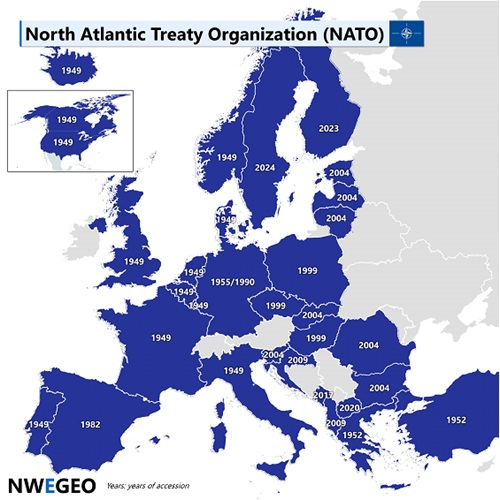 There is nothing new or particularly Western about forming economic, political or military alliances, especially against a common adversary. Whilst it is true that in order to join NATO states must adhere to certain standards: democracy, rule of law, civilian control of the military, etc., these are not uniquely Western. It is also a quirk of NATO that it tolerates member states changing their political orientation. Portugal was accepted despite being an autocracy. Both Greece and Turkey experienced periods of upheaval and military dictatorship. Member states have oscillated between conservative and progressive governments. An example of this flexibility is that not all NATO members states have joined the EU and not all EU members have joined NATO. The UK famously left the EU whilst remaining an important NATO member. Nor do all NATO members agree with other NATO nations. Germany and France, joined by Spain, the Netherlands, Belgium, Italy and Hungary questioned the plan to fast track Ukrainian and Georgian membership at the famous 2008 Bucharest summit. Hungary and Slovakia currently lean towards sympathising with Russia in its war with Ukraine. The accession of Sweden was delayed due to the concerns of Türkiye. Is there any evidence of NATO seeking to push or coerce member states to adhere to an agreed set of 'Western' policies or is it purely a collective security arrangement? If not, what exactly is meant by 'Western encroachment'? These distinctions matter because the idea that there is a significant difference between an imagined West and an Eurasian East is a matter of ideology, not geography. As I pointed out in my recent response to Dillard's Russophobia Misreading Russian History, Imperial Russia was a European nation. Russian culture is distinct in the same way that Spanish, French, German, British and other cultures are distinct. The schism was caused by the Bolshevik revolution and the division into communist versus capitalist spheres of influence. It need not be permanent. Small states in a realist world.I recall my father saying that, even as a smaller boy, he was never bullied because he had made friends with the biggest boy in the school. That is one solution. The other is to seek strength in numbers. Realism ignores questions of right or wrong. It only considers the issue of strong or weak. The strong dominate and they get to define what is right or wrong. The weak either submit or resist by seeking to ally with someone equally strong or building a coalition with sufficient strength. This is exactly what happened during the Bolshevik revolution. The old order was overthrown. To accept the wording that the 'West/NATO encroached' is also to accept that this was somehow wrong, that it is Russia that has suffered some sort of injustice, that it has some sort of unique right to go unchallenged. When all that has happened is that the weaker states have responded to the security threat posed Russia. NATO did not push, the former Warsaw pact countries pushed.The collapse of the Soviet Union also saw the collapse of the Soviet answer to NATO, the Warsaw Pact. Left on their own - and according to realist principles - they had a choice, create a new alliance or join an existing one. The Russian Federation replaced the Warsaw Pact with its version of NATO, CSTO - the Collective Security Treaty Organisation (Armenia, Belarus, Kazakhstan, Kyrgyzstan, Russia and Tajikistan). Why didn't the former Eastern European Soviet states opt to join CSTO? The answer comes from a leading voice in the decision to join NATO, Vaclav Havel, president of the Czech Republic. In a 1996 address delivered in Warsaw, 'NATO: The Safeguard of Stability and Peace In the Euro-Atlantic Region', Havel declared. “The communist takeover of my country in 1948 was a brutal victory for the forces of darkness, crushing freedom and democracy in the very heart of the European continent. Like many other events in Czech and Czechoslovak history, it left its mark on the whole of Europe. In fact, it sparked action by Western democracies to establish the North Atlantic Alliance as a bulwark against the further expansion of totalitarianism and against further attempts by the Soviet leadership to dominate the world.” Whilst 'The Realist's Alibi' recognises the agency of the nations seeking to join NATO, it tends to underplay the depth of the reaction to Soviet oppression. The West didn't need to encroach, the former Warsaw Pact countries invited them in. The US was initially reluctant to expand NATO.Mearsheimer's claim that the US encouraged NATO expansion is a lie. The historical record is clear. The US was initially reluctant to allow former Warsaw Pact countries to join NATO. They were acutely aware of Russian objections, as well as European concerns. In an attempt to manage conflicting demands they proposed compromise security arrangements, the North Atlantic Cooperation Council and the Partnership for Peace. Space does not allow me to go into the detail - a search of these terms will provide a wealth of detail. Safe to say that key Eastern European leaders were not happy with these compromise arrangements and it was Vaclav Havel of the Czech Republic and Lech Walesa of Poland who persuaded Clinton to allow them to join NATO.
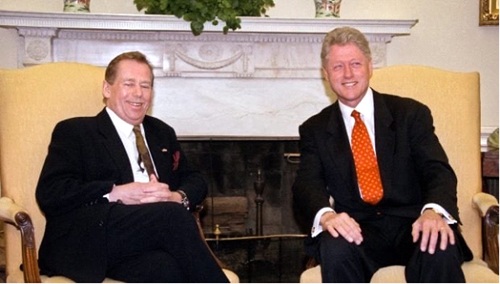
Clinton with Havel
NATO understood Russian objections.There is a an assumption that NATO did not understand Russia's security concerns. They did. They were in constant discussions with the Russians through the entire process. Russia had made its concerns very clear. But Russia was not the only party in these discussions. NATO had also to consider the positions of those countries wishing to join. NATO made its decisions fully aware of Russian concerns. Containment versus invasion.What exactly is the nature of the security threat to Russia? It's a claim that gets thrown around without much examination. In 1963 the world came close to a nuclear war because Russia was building nuclear missile bases in Cuba. Ukraine dismantled its nuclear missile facilities after gaining independence, and yet it was still considered a security threat? How does that make sense? It is argued that NATO now borders Russia, but didn't it always border the Soviet Bloc? What is the aim here? To protect the Russian heartland or the larger Russian Federation? Were the former Warsaw Pact countries just sacrificial pawns arranged to protect the king, or should that be the Muscovy tsar? Since the collapse of the Soviet Union no new NATO member has built offensive missile capabilities on the Russian border. They have however, unsurprisingly, built defensive capabilities. There is simply no evidence that NATO plans to invade Russia. The only time that NATO's Article Five has been invoked was in response the 9/11 attack on the US, which resulted in NATO joining the Iraq and Afghanistan wars. All other NATO actions have been at the request of the UNSC, in which Russia has the power of veto. No, the security issue isn't a concern that Russia will be attacked. It is that Russia will be contained and unable to expand. The deeper fear is that more countries will leave the Russian sphere of influence. Moscow knows that if Kiev joins Europe, it is very likely that Minsk will follow, that Lukashenko will go the way of Yanukovych. So the real security threat is that, like Britain, Russia will gradually loose its empire and therefore its status as a world power. Russian pride will not allow that. Russian aggression proved that NATO expansion was necessary.What better way to prove the need for a defensive pact than to be attacked? Russia invaded Ukraine because it wasn't a member of NATO and was therefore unprotected, not because it might one day join NATO. If the invasion was intended to halt NATO expansion then it has been a spectacular own goal. Instead it has prompted two formerly neutral countries, Sweden and Finland, to join, thus expanding NATO. When Russia annexed Crimea, Ukraine was not seeking to join NATO. Since the invasion it is more determined than ever to join, its fears of Russian aggression realised. And rather than weaken NATO resolve, it has only served to unite and strengthen it. Trump and Putin.Trump's relationship with Putin tells us something important. The US does not, and never did, dictate NATO policy. Whilst it is certainly a senior partner and has a very loud voice, the recent rift between Europe and the Trump administration, especially after Trump announced he wanted to annexe Greenland and make Canada a US state, shows just how rapidly things can change. NATO members are now distancing themselves from Trump. They are certainly not taking his advice.
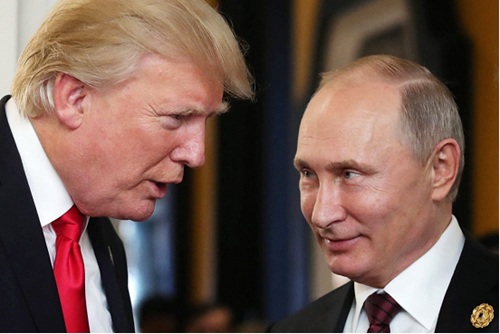 Trump's motivations? Some have suggested kompromat. It is more likely to be ego and greed. Putin may be offering Trump a slice of the pie should Russia succeed. Russia is to blame for NATO expansion. Russia mistreated its European neighbours and so they couldn't wait to be free of it. The US and its allies didn't need to push for NATO expansion. They were pulled in by the vacuum left by the collapse of a tyrannical system. Russia could have admitted it had made some serious mistakes and set a new course. It didn't. It had nothing to offer Ukraine, so Ukraine wanted a divorce. Instead of accepting Ukraine's decision Russia has resorted to the pattern of coercive control and violence. The problem is not that Ukraine wanted to join the West, the problem is that it didn't want to join Russia.
Widget is loading comments...
|