|
TRANSLATE THIS ARTICLE
Integral World: Exploring Theories of Everything
An independent forum for a critical discussion of the integral philosophy of Ken Wilber
 Ray Harris is a frequent contributor to this website. He has written articles on 9/11, boomeritis, the Iraq war and Third Way politics. Since 2007 he took to writing his novels Navaratri, Wild Child and Eden. Harris lives in Ballarat, Victoria, Australia. Cuba and UkraineDillard's MearsheimerRay HarrisIn his most recent offering, "Lessons From the Ukrainian and Iranian Wars", Dillard uses AI to construct an imaginary dialogue between foreign relations scholar John Mearsheimer and economist Micheal Hudson. The first thing to get out of the way is that I regard such an exercise to be unethical. Did Dillard seek their permission to create their AI avatars? Have they reviewed the article to determine if it is an accurate representation of their views? They have never met in real life, let alone exchanged views. Isn't this putting words in their mouth? I am not that familiar with the work of Michael Hudson. He describes himself as a classical economist who is critical of neo-liberal economics. In this sense I don't see him as necessarily anti-Western, rather as anti-neo-liberal. I don't see that he particularly distinguishes himself from the many other economists critical of neo-liberal theory. I am however, very familiar with Mearsheimer. In my article International Relations Theory I pointed out that Mearsheimer has faced serious criticism for his analysis of the Russian invasion of Ukraine. He certainly has a very poor record in predicting the outcome. So why do people defer to Mearsheimer? Because he confirms their prejudices. The war is the West's fault. Russia had no choice. This is the subject of this essay. Category errorThe AI generated dialogue consistently switches between the US, Europe and the West as if they are one and the same. They are not. This seems to be the fault of the AI because Mearsheimer is generally far more careful to distinguish between them. This is important because so-called Western countries often disagree with the US and each other over foreign policy. The split has become even more pronounced under the Trump administration. The European consensus would be further tested should pro-Russian far-right parties gain office. The fact is that foreign policy is a matter of internal political policy, which can change from administration to administration. In the US it has oscillated between isolationism and intervention. Europe certainly remembers that an isolationist US was reluctant to enter European conflicts, significantly WW1 and WW2. It certainly can't be said that the Trump administration is in agreement with Europe. In fact one could describe relations as increasingly hostile. Cuba, Ukraine and defensive realism.Dillard's fictional exchange contains this revealing paragraph. “Western policymakers treated Russian objections as illegitimate because they believed Ukraine had the sovereign right to choose its alliances. But this confused a legal principle with the realities of international politics. The United States would never tolerate a comparable arrangement involving a rival great power in Mexico or Canada, yet Washington expected Russia to accept what American leaders would regard as intolerable in their own neighborhood. This was not simply hypocrisy. It was a catastrophic strategic miscalculation because it assumed that American preferences could override Russian security interests without producing a serious confrontation.” First, notice the shift from 'Western policymakers' to 'Washington'. This is the category error I mentioned above. However, the thing that really caught my attention was this claim 'The United States would never tolerate a comparable arrangement involving a rival great power in Mexico or Canada…' Why no mention of the most obvious example of them all? Let me emphasises this in bold capitals: CUBA. (I was tempted to add an expletive for further emphasis). Cuba means we don't have to imagine a scenario involving Canada or Mexico. We have an actual example of what the US did in fact do. Thing is, Mearsheimer is well aware of Cuba and has used it as an example, so it seems strange that the AI would exclude it. Perhaps it only performed a shallow analysis? A very brief history of Cuba.The connection between Cuba and America dates back to the first humans who established trade networks between the various island and mainland tribes. The Spanish arrived in 1492 and it became a part of the larger Spanish Americas. The great power rivalry between the Spanish, French and British saw the British gain a foothold in 1762. Britain opened Cuba to trade with its other colonies in the Caribbean and North America.
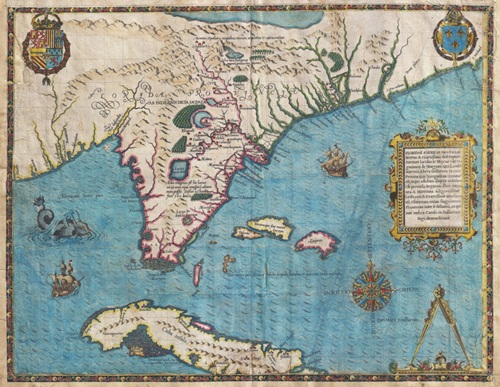
1591 map showing Cuba and Florida
The success of the American and French Revolutions inspired independence movements in Cuba. For the next century Cuba would experience several rebellions and calls for liberal reform. After gaining independence, the newly formed United States developed close economic relations with Cuba. The Spanish-American war saw the US occupy Cuba in 1899. The following years saw the US accept conditional independence. During this period the Cuban economy grew and workers and intelligentsia embraced a series of progressive reforms. Americans invested heavily in the Cuban economy. However, growing inequality and political corruption under Batista lead to the Cuban revolution and the involvement of the Soviet Union - a great power at the opposite end of the world. The point of this very brief history is to show that Cuba has long been the victim of great power rivalry, initially between the Spanish and British and finally the Spanish and the newly formed US. As such it is a prime example of Mearsheimer's great power realism. The Cuban missile crisis.Mearsheimer argues that Russia's hand was forced by the US support for NATO expansion. In his defining 2014 essay Why the Ukraine Crisis is the West's Fault he states that: “…the United States and its European allies share most of the responsibility for the crisis. The taproot of the trouble is NATO enlargement, the central element of a larger strategy to move Ukraine out of Russia's orbit and integrate it into the West.” In this essay Mearsheimer completely ignores the active role of the former Warsaw pact countries in seeking to join NATO. They are considered as passive pawns in a greater US strategy to isolate Russia. He goes on to say: “No Russian leader would tolerate a military alliance that was Moscow's mortal enemy until recently moving into Ukraine. Nor would any Russian leader stand idly by while the West helped install a government there that was determined to integrate Ukraine into the West. Washington may not like Moscow's position, but it should understand the logic behind it. This is Geopolitics 101: great powers are always sensitive to potential threats near their home territory. After all, the United States does not tolerate distant great powers deploying military forces anywhere in the Western Hemisphere, much less on its borders.” Okay, that's a clear statement and in the case of communist Cuba the US proved highly 'sensitive to potential threats near their home territory'. The initial response of the US was to place a blockade on Cuba and to attempt a failed coup known as the Bay of Pigs fiasco. The Soviet Union responded by directly supporting Cuba. In exchange for breaking the blockade and providing financial support, Cuba allowed the Soviets to build a nuclear capable missile facility on its soil. The history of the Cuban Missile Crisis is well-known so there is no need to go over the details here. The critical point is that the US forced the Soviets to back down. But. The Soviets also negotiated an agreement that the US remove its missiles in Turkey and Italy with a promise not to invade Cuba. The end result was that the Castro regime survived supported by the Soviet Union until the collapse of the Soviet system in 1991. Similarities and differences.So, yes, the US did not allow a threat so close to its home territory. It acted decisively according to Geopolitics 101. However, there is a critical difference between Cuba and Ukraine. Whilst Russia was caught building a missile facility close to the US, Ukraine had voluntarily dismantled its missile facilities. In return, the Russian Federation signed the Budapest Memorandum in 1994 in which it agreed to recognise Ukrainian sovereignty. Mearsheimer argues that the Russian violation of the Budapest Memorandum was caused by NATO expansion. In his 2014 essay he correctly states: “At its April 2008 summit in Bucharest, the alliance considered admitting Georgia and Ukraine. The George W. Bush administration supported doing so, but France and Germany opposed the move for fear that it would unduly antagonize Russia. In the end, NATO's members reached a compromise: the alliance did not begin the formal process leading to membership, but it issued a statement endorsing the aspirations of Georgia and Ukraine and boldly declaring, “These countries will become members of NATO.”” Here Mearsheimer exposes his intellectual dishonesty because he leaves out a vital part of the story. On July 1, 2010 the Ukrainian parliament voted not to pursue NATO membership and instead to maintain a position of neutrality. To summarise: 1. Ukraine was not building a missile facility, instead it had dismantled its nuclear capability. 2. Ukraine did not take up the offer to join NATO and had instead adopted a position of neutrality. And what did Russia do? It violated the Budapest Memorandum and invaded a neutral country. Let's return to Cuba. After the Cuban Missile Crisis the US kept its agreement not to invade Cuba. It allowed Russia to continue to support Cuba and in 1972 Cuba became a member of Comecon, the Council for Mutual Economic Assistance. The Cuban economy became reliant on the Soviet Union and in return Cuba acted as a proxy for Russian interests in the region. This is not to say that the US did not continue to try and undermine the communist regime in Cuba. There were many plots and schemes. But history tells the story. The US did not invade. The regime still stands. Two responses.In his essay Mearsheimer admits that NATO expansion was just one of three reasons Russia invaded. He says: “The West's triple package of policies—NATO enlargement, EU expansion, and democracy promotion—added fuel to a fire waiting to ignite. The spark came in November 2013, when Yanukovych rejected a major economic deal he had been negotiating with the EU and decided to accept a $15 billion Russian counteroffer instead.” Oh, the Horror! Not democracy promotion! Please note that the US allowed Cuba to remain communist and join the Soviet economic sphere, but Ukraine becoming a liberal democracy and joining the EU? No, that was the spark that ignited the conflict. Mearsheimer also admits: “Next, Putin put massive pressure on the new government in Kiev to discourage it from siding with the West against Moscow, making it clear that he would wreck Ukraine as a functioning state before he would allow it to become a Western stronghold on Russia's doorstep.” Putin was certainly true to his word. He is certainly determined to wreck Ukraine. But what does the US's treatment of a hostile Cuba tell us? It removed the immediate threat and accepted the unhappy compromise of allowing Cuba to exist as part of the Soviet sphere of influence. It did not invade. It did not rain missiles down on Cuban cities. Russia did have a choice. It could have chosen containment. Instead it has demanded total capitulation.
Widget is loading comments...
|