|
TRANSLATE THIS ARTICLE
Integral World: Exploring Theories of Everything
An independent forum for a critical discussion of the integral philosophy of Ken Wilber
 Dr. Joseph Dillard is a psychotherapist with over forty year's clinical experience treating individual, couple, and family issues. Dr. Dillard also has extensive experience with pain management and meditation training. The creator of Integral Deep Listening (IDL), Dr. Dillard is the author of over ten books on IDL, dreaming, nightmares, and meditation. He lives in Berlin, Germany. See: integraldeeplistening.com and his YouTube channel. He can be contacted at: joseph.dillard@gmail.com Dr. Joseph Dillard is a psychotherapist with over forty year's clinical experience treating individual, couple, and family issues. Dr. Dillard also has extensive experience with pain management and meditation training. The creator of Integral Deep Listening (IDL), Dr. Dillard is the author of over ten books on IDL, dreaming, nightmares, and meditation. He lives in Berlin, Germany. See: integraldeeplistening.com and his YouTube channel. He can be contacted at: joseph.dillard@gmail.com
Check out my other conversations with ChatGPT Lessons From the Ukrainian and Iranian WarsAn Imagined Dialogue Between John Mearsheimer and Michael Hudson About Strategic Arrogance, Economic Power, and the Possible End of Western HegemonyJoseph Dillard / ChatGPT
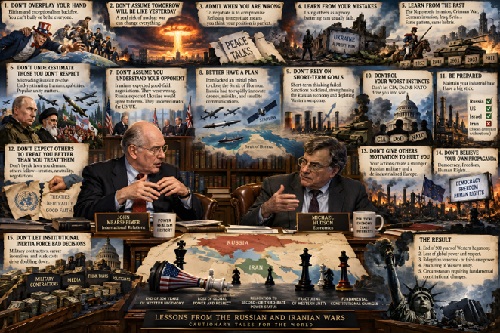
Introduction: When Success Becomes a Strategic LiabilityThe wars involving Russia and Ukraine, and Iran, Israel, and the United States, raise a question that reaches far beyond their immediate military and political consequences. What happens when the strategies that established a civilization's dominance become the principal obstacles to preserving its security, prosperity, and international influence? The question is particularly important for Western societies because their extraordinary success over the past five centuries has produced military, financial, political, and institutional arrangements that are now being challenged by other centers of power. Whether Western governments can respond constructively to those challenges may determine not only their future international standing but also their capacity to preserve the prosperity and security they have accumulated. John Mearsheimer and Michael Hudson approach this problem from different but complementary perspectives. Mearsheimer, a leading scholar of international relations associated with offensive realism, examines how great powers pursue security, respond to perceived threats, and sometimes undermine their own interests through strategic overreach. Hudson, an economist known for his analysis of financialization, debt, and American monetary power, examines how economic institutions, financial dependency, and concentrated interests shape foreign policy. Their analyses converge on a fundamental criticism of contemporary Western policy: the United States and its European allies have become so accustomed to exercising military, financial, and institutional dominance that they increasingly confuse the preservation of that dominance with the preservation of their own security and prosperity. Mearsheimer argues that the United States squandered the extraordinary strategic advantages it enjoyed after the Cold War by pursuing liberal hegemony, expanding NATO toward Russia, attempting to reshape the Middle East through military intervention, and treating the security interests of other major powers as obstacles to be overcome rather than realities to be accommodated. Hudson argues that American foreign policy has become increasingly inseparable from the interests of a financialized economy. As the United States shifted away from the industrial foundations of its earlier economic leadership, it came to rely more heavily on financial institutions, dollar dominance, sanctions, and military power to preserve its international position. These arrangements benefit powerful institutional interests while encouraging other countries to develop alternatives to Western-controlled economic relationships. Together, their arguments suggest that the difficulties confronting Western governments are not simply the result of unusually aggressive adversaries, insufficient military strength, or temporary errors of judgment. They arise from the organization of Western power itself. The following imagined dialogue develops their perspectives on the Ukrainian and Iranian wars, the economic and strategic consequences of Western policies, and the possibility that the institutions responsible for centuries of Western dominance are becoming increasingly incapable of adapting to a changing world. The Fundamental Mistake: Confusing Dominance With SecurityMearsheimer: I think we need to begin with the fundamental strategic mistake the United States made after the Cold War. American policymakers came to believe that because the United States had become the world's only superpower, it could organize the international system according to its own preferences. They assumed that the normal constraints of great-power politics no longer applied. Instead of recognizing that other major powers would continue to defend their security interests, Washington pursued liberal hegemony. It expanded NATO, attempted to spread Western political institutions, intervened militarily in countries whose governments it opposed, and treated American leadership as indispensable to international stability. The underlying assumption was that the United States could extend its influence indefinitely without provoking effective resistance. That was a profound misunderstanding of international politics. Great powers do not willingly accept potentially hostile military alliances near their borders. They do not surrender vital security interests simply because another country considers its own policies benevolent, and they do not remain passive when they believe their strategic position is deteriorating. I warned in 2014 that the United States and its European allies were leading Ukraine down a dangerous path. Western policymakers were determined to draw Ukraine into the Western security orbit, while Russia had made clear that it regarded such a development as unacceptable. The resulting confrontation was entirely predictable because Washington was pursuing a strategy that disregarded the fundamental principles of great-power behavior. Hudson: I agree, but I think we need to explain why American policymakers became so committed to a strategy that was increasingly incompatible with the realities of international power. The answer lies partly in the transformation of the American economy. After the Second World War, the United States possessed extraordinary industrial strength. It was the world's leading manufacturing power, a major creditor nation, and the center of an international economic system supported by its productive capabilities. Over subsequent decades, however, American corporations increasingly relocated manufacturing abroad, while finance, insurance, real estate, and other sectors associated with financial extraction acquired greater economic and political influence. American power became increasingly dependent upon controlling the conditions under which other countries could participate in international economic relationships. The dollar, international financial institutions, payment systems, sanctions, and access to Western markets became instruments through which Washington could pressure governments that resisted its policies. This encouraged a dangerous illusion: that the ability to punish another country's economy was equivalent to the ability to control its political decisions. The transformation of American economic power therefore reinforced the strategic arrogance you describe. Military superiority encouraged the belief that other countries could be compelled to accept American security arrangements, while financial dominance encouraged the belief that economic punishment could substitute for productive economic leadership. Mearsheimer: And the military equivalent was the belief that the ability to destroy an opponent's armed forces was equivalent to the ability to determine its political future. The United States demonstrated extraordinary conventional military capabilities in Iraq, but defeating Saddam Hussein's military was relatively easy compared with constructing a stable political order afterward. American policymakers repeatedly confused military superiority with strategic success, just as they confused the absence of an effective military challenger after the Cold War with the permanent disappearance of great-power competition. The result was a foreign policy that expanded American commitments while generating increasingly powerful incentives for other countries to resist. Hudson: Because the institutions involved in exercising American power increasingly had interests that were not identical to the long-term interests of American society. Military contractors benefited from expanded procurement, financial institutions benefited from international arrangements that privileged American financial power, and political leaders gained influence by presenting themselves as defenders of American primacy. The preservation of these arrangements became an objective in itself. That is the beginning of the contradiction we are discussing. The institutions that helped establish American dominance increasingly came to depend upon preserving that dominance, even when doing so undermined the economic and strategic foundations that had made it possible. Ukraine: The Consequences of Ignoring a Great Power's Security InterestsMearsheimer: Ukraine is the clearest example of what happens when a great power refuses to recognize the security interests of another great power. Russia repeatedly warned that NATO expansion toward its borders was unacceptable. Those warnings were made publicly, consistently, and at the highest levels of the Russian government. The decisive moment came in 2008, when NATO announced at its Bucharest summit that Ukraine and Georgia would eventually become members. From Moscow's perspective, the United States was committing itself to extending a military alliance created to contain the Soviet Union into territory Russia considered central to its security. Western policymakers treated Russian objections as illegitimate because they believed Ukraine had the sovereign right to choose its alliances. But this confused a legal principle with the realities of international politics. The United States would never tolerate a comparable arrangement involving a rival great power in Mexico or Canada, yet Washington expected Russia to accept what American leaders would regard as intolerable in their own neighborhood. This was not simply hypocrisy. It was a catastrophic strategic miscalculation because it assumed that American preferences could override Russian security interests without producing a serious confrontation. Hudson: The confrontation over Ukraine also had an important economic dimension. For decades, Germany and other European countries developed extensive economic relationships with Russia, particularly in energy. Russian natural gas supported European manufacturing, while European technology and industrial equipment contributed to Russian development. This relationship created the possibility of deeper economic integration between Western Europe and Eurasia. From the standpoint of European industrial competitiveness, access to Russian energy was a significant advantage. From the standpoint of American geopolitical dominance, however, increasing European economic integration with Russia could reduce Europe's dependence on Washington. The Ukraine conflict disrupted that relationship. Europe lost access to much of its Russian pipeline gas, increased its dependence on alternative energy supplies, expanded military expenditure, and became more closely tied to American strategic priorities. Germany's industrial economy has been particularly exposed to the consequences. The conflict therefore produced an important redistribution of economic relationships within the Western alliance system, strengthening certain forms of dependence on the United States while weakening economic arrangements that had supported European industrial competitiveness. Mearsheimer: Which illustrates why European governments should have taken Russian security concerns seriously. A stable European order required an arrangement that both Russia and the Western powers could live with. Instead, Western policymakers pursued the expansion of their own security institutions while treating Russia's objections as evidence of hostility. They believed Russia was too weak to prevent Ukraine's integration into the Western orbit, and they underestimated the willingness of Russian leaders to accept enormous costs in order to prevent that outcome. The result was a war that devastated Ukraine, militarized Russia, destabilized European security, and created a confrontation between nuclear powers that could continue for years. Hudson: Western governments also underestimated Russia's capacity for economic adaptation. They assumed that sanctions and the disruption of trade would impose intolerable costs, forcing Russia to abandon its objectives. Instead, Russia reorganized substantial portions of its economy around the demands of prolonged confrontation. It redirected energy exports, expanded military production, developed alternative commercial relationships, and accelerated efforts to reduce dependence on Western financial institutions. The important lesson is that economic coercion can create incentives for the targeted country to develop precisely the capacities that make future coercion less effective. The War That Could Have Been AvoidedMearsheimer: The most tragic aspect of the Ukraine war is that the underlying security confrontation was avoidable. The United States did not need Ukraine in NATO to preserve American security. Ukraine's incorporation into the Western military orbit was not a vital American interest, whereas Russia treated Ukraine's strategic orientation as a vital security concern. That asymmetry should have shaped Western policy. A prudent United States would have sought an arrangement preserving Ukrainian independence while avoiding the transformation of Ukraine into a Western military outpost. Neutrality, which is what Russia requested, and had served Austria, Switzerland, and Finland well, credible security guarantees, and negotiated limits on military deployments could have formed the basis of such an arrangement. Instead, Western governments continued pursuing a policy that increased the likelihood of confrontation. Even after Russia presented security proposals in December 2021, the broader question of European security was not resolved through negotiations. Once the invasion began, the spring 2022 discussions between Russia and Ukraine demonstrated that alternatives to prolonged war were being explored. The Istanbul negotiations included proposals concerning Ukrainian neutrality, international security guarantees, and other elements of a possible settlement. Those negotiations should have been treated as an opportunity to prevent the conflict from becoming a prolonged war of attrition. Hudson: Once the war began, however, the economic and political interests surrounding it changed. The conflict created new military procurement requirements, expanded defense budgets, intensified European dependence on American military capabilities, and reorganized energy markets. A prolonged war could weaken Russia's economy and military capabilities while strengthening particular Western industries. This created an important divergence between the interests of Ukraine and the interests of some of its external supporters. For Ukrainians, the war meant death, destruction, displacement, and the devastation of productive infrastructure. For institutions benefiting from expanded military expenditure and geopolitical confrontation, the same war created opportunities. The longer the war continued, the more difficult it became to acknowledge that earlier compromise might have been preferable. Governments invested political credibility, financial resources, military equipment, and public expectations in the promise of eventual success. Military institutions expanded, contractors acquired new business, and political leaders associated their reputations with particular outcomes. To change direction was no longer simply to reconsider a strategy. It was to threaten the accumulated interests and identities organized around that strategy. The question increasingly became not whether continuing the war would improve the future, but how governments could justify what they had already sacrificed. Mearsheimer: And that is why treating Ukraine primarily as an instrument for weakening Russia is such a dangerous strategy. The United States can provide weapons, intelligence, and financial assistance while avoiding the direct deployment of large conventional forces, but the destruction of Ukrainian society cannot be transferred to Washington. Ukrainians bear the immediate human costs of a prolonged conflict, while American policymakers evaluate the war partly through its consequences for the balance of power. Those interests may overlap, but they are not identical. A responsible American strategy would have placed far greater emphasis on avoiding the war in the first place and achieving a negotiated settlement before the costs became so enormous. Iran: Why Military Superiority Does Not Guarantee VictoryMearsheimer: Iran presents another example of the limits of American military power. The United States and Israel possess overwhelming advantages in conventional military technology, air power, intelligence, and global logistical capabilities. They can inflict enormous damage on Iranian military installations, infrastructure, and leadership, but the ability to destroy targets is not the same as the ability to achieve a desirable political outcome. Iran is a large country with a substantial population, difficult geography, and a long history of resisting foreign domination. It has spent decades developing capabilities intended to impose costs on a technologically superior adversary. Those capabilities include ballistic missiles, drones, dispersed infrastructure, and the ability to threaten regional military installations and energy facilities. Iran does not need to defeat the United States in a conventional war to make military intervention strategically unsuccessful. It needs to survive, retain sufficient retaliatory capabilities, and demonstrate that the costs of attempting to dominate it exceed the benefits. American and Israeli policymakers risk repeating the mistake of assuming that the destruction of military assets will necessarily produce political submission. Hudson: Iran's geographical position gives it economic leverage that cannot be understood simply by comparing military capabilities. The Strait of Hormuz is one of the world's most important energy transit routes, and disruption of shipping through the Persian Gulf can affect oil prices, insurance costs, transportation, industrial production, and inflation throughout the global economy. This means Iran can impose costs on countries far beyond the immediate battlefield. The United States may be capable of destroying Iranian military facilities while simultaneously triggering economic consequences that damage its own allies and trading partners. The broader economic contradiction is that the United States seeks to preserve its influence over international energy and financial relationships through military coercion, but the exercise of that coercion can disrupt the very relationships it seeks to control. Countries dependent upon Gulf energy have incentives to develop alternative supply arrangements, while governments threatened by American sanctions have incentives to reduce their dependence upon dollar-centered financial institutions. The attempt to preserve economic dominance can therefore accelerate the development of arrangements outside American control. Mearsheimer: There is also the question of regime survival. American policymakers frequently underestimate how states behave when they believe their existence is threatened. A government facing an existential threat may accept costs that an outside power considers intolerable. Military attacks can also strengthen national resistance, including among people who otherwise oppose their government. The assumption that sufficient military pressure will produce political submission is therefore extremely dangerous. In Iran's case, the attempt to eliminate its deterrent capabilities may strengthen the conviction among Iranian leaders that only a more powerful deterrent can guarantee their survival. Hudson: The same applies to economic sanctions. For decades, the United States has attempted to constrain Iran through restrictions on trade, finance, investment, and access to international markets. Those measures have imposed severe economic costs, but they have also encouraged Iran to develop alternative relationships with countries less willing to participate in American financial coercion. Iran's cooperation with Russia and China reflects this process. The United States is helping create the economic and strategic relationships it regards as threatening, because the countries subjected to American pressure have increasingly strong incentives to cooperate in reducing their common vulnerability. The Industrial ContradictionHudson: The Ukrainian and Iranian wars also expose a fundamental weakness in the Western industrial model. Modern warfare requires the ability to produce enormous quantities of ammunition, missiles, drones, replacement components, and other military equipment. Yet Western military procurement has increasingly emphasized sophisticated, expensive weapons systems produced through highly concentrated industrial arrangements. Those systems can be extraordinarily effective, but they are expensive and difficult to replace rapidly. An adversary that can produce large numbers of relatively inexpensive drones or missiles may impose disproportionate costs on a defender relying on much more expensive interception systems. This is not simply a technological problem. It is an industrial and economic problem. A military procurement system organized around high-value contracts and complex weapons platforms may be poorly suited to prolonged attritional warfare. The interests of contractors producing expensive systems do not necessarily coincide with the military requirements of sustaining large-scale production over many years. An economy that rewards financial returns more consistently than productive investment may find itself technologically sophisticated but industrially unprepared for the demands of prolonged conflict. Mearsheimer: Wars of attrition are ultimately contests of production, manpower, logistics, and political endurance. Western policymakers often assume that technological superiority will produce decisive military outcomes, but an opponent capable of sustaining production, absorbing losses, and adapting its tactics can make that superiority much less decisive. Russia's adaptation in Ukraine demonstrates the importance of industrial mobilization, while Iran's development of asymmetric military capabilities demonstrates the importance of producing weapons appropriate to the strategic problem a country faces. Military effectiveness cannot be measured simply by the sophistication of individual weapons systems. It must be evaluated in relation to the political objectives of the war, the capabilities of the opponent, and the resources required to sustain operations. Hudson: This is where the transformation of the American economy becomes especially consequential. An economy organized around financial returns does not necessarily prioritize the productive capacities required for long-term national resilience. Corporations may find it more profitable to relocate manufacturing, reduce inventories, consolidate suppliers, and maximize shareholder returns. Those decisions can make sense from the standpoint of individual firms while weakening the industrial capabilities on which national security depends. When a crisis arrives, governments discover that financial resources cannot instantly recreate production facilities, trained workers, supply chains, or specialized industrial knowledge. A country cannot manufacture industrial resilience through financial transactions alone. Sanctions and the Erosion of Dollar DominanceHudson: One of the most consequential developments in contemporary international politics is the increasing use of financial infrastructure as an instrument of geopolitical coercion. The United States exercises enormous influence because the dollar remains central to international trade, financial reserves, and cross-border transactions. That position gives Washington the ability to impose sanctions, restrict access to financial networks, and threaten institutions that conduct business with targeted countries. But the more frequently this power is exercised, the more other governments recognize their vulnerability. The freezing of Russian sovereign assets following the 2022 invasion sent a powerful message to countries throughout the world. Assets held within Western financial jurisdictions could become inaccessible if political relations deteriorated. That realization encourages governments to diversify reserves, expand trade in national currencies, develop alternative payment systems, and reduce their dependence on Western-controlled financial institutions. Countries may continue using the dollar because of its enormous practical advantages while simultaneously investing in arrangements that reduce their future dependence upon it. This is how a dominant system can gradually undermine the conditions sustaining its dominance. Mearsheimer: This is precisely what balance-of-power theory would lead us to expect. When a state possesses a capability that can be used to threaten others, those others have incentives to reduce their vulnerability. The United States treats financial sanctions as instruments for maintaining international influence, but the widespread use of those instruments encourages other countries to organize against that influence. The result can be the opposite of what Washington intends. A strategy designed to preserve American primacy may accelerate the emergence of competing economic and strategic arrangements. Hudson: The United States has benefited enormously from the dollar's international position, but international monetary dominance depends upon other countries continuing to regard the system as useful and sufficiently reliable. When financial infrastructure becomes an instrument of political punishment, the incentives supporting participation begin to change. The process need not produce an immediate collapse of the dollar. It can produce a long-term erosion of American financial leverage as more countries acquire alternatives. That erosion becomes especially consequential when combined with the broader redistribution of industrial production and technological capabilities throughout the world. Why Economic Coercion Can Strengthen ResistanceMearsheimer: When policymakers impose costs on another country, they often assume that the costs will weaken its determination. But the relationship between suffering and political behavior is not so simple. If a government believes its vital interests are threatened, external pressure may strengthen its determination to resist. That is particularly true when the population interprets the pressure as an attack on national independence. Economic damage can therefore coexist with increased political resistance, particularly when leaders believe that surrender would expose their country to even greater vulnerability. Hudson: Economic coercion can also generate productive responses that would not otherwise have occurred. Russia's agricultural development provides an example. Following sanctions and Russian counter-sanctions beginning in 2014, domestic producers gained opportunities to replace certain imported agricultural products. Government support, investment incentives, and restrictions on competing imports contributed to expansion in selected sectors. Russia also strengthened its position as a major grain exporter. These developments illustrate how external pressure can encourage domestic production and economic reorganization. The important issue is that sanctions can produce adaptations that reduce the targeted country's future vulnerability. If the objective is to compel a country to abandon a policy it considers vital, and the sanctions instead encourage greater resistance and closer cooperation with other adversaries of the United States, then the strategy may undermine American interests. The same principle applies to Iran, where financial isolation encourages commercial relationships outside institutions controlled by the sanctioning powers. Over time, those arrangements can become more durable, giving countries greater capacity to resist future coercion. The Difference Between Winning a War and Benefiting From ItHudson: I think we need to confront a question that conventional geopolitical analysis often neglects: who benefits when a war continues? A war can be disastrous for a society while profitable for particular industries and institutions. Consider Iraq. The invasion destroyed the existing Iraqi political order, contributed to prolonged instability, and imposed enormous human and financial costs. From the standpoint of American strategic interests, the war was a major failure. Yet defense contractors, security firms, and other institutions involved in military operations and reconstruction received substantial business. Once military operations began, the institutions involved acquired interests in maintaining and expanding their roles. The people bearing the greatest costs were not necessarily those exercising the greatest influence over whether the policy continued. This distinction between national failure and institutional success helps explain why governments can persist in policies whose consequences are increasingly destructive. What appears irrational from the standpoint of broad public welfare may remain advantageous to institutions whose resources and authority depend upon the continuation of the policy. Mearsheimer: The strategic failure in Iraq was compounded by the inability of American policymakers to recognize the limitations of military power. The United States could defeat Iraq's conventional forces rapidly, but it could not simply impose a stable political order upon Iraqi society. The invasion also strengthened Iran's regional position in important respects, producing an outcome contrary to major American objectives. The United States expended enormous resources and weakened its international standing while failing to achieve the political transformation its leaders had anticipated. Yet the experience did not produce a fundamental abandonment of the assumptions that had made the invasion possible. Hudson: That persistence is what political economy helps explain. From the standpoint of American taxpayers, Iraqi civilians, and long-term regional stability, the war was disastrous. From the standpoint of institutions receiving contracts, budgets, and expanded authority, the war created substantial opportunities. The institutions responsible for implementing a policy may not experience its failure in the same way as the population bearing its costs. Political leaders face an additional problem because admitting failure threatens their reputations. Once they have publicly committed themselves to a particular outcome, compromise can appear to be an admission that earlier sacrifices were unnecessary. The longer the conflict continues, the more difficult it becomes to change direction, and strategic failure becomes institutionally self-reinforcing. The Military-Industrial-Financial ComplexHudson: Eisenhower warned about the military-industrial complex, but the contemporary problem extends beyond military procurement. We should examine the relationship between military institutions, financial interests, political leadership, intelligence organizations, and the industries that benefit from maintaining American international dominance. Military expenditure supports defense contractors, financial dominance supports institutions benefiting from dollar-centered international relationships, and sanctions create opportunities for some firms while restricting competitors. Political leaders gain influence by presenting external threats as reasons for national mobilization. These interests do not have to coordinate through a single conspiracy. They can reinforce one another through the ordinary operation of political and economic institutions. Military organizations develop missions and budgets, corporations develop business models, financial institutions develop revenue streams, and political leaders develop identities around maintaining American primacy. Over time, the preservation of these arrangements becomes increasingly important to the people and organizations that control them. Policies that threaten their continuation encounter resistance even when those policies might improve national security or economic prosperity. Mearsheimer: These interests operate within an ideology that treats American primacy as essential to international order. American policymakers sincerely believe that the United States must lead and that challenges to American dominance threaten global stability. That worldview makes strategic restraint difficult because any reduction in American influence can be interpreted as a dangerous concession. The result is a foreign policy that repeatedly expands the definition of vital interests, treating regional influence, alliance commitments, and the preservation of American prestige as though they were essential to national survival. Hudson: Financial interests reinforce the same confusion. The preservation of dollar dominance becomes identified with economic security, the preservation of global military deployments becomes identified with national defense, and the preservation of Western-controlled financial institutions becomes identified with international stability. But these are not identical objectives. A country can remain secure without exercising military dominance everywhere, and it can remain prosperous without controlling the financial relationships of other countries. The problem is that the institutions benefiting from existing arrangements have powerful incentives to preserve the confusion between their own privileges and the broader interests of society. The Danger of Believing Your Own PropagandaMearsheimer: Governments construct narratives that justify their policies, and in the United States foreign policy is frequently presented as a struggle between democracy and authoritarianism, freedom and oppression, or an international rules-based order and revisionist aggression. These narratives can make it difficult to examine strategic interests objectively. If a conflict is understood primarily as a struggle between good and evil, compromise becomes morally suspect. Recognizing an opponent's security interests can be portrayed as appeasement, questioning the effectiveness of sanctions can be portrayed as sympathy for an adversary, and advocating negotiations can be portrayed as weakness. The danger is not simply that policymakers mislead the public. They can come to believe their own narratives. When a strategic interpretation becomes part of national identity, evidence contradicting it may be dismissed as hostile propaganda. Successful strategy requires understanding the world as it is, including the interests and capabilities of adversaries. A government that treats its own moral convictions as sufficient evidence of strategic wisdom becomes increasingly vulnerable to miscalculation. Hudson: The economic interests supporting these narratives are rarely examined with comparable intensity. When a government claims that military intervention is necessary to defend democracy, the public should ask which institutions benefit from the intervention and which populations bear its costs. When sanctions are presented as moral punishment, we should ask whether they achieve their political objectives and how they affect the economic relationships of the countries imposing them. When increased military expenditure is presented as necessary for security, we should ask whether the expenditure actually improves security or simply expands the resources controlled by military institutions. Propaganda becomes especially powerful when it prevents these questions from being asked. The public is encouraged to identify national loyalty with support for policies whose principal beneficiaries may be relatively concentrated. Under those circumstances, ideology and material interests reinforce one another. A worldview can be sincerely believed while simultaneously protecting institutions that benefit from its continued dominance. Why the West Is Creating Its Own OppositionMearsheimer: One of the central principles of realism is that states balance against threats. The United States has pursued policies that give Russia, China, and Iran increasingly strong reasons to cooperate. These countries have different interests, histories, political systems, and strategic priorities, but American military and financial pressure creates incentives for them to coordinate. Russia seeks alternatives to Western financial and technological dependence, Iran seeks partners capable of reducing its vulnerability to sanctions and military isolation, and China has an interest in preventing the United States from maintaining uncontested dominance over international economic and security arrangements. American policy helps bring these interests together. The United States is effectively encouraging the formation of a coalition whose members have strong reasons to resist American dominance. A more restrained foreign policy could reduce those incentives, but Washington repeatedly interprets the resulting cooperation as evidence that still greater pressure is necessary. This produces a self-reinforcing cycle in which American efforts to preserve primacy generate the opposition used to justify further attempts to preserve primacy. Hudson: The economic relationships supporting that cooperation can become increasingly durable. Countries that develop alternative payment systems, trading arrangements, transportation networks, and industrial supply chains acquire practical capacities for operating outside Western-controlled institutions. These arrangements do not require ideological unity. They require shared interests in reducing vulnerability to American coercion. That is why the growing cooperation among countries challenging Western dominance should also be understood as a response to the economic and strategic incentives created by American policy. The process becomes particularly consequential when economic and military pressures reinforce one another. Sanctions encourage alternative trade, military threats encourage security cooperation, and restrictions on technology encourage domestic production and new supply relationships. The United States thereby contributes to the development of an international economic and strategic infrastructure less dependent upon American institutions. The more that infrastructure develops, the less effective future coercion may become. Why Europe May Be Paying a Particularly High PriceHudson: Europe occupies a particularly difficult position in this transformation because its prosperity depends upon industrial production, international trade, energy supplies, and access to global markets. The confrontation with Russia disrupted important economic relationships, particularly in energy, while Europe simultaneously faced growing competition from Chinese manufacturing and pressure to increase military expenditure. The result is a combination of economic and strategic burdens that European governments have accepted largely within the framework of American geopolitical leadership. American energy producers and defense contractors can benefit from developments that impose costs on European industries. The economic interests of the United States and Europe are therefore not always identical. European governments need to distinguish the preservation of American geopolitical leadership from the preservation of European industrial competitiveness and prosperity. The disruption of Russian-European economic relationships has made that distinction increasingly important. Mearsheimer: Europe must also confront the question of strategic autonomy. A stable relationship with Russia is geographically important to Europe in a way that it is not to the United States. The United States is protected by two oceans and possesses extraordinary military capabilities, while Europe must live with the consequences of its relationship with Russia. A prolonged confrontation therefore imposes different costs on European countries than on Washington. European governments should be asking what security arrangements best serve Europe's long-term interests rather than assuming that the indefinite expansion of confrontation necessarily produces greater security. The Nuclear Risk of Strategic ArroganceMearsheimer: The most dangerous consequence of Western strategic overreach is the risk of nuclear escalation. Russia possesses a nuclear arsenal capable of destroying the United States and much of Europe. When Western policymakers pursue policies that Moscow regards as threatening vital interests, they are operating in an environment where miscalculation could produce catastrophic consequences. The danger is not simply that Russia might deliberately choose nuclear war. It is that escalation can develop through a sequence of decisions in which each side believes it is acting defensively. One side increases military pressure, the other responds, and the first interprets the response as evidence of aggression requiring further escalation. Eventually, leaders may confront circumstances they never intended to create. Nuclear deterrence does not eliminate this danger because deterrence depends upon perceptions, credibility, and the ability of decision-makers to interpret one another's intentions under extreme pressure. The United States has no vital interest in controlling every country's security orientation, but it has an overwhelming vital interest in avoiding nuclear war. A foreign policy that risks the second objective in pursuit of the first is strategically irrational. Hudson: The institutional incentives we have discussed can make de-escalation more difficult. Political leaders have invested their reputations in particular outcomes, military institutions have developed plans and commitments, industries benefit from continued mobilization, and public narratives present compromise as surrender. Under those circumstances, changing direction can become politically more threatening than continuing escalation. The people making escalation decisions may also be insulated from many of the consequences borne by the populations exposed to the risks. This separation of decision-making authority from exposure to consequences is one of the most dangerous features of the political and economic organization of modern warfare. The End of Five Centuries of Western Dominance?Hudson: I think these conflicts must be understood within a much longer historical transition. For roughly five centuries, Western powers exercised disproportionate influence over international trade, finance, military affairs, and political institutions. That dominance took different forms, beginning with European colonial expansion and continuing through industrial superiority, naval power, international financial institutions, and eventually American military and monetary primacy. The United States combined military superiority, industrial strength, technological leadership, and dollar dominance into an extraordinary system of international influence. But the productive foundations of global power have changed. China has become a central manufacturing power, India is expanding its economic and technological capabilities, and countries across Asia, Africa, Latin America, and the Middle East are seeking greater freedom to organize their economies and international relationships. The United States can no longer assume that it possesses the productive or military capacity to determine the international order unilaterally. Its attempts to preserve that position through sanctions and military coercion encourage other countries to accelerate the development of alternative arrangements. Mearsheimer: The unipolar moment has ended because China's rise has fundamentally changed the global balance of power. Russia remains a major military power, particularly because of its nuclear capabilities, and other countries are becoming increasingly important regional actors. The United States must adapt to a world in which other major powers can resist its preferences. But the end of hegemony does not mean the end of American great-power status. The United States remains extraordinarily powerful, and its geographical advantages, resources, technological capabilities, and military strength provide substantial foundations for continued security and influence. The problem is that American leaders continue behaving as though preserving global primacy were necessary for preserving American security. That assumption encourages commitments and confrontations that weaken the country's strategic position. A more restrained United States could remain secure and influential without attempting to determine the political and military arrangements of every major region. Hudson: Nor does the end of Western hegemony necessarily mean the end of Western prosperity. The distinction is between remaining powerful and retaining the ability to dictate the rules under which other countries operate. Western countries can continue to prosper in a more multipolar world, but doing so requires adapting their economic and strategic relationships to circumstances in which other societies possess greater independence. The problem is that the institutions benefiting from Western dominance may resist precisely those adaptations. Their interests are tied to preserving arrangements that the changing distribution of productive and political power makes increasingly difficult to sustain. Why Declining Hegemons Make Dangerous DecisionsMearsheimer: Historically, great powers often respond poorly when their relative position deteriorates. They become accustomed to exercising influence and interpret resistance as evidence that their authority is being challenged. Rather than adjusting their ambitions to their capabilities, they attempt to restore the previous balance through greater pressure. That can produce strategic overextension. The United States faces this danger today because its commitments are extensive, its adversaries are becoming more capable, and its resources must be distributed across multiple regions. Attempting to preserve primacy everywhere can weaken its ability to defend its most important interests. The United States does not need to dominate every region to remain secure. It needs to preserve its most important advantages, avoid unnecessary confrontations, and recognize the security interests of other major powers. Strategic restraint is therefore not a retreat from national security. It is a means of preserving security by refusing commitments whose costs exceed their benefits. Hudson: The economic equivalent is the attempt to preserve financial privileges after the productive relationships supporting them have changed. An economy that has become dependent upon financial extraction may resist reforms that would strengthen productive capacity because those reforms threaten established beneficiaries. The institutions that benefited from earlier success become obstacles to necessary reorganization. This is why decline can continue even when its causes are increasingly apparent. The problem is not necessarily a lack of information. It is that the institutions possessing the power to act upon that information have incentives to preserve existing arrangements. The United States does not need to control other countries' financial relationships to remain prosperous. It needs to rebuild its industrial capabilities, invest in infrastructure and education, and organize economic policy around productive development rather than the preservation of financial privileges. But these changes require confronting institutions that have accumulated enormous influence within the existing economic order. What Would a Different Western Strategy Look Like?Mearsheimer: A more successful American foreign policy would begin by abandoning liberal hegemony. The United States should stop attempting to transform other societies according to American political preferences and recognize that other great powers possess security interests that cannot simply be dismissed. Stable international relationships require accommodation, particularly when competing powers possess the capacity to impose enormous costs on one another. In Europe, this means pursuing a negotiated security arrangement that recognizes the strategic importance of Ukraine to Russia while protecting Ukraine's independence through arrangements that do not make it the center of permanent great-power confrontation. In the Middle East, it means abandoning the assumption that military superiority can resolve political conflicts or produce governments willing to accept American preferences. In Asia, it means recognizing that China's rise requires careful strategic management rather than the indiscriminate expansion of confrontation. The United States should defend its vital interests while avoiding commitments that exceed its capabilities or create unnecessary risks. Hudson: I would complement that with a fundamental reorientation of American economic policy. The United States should rebuild productive capacity rather than relying increasingly on financial extraction. It should invest in infrastructure, scientific education, manufacturing, energy systems, and technological development. It should reduce the political influence of institutions whose profits depend upon maintaining debt dependency, speculative financial arrangements, and permanent military mobilization. Internationally, it should replace coercive economic relationships with arrangements based more substantially on productive cooperation and reciprocal benefit. Sanctions should not become the default response to governments that refuse American strategic preferences. The United States should recognize that other countries have legitimate interests in economic sovereignty and that attempting to prevent their development through financial coercion ultimately encourages them to organize outside Western institutions. A country that develops productive capabilities and maintains mutually beneficial relationships can remain prosperous without requiring other societies to accept its dominance. Mearsheimer: A United States pursuing those policies could remain extraordinarily secure and influential. It would possess enormous resources, advanced technology, strong defensive capabilities, and extensive opportunities for international cooperation. The loss of global hegemony need not mean national decline. The danger lies in confusing the preservation of American security with the preservation of an international position that the changing distribution of power makes increasingly difficult to maintain. Why Changing Course Is So DifficultMearsheimer: This brings us to the question that neither strategic analysis nor economic criticism fully resolves. Why do governments continue pursuing policies whose consequences increasingly undermine their stated objectives? American policymakers have seen the failures of military intervention in Iraq and Afghanistan, the confrontation produced by NATO expansion, and the ways sanctions encourage targeted countries to develop alternative economic relationships. Yet the basic assumptions of American foreign policy remain remarkably resistant to change. One reason is that strategic commitments become associated with national prestige and political identity. American leaders have repeatedly described their country's international role as indispensable to global stability. To acknowledge that the attempt to preserve primacy has become strategically counterproductive would require reconsidering assumptions that have shaped American foreign policy for decades. Such reconsideration threatens not only particular policies but also the professional identities and reputations of the people responsible for them. Hudson: The difficulty is reinforced by the economic organization of political power. The institutions responsible for implementing these policies are also among the institutions that benefit from their continuation. A defense establishment organized around global military commitments does not naturally favor reducing those commitments. Financial institutions benefiting from dollar dominance do not naturally favor arrangements that reduce their international privileges. Political leaders whose reputations depend upon American primacy do not naturally favor acknowledging the limits of that primacy. These interests become embedded in budgets, careers, professional identities, and political institutions. The longer an arrangement persists, the more resources become invested in preserving it. Military organizations develop missions and procurement systems, financial institutions develop business models, and political leaders develop networks of support around established commitments. What began as a means of achieving security or prosperity becomes an institutional arrangement whose continuation is treated as an end in itself. Mearsheimer: Ideological commitments reinforce those investments. American policymakers believe that American leadership is essential to international stability, and they interpret challenges to that leadership as threats. This makes it difficult to distinguish between defending American security and defending American dominance. The more closely those objectives become identified, the harder it becomes to recognize when maintaining dominance is undermining security. Hudson: Financial interests reinforce the same confusion. The preservation of the existing monetary order becomes identified with national prosperity, the preservation of military expenditure becomes identified with national defense, and the preservation of institutional privileges becomes identified with protecting the international system. Eventually, the means become ends in themselves. A society can understand the consequences of its policies and nevertheless remain incapable of changing them because the people and institutions with the greatest power to make decisions are also those most invested in preserving the existing arrangements. The Most Dangerous Mistake: Being Unable to LearnMearsheimer: If I had to identify the central lesson of these conflicts, it would be that great powers must recognize the limits of their power before those limits are imposed upon them. The United States has repeatedly treated its strategic preferences as though they were vital interests, underestimated the determination of other countries to resist American dominance, and confused military superiority with the ability to achieve political objectives. It has pursued commitments that create unnecessary risks while weakening its capacity to defend what genuinely matters. A great power that refuses to distinguish its ambitions from its essential interests eventually overextends itself. The irony is that the United States still possesses extraordinary resources for changing course. It remains a major military, technological, and economic power, with the capacity to pursue a more restrained and sustainable foreign policy. But that requires abandoning the assumption that American security depends upon preserving global dominance. The United States can remain powerful without attempting to control the security arrangements of every major region, and it can preserve its most important interests by avoiding confrontations that threaten to exhaust its resources or provoke catastrophic escalation. Hudson: I would identify the corresponding economic lesson. A country cannot preserve its prosperity indefinitely by relying upon financial privileges that increasingly encourage other societies to develop alternatives. It cannot substitute financial extraction for productive investment, assume that sanctions will compel political submission simply because they impose economic costs, or expect institutions benefiting from existing arrangements to reorganize themselves voluntarily when doing so threatens their privileges. The economic foundations of international power must be renewed through productive development and relationships that other countries have reasons to maintain. The United States still possesses enormous productive potential, but realizing that potential requires confronting institutions that benefit from financialization, military expenditure, and international economic dependency. American prosperity does not depend upon preserving every financial and institutional privilege associated with the existing international order. Indeed, preserving those privileges may increasingly undermine the productive foundations of American prosperity. Mearsheimer: So the central obstacle may not be a lack of strategic alternatives. The United States could pursue a foreign policy based upon restraint, recognition of other great powers' security interests, and the careful allocation of resources to genuinely vital objectives. What prevents such a reorientation is the extent to which existing commitments have become associated with national prestige, institutional authority, and the political identities of those responsible for maintaining them. The country may therefore continue pursuing a strategy that undermines its security because abandoning that strategy would require acknowledging the limits of American power. Hudson: Nor is the problem a lack of economic alternatives. The United States could invest in productive industry, infrastructure, education, technological development, and more reciprocal international relationships. But such a transformation would threaten powerful institutions whose privileges depend upon existing arrangements. The country may therefore continue preserving economic structures that undermine its prosperity because reorganizing those structures would require confronting beneficiaries who possess substantial influence over political decision-making. Mearsheimer: The ultimate danger is that the United States will encounter the limits of its power through crises that could have been avoided through strategic restraint. Great powers do not necessarily decline because they lack strength. They can decline because they become incapable of distinguishing their vital interests from their accumulated ambitions. When every commitment becomes indispensable and every compromise appears to threaten national credibility, the capacity for strategic judgment deteriorates. Hudson: Nor do civilizations necessarily decline because they lack wealth, technology, or intelligence. They can decline because the institutions controlling their resources become more committed to preserving their own privileges than to reorganizing themselves in response to changing circumstances. The institutions responsible for earlier success become obstacles to the changes necessary for preserving that success. The question is whether Western societies can recognize this contradiction while they still possess the resources and freedom to change course, or whether they will continue defending the arrangements that established their dominance until those arrangements undermine its foundations. Epilogue: What Would It Take for a Civilization to Learn?The arguments developed by Mearsheimer and Hudson raise a question that extends beyond the Ukrainian and Iranian wars. Why do societies continue pursuing strategies that increasingly undermine their own security and prosperity, particularly when the consequences of those strategies become difficult to ignore? Their analyses identify different but complementary dimensions of the problem. Mearsheimer explains how American policymakers have pursued a grand strategy increasingly incompatible with the realities of international power, while Hudson explains how the institutional organization of Western economies creates incentives to preserve arrangements that are becoming increasingly costly to maintain. Mearsheimer's answer begins with the failure of strategic judgment. The United States became accustomed to a degree of international dominance that encouraged its leaders to disregard the security interests of other major powers. NATO expansion, military intervention, and the attempt to maintain primacy across multiple regions reflected a conception of American power increasingly disconnected from the constraints imposed by geography, competing interests, and the capabilities of other states. Hudson's answer begins with the transformation of economic power. The institutions that benefited from American financial and military dominance acquired interests in preserving arrangements that were becoming increasingly costly to maintain. What served the interests of financial institutions, defense contractors, and other influential beneficiaries did not necessarily serve the long-term prosperity and security of American society. Together, these explanations reveal why policies can persist even when their consequences contradict their stated objectives. Mearsheimer identifies the strategic mismatch, while Hudson identifies the institutional interests that help perpetuate it. Adaptive Reorganization Theory extends their analysis by asking what happens when successful organizations accumulate so much investment in their existing arrangements that they lose the capacity to reconsider them. The problem begins with success. Military superiority enabled the United States to establish an extraordinary international position, financial dominance gave it enormous influence over international trade and investment, and technological leadership reinforced both advantages. Political institutions developed around the expectation that American primacy could be maintained. These arrangements produced substantial benefits, but they also created beneficiaries whose authority, resources, and identities became dependent upon their continuation. Over time, the preservation of those arrangements acquired increasing importance, and the distinction between preserving a value and preserving a particular organization of that value gradually disappeared. Military dominance became associated with national security, financial dominance became associated with economic prosperity, and the expansion of Western institutions became associated with international stability. Challenges to these arrangements were interpreted as threats to the values and interests they had originally helped protect. This is a central mechanism of restrictive precipitation. An adaptive organization becomes restrictive when the accumulated investments supporting it prevent the system from adequately considering alternatives, even when changing circumstances make those alternatives increasingly important. The consequences can be seen in the very processes Mearsheimer and Hudson describe. When military pressure produces resistance, institutions committed to military dominance interpret that resistance as evidence that additional pressure is necessary. When sanctions encourage alternative financial arrangements, institutions committed to financial dominance respond by seeking additional means of coercion. When geopolitical confrontation weakens economic relationships, governments interpret the resulting insecurity as justification for further military mobilization. The system repeatedly responds to evidence of mismatch by strengthening the arrangements contributing to that mismatch. What appears to be determination and consistency may actually be an increasing inability to reorganize in response to experience. The difficulty is not necessarily that decision-makers lack intelligence or information. It is that the institutional organization of decision-making gives disproportionate weight to the perspectives, interests, and assumptions of those who benefit from preserving existing arrangements. Evidence is not simply received and evaluated. Its significance is influenced by who possesses the authority to interpret it, whose interests are threatened by it, and which alternatives are permitted to enter serious consideration. A government may therefore possess extensive intelligence capabilities, sophisticated economic analysis, and highly educated policymakers while remaining unable to reconsider the assumptions organizing its policies. Greater information does not automatically produce greater adaptability when the institutions evaluating that information are organized to preserve particular conclusions. This distinction is especially important because neither Mearsheimer's realism nor Hudson's political economy, by itself, guarantees the institutional capacity for correction. A government can recognize the importance of balancing power and nevertheless become rigid in its definition of national interests. An economy can be reorganized around productive development and nevertheless create powerful beneficiaries who resist subsequent changes. A multipolar international order can reduce the dominance of a single power while reproducing the same patterns of coercion, institutional self-preservation, and resistance to correction. The replacement of one dominant arrangement by another does not necessarily solve the underlying problem. An adaptive civilization would therefore require more than strategic realism, economic reform, or a redistribution of international power. It would require institutions capable of recognizing when their established definitions of security, prosperity, and success have become obstacles to the purposes they were intended to serve. That capacity would have to be built into the organization of political and economic decision-making. It would require greater independence for those evaluating policies, particularly when their conclusions threaten powerful beneficiaries. It would require meaningful participation by those who bear the consequences of decisions but possess little influence over them. It would require the systematic examination of competing explanations and the willingness to test alternatives whose implications challenge established interests. And it would require mechanisms through which demonstrated failures produce actual changes in policy rather than additional justifications for continuing existing commitments. These requirements correspond to four principles central to Adaptive Reorganization Theory: Autonomy, Reciprocity, Confirmation, and Reliability. Autonomy concerns the capacity of participants to contribute information and judgments without being subordinated to the interests of those who control rewards, punishments, and institutional advancement. Reciprocity concerns whether those affected by decisions possess meaningful opportunities to influence them and whether the benefits and costs of collective arrangements are distributed in ways that support continued cooperation. Confirmation concerns whether competing perspectives and explanations receive serious examination, particularly when they challenge established assumptions. Reliability concerns whether institutions follow through on their stated commitments, test the consequences of their decisions, and change course when experience demonstrates the need for correction. Applied to geopolitical strategy, these principles would change how governments evaluate success. Instead of measuring the effectiveness of sanctions primarily by the damage inflicted upon an adversary, policymakers would examine whether sanctions actually improve long-term security and international influence. Instead of measuring military success primarily through targets destroyed or territory controlled, they would examine whether military operations produce political arrangements more stable and secure than those they replaced. Instead of assuming that expanded military alliances necessarily increase security, they would examine how those alliances alter the threat perceptions and behavior of other states. Most importantly, the institutions responsible for these evaluations would need sufficient independence from the beneficiaries of existing policies to make meaningful correction possible. The same principles apply to economic organization. A financial system should be evaluated by its contribution to productive development and broad prosperity, not simply by the returns generated for financial institutions. Military procurement should be evaluated by its contribution to actual security rather than the volume of expenditure. International economic relationships should be evaluated by their capacity to sustain productive cooperation rather than preserve the privileges of dominant participants. These are practical questions about how societies organize the selection of policies, allocate resources, and respond to evidence. They concern whether the institutions making decisions remain capable of reconsidering the criteria by which their own success is judged. The problem is not confined to Western civilization. Russia can become trapped by its conception of regional security, Iran can become trapped by institutions organized around permanent resistance, and China can become trapped by the economic and political arrangements supporting its rise. Any emerging international order can develop beneficiaries whose interests become increasingly identified with the preservation of existing arrangements. The danger is inherent in successful organization itself because success generates stability, resources, and accumulated investment. Those achievements make further development possible, but they also increase the costs of changing direction. The more an organization has accomplished, the more it may have to reconsider when circumstances change. This is why the central question is not whether Western dominance will end or whether a multipolar order will replace it. The deeper question is whether the next international order will possess a greater capacity for adaptive reorganization than the one it replaces. A civilization capable of learning would not be one that continually abandons its commitments. It would be one that can distinguish enduring values from the particular arrangements through which those values have been pursued. It could remain committed to security while reconsidering military dominance as the means of achieving it. It could remain committed to prosperity while reconsidering financial arrangements that increasingly undermine productive development. It could remain committed to international cooperation while recognizing that cooperation cannot be sustained indefinitely through coercion. The ability to make these distinctions becomes especially important when reconsideration threatens the people and institutions that have benefited most from previous success. It is relatively easy for a government to revise policies that threaten no powerful interests. It is much harder to reconsider policies that sustain military budgets, financial privileges, political reputations, and national identities. The capacity to change under those circumstances is a more demanding measure of political and civilizational maturity than military strength, economic wealth, or technological sophistication. Mearsheimer's analysis warns that great powers can undermine their security by refusing to recognize the limits of their power. Hudson's analysis warns that economic systems can undermine their prosperity by preserving institutional privileges at the expense of productive development. Adaptive Reorganization Theory identifies the more general problem connecting these failures: successful organizations can become so invested in preserving themselves that they lose the capacity to recognize when their continued success requires fundamental change. The wars involving Russia and Iran make that problem especially consequential because the costs of institutional rigidity extend beyond economic inefficiency or political stagnation. They include prolonged warfare, the destruction of societies, escalating international confrontation, and the possibility of nuclear catastrophe. The historical significance of these conflicts may therefore extend far beyond their eventual military and diplomatic outcomes. They may reveal whether Western governments can reorganize their understanding of security and prosperity before the consequences of their existing policies force changes under far more destructive circumstances. They also raise an equally important question for the countries challenging Western dominance. If China, Russia, Iran, India, and other emerging powers acquire greater influence over the international order, will they develop institutions more capable of correcting their own mistakes? Or will their successes create new concentrations of power, new institutional beneficiaries, and new forms of resistance to change? The answer will determine whether the transition away from Western hegemony represents merely a redistribution of power or an opportunity for a more fundamental improvement in how civilizations organize themselves. The lesson of Mearsheimer and Hudson is that power can become self-defeating when its preservation becomes more important than the purposes it originally served. The additional lesson of Adaptive Reorganization Theory is that recognizing this danger is not enough. Societies must develop practical capacities for changing direction, especially when doing so threatens their most successful and influential institutions. The ultimate question is not whether the West can preserve its dominance, or whether emerging powers can replace it. It is whether civilizations can learn to preserve what matters without becoming prisoners of the institutions that once made their success possible. Additional information about Adaptive Reorganization Theory is available in The Adaptive Civilization and at AdaptiveReorganizationTheory.Com. Widget is loading comments...
|