|
TRANSLATE THIS ARTICLE
Integral World: Exploring Theories of Everything
An independent forum for a critical discussion of the integral philosophy of Ken Wilber
 Ray Harris is a frequent contributor to this website. He has written articles on 9/11, boomeritis, the Iraq war and Third Way politics. Since 2007 he took to writing his novels Navaratri, Wild Child and Eden. Harris lives in Ballarat, Victoria, Australia. Ray Harris is a frequent contributor to this website. He has written articles on 9/11, boomeritis, the Iraq war and Third Way politics. Since 2007 he took to writing his novels Navaratri, Wild Child and Eden. Harris lives in Ballarat, Victoria, Australia.Grace and RealityA response to the Reynolds/Visser debateRay Harris
Inflation or reduction?I've been following this debate with some interest. It's not new to me. In fact it explores an issue I've wrestled with myself. In a number of recent essays Frank Visser has been critical of Wilber's metaphysical speculation, accusing him of inflationary thinking. “A simple introspective exercise can become the entry point into a vast metaphysical system involving consciousness, Spirit, nonduality, emptiness, and evolutionary development.” Brad Reynolds has defended Wilber and accused Frank of reductionism. “But the Integral Vision, at its best, has never been about reducing everything to science. It has been about expanding our understanding to include the full spectrum of human knowing—what Wilber himself has referred to as the “three eyes of knowing”: the sensory-empirical, the rational-mental, and the contemplative-spiritual. Each discloses a different dimension of reality. Each has its own methods, its own validations, its own truths. To collapse them into a single epistemological framework is not rigor—it is reduction.” Brad then accuses Frank of lacking the insight of the contemplative-spiritual, asserting that: “In genuine transpersonal disclosures, the subject or "I" is transcended, so it is not merely "subjective" (for it can be verified through a community of the adequately trained)—a point you cannot understand without practicing the Yoga.” He further expands this point: “Meaning, as I am using the term, is not imposed; it is disclosed. It is not a projection onto an otherwise neutral universe, but a dimension of reality that becomes evident within conscious awareness, but only through proactive self-transcendence—cultivated through serious meditation, disciplined spiritual practice, Right Life (including proper diet), seva or selfless service, breathwork, study of sacred texts, and other forms of sustained inner transformation, not through conceptual analysis alone.” There is a trap here, one that Frank exposes: “This creates an unusual epistemological hierarchy. Those who have not realised non duality are, by definition, missing the highest perspective. Those who have realised it possess unique insight into reality itself. This structure resembles what philosophers call epistemic asymmetry; disagreement can always be explained by the critics insufficient development. But what if someone has undergone a disciplined spiritual practice, has experienced nonduality and agrees with Frank's critique? My spiritual pathFor many years I was a dedicated devotee in the Siddha Yoga movement, under the recognised lineage of Bhagavan Nityananda, Swami Muktananda and Swami Chidvilasananda, a movement well known in Integral circles. That dedication saw me leave my profession to become a full time staff member living in Siddha Yoga ashrams in Sth Fallsburg, Sydney and Melbourne. I might have considered becoming a swami if it were possible. I left the ashram to enter a relationship with a fellow devotee. Both Muktananda and Chidvilasananda were swamis in the Saraswati order founded by Shankara and they taught a fusion of classic Yoga, Advaita Vedanta and Kashmir Shaivism. And whilst the main focus was on Guru and Bhakti Yoga, there was a strong emphasis on Jnana Yoga, the path of philosophical inquiry. It was through Siddha Yoga that I was introduced to the writings of Dr Paul Mueller-Ortega and Dr Christopher Hareesh Wallis, who are leading teachers of Kashmir Shaivism. Independent of that line of inquiry I also did a deep dive into comparative religion, comparative mythology, transpersonal and humanistic psychology, Jung, and of course, Wilber. I was part of the Integral Institute and traveled to the US to meet with Ken privately as well as to meet a range of folks involved in the Integral and adult developmental psychology movements. Meeting Micheal Lamport Commons at the 2002 SRAD conference in NY was a surprise highlight. But most importantly of all, my years of meditation practice gave me direct experience of the many states and stages of awareness from a classic kundalini awakening to nondual realisation, which I would describe as a direct experience of the Clear Light or Great Clarity. All of which is to say I have done the Yoga and consider myself part of the community of the qualified. Is there a community of the qualified?The scientific method slowly works towards consensus. It may take centuries and make several wrong turns, but the good faith application of the method is ultimately self-correcting. Many issues have long been settled and entire disciplines are now regarded as universally valid. Mineralogy, metallurgy, geology, chemistry, agriculture, plant and animal biology, Newtonian physics, mechanical engineering, electronics - the list is long with most of it taken for granted. Modern medicine now largely replaces, or at least compliments, traditional systems such as TCM and Ayurveda. There are still disagreements, unknowns and new discoveries. Billions have been spent building highly sophisticated equipment to resolve some of the issues in cosmology and quantum mechanics; from the Large Hadron Collider at CERN to a series of new terrestrial and space telescopes. Papers and books are written and reviewed, professional associations are formed, conferences and seminars are held where theories are presented and debated, and universities and colleges create doctorates and degrees in each of the disciplines. This is simply not the case amongst the 'enlightened', those who claim they have realised shunyata, satori, moksha, or any of the other many labels applied to the core nondual experience. This experience is certainly studied: by psychologists, sociologists, theologians, philosophers, adherents and religious studies scholars. But there are no universally accepted doctorates in nondual realisation itself. You can't enrol at Cambridge or Yale and undertake a doctorate and graduate fully realised. There are no academic boards with the ability to censure the realised for professional misconduct. And yes, I realise that there are several monastic orders that appear to operate like professional associations, but these are sectarian institutions. They are not universal. This is where we come to an uncomfortable truth. There is actually no consensus amongst the realised. Each path/school believes it is superior, that it teaches the true or highest path. This is not to say there is no interfaith dialogue or recognition of other paths. My own path of Siddha Yoga often mentions the saints and sages of other traditions, especially Indian Sufi saints. It also welcomes members of other faiths and marks every major religious festival. I recall talking with a Catholic nun who claimed she had a vision of Gurumayi as Saint Mary. Despite this universalist approach, Siddha Yoga still experienced factionalism with devotees and swamis leaving to form rival sanghas. The most significant of these splits is directly relevant to this discussion - the split between Muktananda and Franklin Jones/Adi Da, who was an important, early influence on Wilber. Adi Da decided he had surpassed, not only Muktananda, but every other recognised master in spiritual attainment, including the Buddha and Jesus. To justify his claim he devised a system of seven stages of realisation placing himself as the single example/avatar of the highest stage. Muktananda was relegated to a lower, fifth stage and the Buddha, Jesus, Ramana Maharshi, and just about every other Hindu and Buddhist lineage, to the sixth stage. Unsurprisingly the other traditions rejected Adi Da's extraordinary claims. Lineage politicsThis spiritual one-upmanship is unfortunately rather common, with teachers and their followers disputing lineage authority, claiming superiority and creating unauthorised, breakaway sanghas. Siddha Yoga was disrupted by a dispute over lineage authority between Swami Chidvilasananda and her younger brother, Swami Nityananda. Another significant influence on Wilber was Chögyam Trungpa. A controversial teacher in his time, his community split after his death due to a dispute over succession. Trungpa's US based organisation, Shambhala International, appointed an American disciple ösel Tendzin (Thomas Rich Jr) as his successor. However, senior Kagyu lineage holders based in India and Tibet disputed this choice and appointed a senior figure of the Kagyu lineage, the Tai Situ (Pema Tönyö Nyinje) and Trungpa's half-brother, Damchu Tenphel, to head Shambhala. It was a classic power struggle with ösel Tendzin attempting to prevent his students from contacting other Kagyu teachers and claiming that only he possessed the special transmission powers of the tradition. Tendzin died of AIDS at the age of 47 after having been accused of sexual misconduct and knowingly spreading the disease to several of his students. Here I want to note that the majority of Hindu and Buddhist religious sects experience rather mundane internal political disputes over power and authority, especially between ambitious devotees. Self-declared teachersThe issue of who does or does not belong the community of the qualified is further complicated by the claims of self-identified realisers/teachers. The history of religion is full of examples with some self-declared prophets founding mainstream religions and others forming cults that collapsed when they died or had been exposed as frauds. I've already mentioned that Wilber was greatly influenced by Adi Da who declared himself a level above most other teachers. Wilber also endorsed another controversial teacher, Andrew Cohen, appearing with him in a series of talks called 'The Guru and the Pandit'. Cohen claimed that he had a spontaneous experience of enlightenment at age 16. At age 22 he travelled to India where he visited Poonjaji, a student of Ramana Maharshi. According to Cohen, Poonjaji gave him permission to teach, a claim that Poonjaji denied. On his return to the US Cohen founded EnlightenNext and established himself as an enlightened master. Cohen was not the only influential self-appointed master. It is perhaps worth noting one other infamous example, Osho, or Bhagwan Shri Rajneesh. These factors have led to the opposite of consensus: fragmentation, with spiritual movements splitting into multiple schools and factions. Competing cosmologiesAll of the great contemplative traditions were developed in the pre-scientific age and are therefore based on a limited and false understanding of the cosmos. This has generated an enormous variety of metaphysical and cosmological systems, not just between different religions, but within the same religion, creating thousands of sects who differ over often petty or absurd differences. My personal favourite is the debate amongst fundamentalist Christian sects (Baptist, Pentecostal, Evangelical) over whether the tribulation will happen before, during or after the Rapture, an event that has been predicted many times and always failed to arrive. The Eastern religions have not been spared either, in fact there is a greater variety of cosmological speculation within the Hindu, Buddhist, Tantric and Jain traditions than there is amongst the Abrahamic faiths. Consider the difference between the elaborate cosmology of Tantric Buddhism with its multiple Buddhas and mahasiddhas and stripped down Zen. Or the debate between the Tibetan Gelugpa and Jonang schools over the nature of Emptiness leading to the suppression of Jonang.
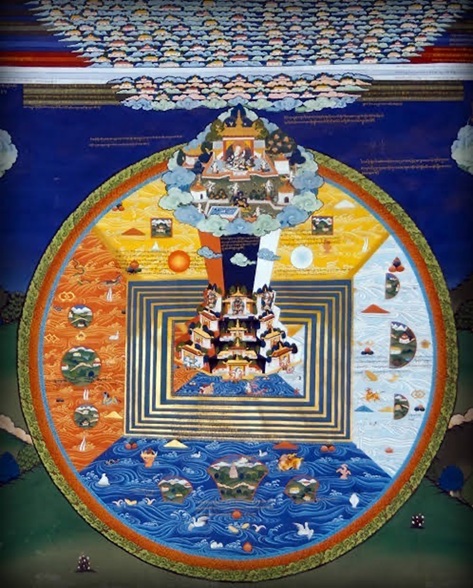
Vajrayana mandala representing the cosmos
Eros and AgapeReynolds's main complaint against Visser is that he has criticised Wilber's conception of Eros and Agape using reductionist scientific reasoning - scientism. He argues that if Visser were realised he would immediately see that Wilber was correct. As Reynolds explains. “Eros, in this context, is not the engine of evolution in a mechanistic sense. It is the interior recognition of the movement of Becoming as an expression of Being. It is how the unfolding of the universe appears when seen through the lens of awakened awareness. It is not an addition to science; it is a disclosure of meaning.” The problem with this is that the assumed community of the qualified, those who have claimed to have 'awakened awareness', do not necessarily agree with Wilber's metaphysical assumptions. Let's consider just three examples. The first is the shamanistic path through the use of psychotropic plants, most typically psilocybin mushrooms, peyote and ayahausca. Whilst it is possible to take these substances under the guidance of an authentic shaman (most are self-appointed), many people take them in a recreational setting. I can recall going on magic mushroom expeditions and tripping out. Participants report a wide variety of experiences including feeling at one with the universe. This method does not require any formal belief, meditation discipline or transmission by a guru. The second is the experience of union with God found amongst the Abrahamic faiths, the Jewish, Christian and Sufi mystics who may or may not follow a set of injunctions designed to generate enlightenment. Here I am thinking of those who inadvertently enter ecstatic states and struggle to explain them to the religious authorities. For example, Meister Eckhart who was condemned as a heretic by Pope John XXII in 1329. A personal favourite is Hildegard of Bingen who described having powerful visions starting when she was a child and who was fortunate to receive papal approval.
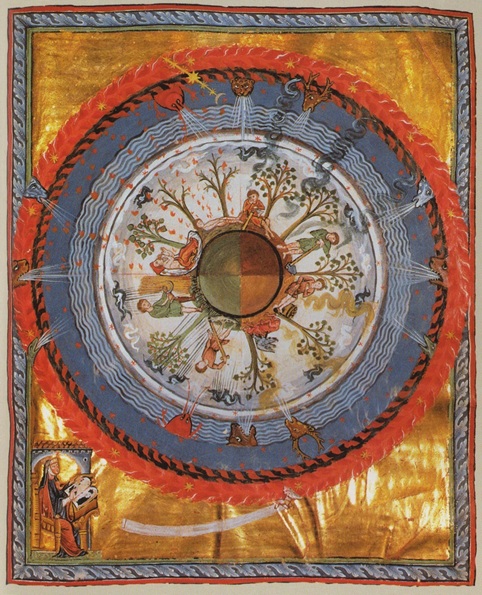
Artwork by Hildegard of Bingen
And the third, the Indian traditions, which has had the greatest impact on Wilber's metaphysics, especially Tantric Hinduism and Buddhism. This is a complex and varied tradition that focuses specifically on achieving enlightenment. However, unlike Christianity and Shamanism, it assumes reincarnation and many lifetimes of accumulated karmic merit to even begin the path to enlightenment. Lifetimes, a single lifetime, a psychotropic substance. An absurdly large cosmosAs I argued in my recent article Eros in an absurdly large cosmos a universe that consists of an estimated two trillion galaxies is far in excess of that needed for humans to achieve enlightenment. Even a single galaxy of two hundred billion stars is a ridiculous extravagance. For Wilber's claim that 'Kosmos' evolves towards realisation to make any sense we would need to be in contact with multiple other advanced civilisations to confirm that they also achieve enlightenment. At the moment the only known example is a single species a mere 500,000 years old living on one planet orbiting a single sun out of an estimated one septillion in a universe billions of years old - a mere flash of light on a spec of dust in a vast dust storm. Jung and IndividuationThere is a solution to this problem. The experience of enlightenment and the many theories used to explain it are a product of our minds. As I suggested in 'Eros in an absurdly large cosmos' humans have very vivid imaginations. We are able to construct elaborate and complex narratives just for entertainment. In my opinion the person who has done the most to explain human consciousness is Carl Jung (along with his followers). One of the first articles I wrote for Integral World was Revisioning Individuation: bringing Jung into the Integral fold. That was way back in 2001, 25 years ago. That article says everything I need to say about the archetypes, especially the archetype of the Self. To save time I am not going to repeat them here. What I will say is that the experience of nondual realisation can be understood as part of the process of Individuation.

Mandala by Jung
And following Jung we can say that all metaphysical explanations are projections of internal processes onto objective reality. Wilber's Eros/Agape is not a function of a 'Kosmos' of two trillion galaxies evolving to an omega point. It is the projection of an internal, subjective process onto the Kosmos. I do not think this diminishes the experience in any way. Conclusion As someone who understands and has followed a recognised spiritual path, and who has experienced nondual realisation, I claim to belong to the community of the qualified. And I agree with Visser's assessment. “The existence of depth in experience does not prove the existence of a divine essence. The dissolution of the ordinary self does not prove the existence of a cosmic Self. The experience of unity does not prove that reality is metaphysically One.” Widget is loading comments...
|