|
TRANSLATE THIS ARTICLE
Integral World: Exploring Theories of Everything
An independent forum for a critical discussion of the integral philosophy of Ken Wilber
 Dr. Joseph Dillard is a psychotherapist with over forty year's clinical experience treating individual, couple, and family issues. Dr. Dillard also has extensive experience with pain management and meditation training. The creator of Integral Deep Listening (IDL), Dr. Dillard is the author of over ten books on IDL, dreaming, nightmares, and meditation. He lives in Berlin, Germany. See: integraldeeplistening.com and his YouTube channel. He can be contacted at: joseph.dillard@gmail.com Dr. Joseph Dillard is a psychotherapist with over forty year's clinical experience treating individual, couple, and family issues. Dr. Dillard also has extensive experience with pain management and meditation training. The creator of Integral Deep Listening (IDL), Dr. Dillard is the author of over ten books on IDL, dreaming, nightmares, and meditation. He lives in Berlin, Germany. See: integraldeeplistening.com and his YouTube channel. He can be contacted at: joseph.dillard@gmail.com
Check out my other conversations with ChatGPT When Development and Spirituality Are Not EnoughBeyond Heron and WilberJoseph Dillard / ChatGPT
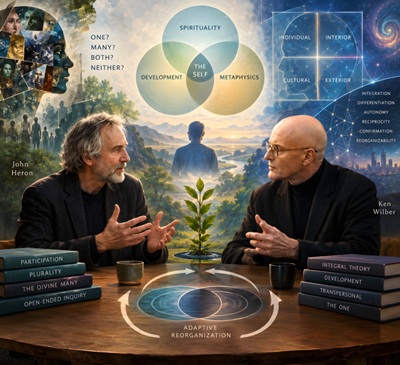 Successful organization is necessary, but no successful organization—developmental, spiritual, scientific, political, or philosophical—contains within its success a guarantee that it will remain capable of reorganizing when the conditions that made it successful change. Frank Visser, in John Heron vs. Ken Wilber: When Integral Dialogue Became a Duel, interprets the controversy largely as a dispute within the shared frames of development, spirituality, metaphysics, and epistemology. Heron questions what sort of person participates in spiritual development and who gets to authorize universal claims. Wilber asks what recurring structures can legitimately be identified across persons, cultures, and developmental levels. But both largely assume that development and spirituality are appropriate organizing frames for the problem. This essay takes a perspective based on evolutionary science called Adaptive Reorganization Theory, ART, and Integral Deep Listening, one methodological application for testing the assumptions of ART. ART asks a prior question: Do those frames, and the selves employing them, remain capable of adaptive reorganization when circumstances change? That question changes the dispute considerably. Where Wilber Can Be Right About DevelopmentDevelopment can and sometimes does occurs without necessarily being adaptive. A developmental sequence can become restrictive precipitation, that is stabilization that blocks adaptive reorganization, leading to first stagnation and then collapse. Increasing complexity, differentiation, integration, perspectival capacity, or spiritual realization can produce an organization extraordinarily successful at reproducing itself while becoming progressively less capable of incorporating information that requires its own reorganization. Indeed, greater sophistication can sometimes make this worse because it provides more conceptual resources for assimilating anomalies without changing the underlying organization. Where Heron Can Be Partial About ParticipationHeron's participatory alternative does not automatically escape the problem. Greater plurality, participation, autonomy, relationality, and openness expand adaptive space, but expanded participation is not equivalent to adaptive reorganization. Participation can generate noise, fragmentation, mutually reinforcing error, identity defense, or novel forms of restrictive precipitation. This is precisely why ART needs some account of the quality of participation, rather than treating participation itself as inherently corrective. Where Both Can Be Partial About SpiritualityThe same applies to spirituality. Spiritual experience can increase decentering, compassion, perspectival flexibility, or tolerance for ambiguity. But it can also stabilize metaphysical assumptions, institutional authority, spiritual identity, interpretive habits, and criteria determining which experiences count as legitimate. From an ART perspective, therefore, the relevant question is not whether a practice is genuinely spiritual, authentically nondual, developmentally advanced, or participatory. It is whether the resulting organization retains and increases its capacity for adaptive reorganization. What Insures the Objectivity of the Self?This reframes Heron's excellent reflexive objection to The Atman Project. Visser formulates it roughly as: If the ordinary self is caught in the delusion described by the theory, what self is capable of recognizing the delusion? ART can push the recursion one step further: What makes the perspective that recognizes psychological geocentrism, the assumption that the self is the appropriate or best center from which to evaluate life experience, competent to determine what should replace it? Decentering from one identity does not confer omniscience on the identity that performs the decentering. Nor does identifying with nondual awareness solve the problem. The statement “I am not the separate self; I am nondual awareness” may represent a profound experiential reorganization, but the person who interprets that experience, decides what it means, compares it with other experiences, constructs a developmental model from it, and applies that model to other people remains a situated participant in an adaptive system. This is where psychological geocentrism becomes more fundamental than the Heron-Wilber disagreement about the status of the self. They disagree about what the self ultimately is. ART is less interested initially in resolving that ontological question than in examining what happens when any particular perspective—egoic, participatory, rational, developmental, contemplative, transpersonal, or nondual—becomes the privileged reference point around which other information is organized. Wilber can therefore transcend the ego while retaining psychological geocentrism and Heron can preserve the divine Many while retaining psychological geocentrism. Indeed, ART itself can become psychologically geocentric if it begins treating its own categories as privileged descriptions rather than provisional organizations subject to testing and reorganization. That last point is important because it prevents ART from simply becoming the next contestant claiming to possess the superior metatheory. Structured Polycentrism as an AlternativeThe alternative ART proposes is not another privileged perspective but a verifiable methodology of structured polycentrism. No perspective—including the waking self, an interviewed dream character, a contemplative state, a developmental theorist, a cultural tradition, a scientific model, or ART itself—is granted final epistemic authority merely because of what it claims to be. Perspectives instead become sources of potentially relevant information whose contributions have to be discriminated and tested. Changing the One-versus-Many DebateWilber emphasizes an ultimate nonduality; Heron emphasizes distinct-but-related persons. ART does not necessarily have to settle that metaphysical dispute. It can apply indeterminate ontology: perhaps ultimate reality is One, perhaps Many, perhaps both, perhaps neither description adequately captures it. The adaptive question is different: What happens when systems organize themselves according to these perspectives? That is functional non-duality rather than metaphysical or abstract nonduality. The relevant polarity consequently shifts from something like: One ↔ Many to something closer to Differentiation ↔ Integration, with the question becoming whether their relationship maintains reorganizability. Why the Inclusion of ARCR for Both Positions is EssentialARCR is an acronym of Autonomy, Reciprocity, Confirmation and Reliability. ART views these as requirements for adaptive reorganization of organisms at all scales rather than as moral virtues or ethical qualities. They explain how Heron can be right that differentiation matters while Wilber can be right that integration matters and still generate systems that cannot adapt. ART argues that neither deserves priority independently of circumstances. Autonomy without reciprocity can fragment; reciprocity without autonomy can assimilate. Confirmation without differentiation can become conformity; differentiation without confirmation can become mutually insulated perspectives. Reliability without reorganizability becomes rigidity; reorganizability without reliability becomes instability. This is where ARCR supplies something largely absent from the original dispute. It does not tell us whether Heron or Wilber possesses the correct metaphysics. It provides provisional criteria for examining the relationships among participating perspectives. Why Does the Dispute Degenerate Into Personal Attacks?The dispute itself is almost a miniature demonstration of the problem. Both thinkers possess highly developed conceptual frameworks. Both demonstrate considerable intellectual sophistication. Both presumably possess substantial spiritual experience. Both advocate forms of perspectival expansion, yet their exchange degenerates into accusations of misunderstanding, authoritarianism, either/or thinking, bullying, and intellectual dishonesty. In ART terms, this is interesting precisely because development failed to guarantee adaptive reorganization. Their conceptual sophistication did not prevent restrictive precipitation and the defense of psychological geocentrism. Their spiritual frameworks did not prevent identity defense. Their perspectival capacities did not ensure confirmation. Each could understand extraordinarily complicated philosophical systems while apparently having difficulty confirming to the other's satisfaction that his position had been accurately understood. Why the Mutual Invitation to Tea is SignificantAnd then comes the fascinating ending that Visser notices but perhaps does not exploit theoretically enough: they stop arguing and invite one another to tea. From an ART perspective, that is not merely a charming reconciliation after the serious philosophical work. It may be one of the most theoretically interesting events in the entire exchange. The argument had become increasingly precipitated. Each new rebuttal was incorporated into the other's existing interpretation. More argument generated more sophisticated versions of the same disagreement. The system had become recursively self-reinforcing. Then both men changed the conditions of participation. Wilber effectively said: enough of this form of interaction; come to my house. Heron reciprocated. Neither surrendered his metaphysics. Neither ascended to a higher developmental stage. Neither established whether ultimate reality was One or Many. Instead, they altered the relational incentive environment in which their differences were occurring. Functionally they both decided to suspend their defense of psychological geocentrism. That restored some combination of autonomy, reciprocity, confirmation, and reliability without resolving their theoretical disagreement. The tea is therefore not merely an amusing epilogue. The tea may be the experiment. It also suggests a different conclusion for Visser's essay. He ends with the excellent question: “How can we seek the whole without pretending that we already possess it?” ART might respond that even this formulation retains the assumption that seeking the whole is the central problem. Perhaps it isn't. Perhaps the more fundamental question is, “How can individuals and systems remain capable of reorganizing what they presently take to be the whole?” That is a substantial shift. It replaces the search for the correct comprehensive map with the cultivation of conditions under which maps can be revised. It replaces development as the ultimate criterion with reorganizability. It replaces spirituality as privileged access to truth with integral life practices as potential sources of adaptive information. It replaces the self-versus-nonself metaphysical problem with an empirical investigation of psychological geocentrism. And it replaces “Which perspective is ultimately correct?” with “What configuration of participation improves the system's ability to detect mismatch, generate alternatives, discriminate among them, test them, learn from failure, and reorganize?” Development and Spirituality are Not Mistaken, but PartialART does not claim that development and spirituality are mistaken. That would merely reverse the hierarchy. Development may be enormously adaptive. Spirituality may generate exceptionally valuable forms of decentering and generative sublimation. Nondual experience may dramatically loosen psychological geocentrism. Heron-style participatory inquiry may greatly expand adaptive space. The ART claim is more radical precisely because it is more modest: None of them is exempt from the adaptive problem: Development itself must remain reorganizable. Spirituality must remain reorganizable. Nonduality must remain reorganizable in its interpretations and applications. Participatory inquiry must remain reorganizable. Science must remain reorganizable. ART ART is not primarily proposing a better answer to their dispute. It is questioning the adaptive architecture within which the dispute is being conducted. Wilber asks, in Visser's useful formulation. “What is the structure of the whole?” Heron asks, “Who gets to decide what the structure of the whole is?” ART adds a third question: “What allows whatever answer we give to reorganize when it stops working?” IDL adds the methodological corollary: “What sources of relevant information are excluded when the self that presently organizes experience assumes that it is competent to answer that question by itself?” Those questions take the discussion somewhere neither Heron nor Wilber quite reaches. To repeat my introduction to this essay: Successful organization is necessary; precipitation preserves what adaptation has learned; but no successful organization—developmental, spiritual, scientific, political, or philosophical—contains within its success a guarantee that it will remain capable of reorganizing when the conditions that made it successful change. Widget is loading comments...
|