|
TRANSLATE THIS ARTICLE
Integral World: Exploring Theories of Everything
An independent forum for a critical discussion of the integral philosophy of Ken Wilber
 Dr. Joseph Dillard is a psychotherapist with over forty year's clinical experience treating individual, couple, and family issues. Dr. Dillard also has extensive experience with pain management and meditation training. The creator of Integral Deep Listening (IDL), Dr. Dillard is the author of over ten books on IDL, dreaming, nightmares, and meditation. He lives in Berlin, Germany. See: integraldeeplistening.com and his YouTube channel. He can be contacted at: joseph.dillard@gmail.com Dr. Joseph Dillard is a psychotherapist with over forty year's clinical experience treating individual, couple, and family issues. Dr. Dillard also has extensive experience with pain management and meditation training. The creator of Integral Deep Listening (IDL), Dr. Dillard is the author of over ten books on IDL, dreaming, nightmares, and meditation. He lives in Berlin, Germany. See: integraldeeplistening.com and his YouTube channel. He can be contacted at: joseph.dillard@gmail.com
SEE MORE ESSAYS WRITTEN BY JOSEPH DILLARD
Check out my other conversations with ChatGPT Michael Levin, Basal Cognition, and Adaptive Reorganization TheoryToward a General Science of Adaptive OrganizationJoseph Dillard / ChatGPTMichael Levin has become one of the most original and influential developmental biologists of the twenty-first century. His work on developmental bioelectricity, regeneration, and what he calls basal cognition has challenged long-standing assumptions about how living systems organize themselves. Rather than treating genes as blueprints that mechanically specify anatomical form, Levin argues that cells communicate through bioelectric networks that coordinate collective behavior, enabling tissues to build, repair, and regenerate complex bodies.1 These networks exhibit properties traditionally associated with cognition: memory, error correction, adaptation, and flexible problem solving.2 Evolution, on this view, did not invent intelligence with brains. It progressively scaled preexisting physiological competencies into increasingly sophisticated forms of organization.3 Adaptive Reorganization Theory (ART) and Integral Deep Listening (IDL) intersect with Levin's work in profound ways. They share a commitment to understanding adaptive organization across multiple scales, reject reductionistic accounts that equate explaining components with explaining wholes, and treat coordination rather than isolated entities as the fundamental unit of explanation. Yet they differ in important respects. Levin's experimental program remains grounded primarily in developmental and regenerative biology, although his theoretical work increasingly extends to cognition, artificial intelligence, and diverse forms of agency. ART generalizes adaptive principles still further across psychological, organizational, scientific, civilizational, and artificial systems. IDL, in turn, proposes an experimentally testable methodology for increasing adaptive reorganizability within human cognition.
Rather than competing, these approaches are largely complementary. Levin provides ART with one of its strongest independent scientific convergences.4 Beyond Genetic ReductionismOne of Levin's most important contributions is demonstrating that genes do not directly specify anatomical form. Genes produce proteins, proteins regulate cellular behavior, but the remarkable reliability of morphogenesis—the construction and repair of highly organized bodies despite injury, perturbation, and developmental variability—requires an additional level of organization. Cells communicate through bioelectric signaling networks that coordinate their activities across tissues, allowing large-scale anatomical structures to emerge and regenerate.5 ART begins from a parallel observation at a much broader scale. Knowledge does not automatically generate adaptability. Development does not automatically generate wisdom. Complexity does not automatically generate reorganizability. Just as genes alone cannot explain coordinated morphogenesis, intelligence, technology, institutions, and development alone cannot explain why adaptive systems remain capable of successful reorganization over time. In both frameworks, organization becomes the central explanatory problem. From Basal Cognition to Adaptive Reorganization Levin describes biological systems as exhibiting basal cognition. Cells display competencies that include sensing, memory, error correction, and context-sensitive adaptation. These competencies do not require nervous systems. They emerge from distributed communication among many interacting cells organized through bioelectric signaling.6 Evolution subsequently scales these competencies into increasingly sophisticated forms of cognition. ART welcomes this general direction while proposing a different conceptual vocabulary. One place where ART may deliberately diverge concerns anthropomorphic language. Levin often speaks of cellular “goals,” “preferences,” “decisions,” and “intelligence.”7 These terms successfully challenge mechanistic reductionism but also risk projecting human-level cognition onto simpler adaptive systems.
ART prefers language that remains closer to cybernetics and dynamical systems:
adaptive orientations preferred organizations organizational attractors reference states adaptive dispositions
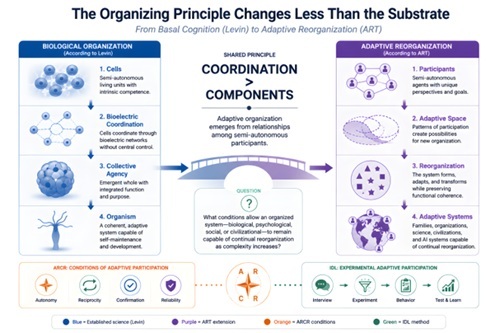
These concepts describe persistent tendencies of reorganization without implying conscious purpose or psychological intention. Cells need not “want” to regenerate. Adaptive systems need only exhibit stable tendencies toward particular organizations under given constraints. This seemingly minor linguistic difference has significant theoretical consequences. ART attempts to formulate principles that apply equally well to embryos, immune systems, corporations, scientific communities, civilizations, and artificial intelligence without requiring anthropomorphic interpretations. Coordination Rather Than ComponentsPerhaps Levin's deepest insight is that biological intelligence is fundamentally collective. Organisms are not centralized controllers directing passive cells. Rather, coherent organisms emerge because billions of semi-autonomous cells continuously coordinate their activities across multiple spatial and temporal scales. Bioelectric signaling functions as what Levin calls the “cognitive glue” binding these cellular competencies into larger adaptive organizations.8 ART proposes an analogous principle. Adaptive organization depends upon the quality of participation among constituent elements. At the biological level these participants are cells. Within organizations they are individuals and departments. Within science they are investigators, institutions, and competing hypotheses. Within civilizations they include governments, markets, educational systems, media, and citizens. Within IDL they become interviewed perspectives that ordinarily remain excluded from conscious participation. The principle remains constant while the substrate changes. Scale-Free Organization Levin has increasingly argued that cognition scales continuously across biological organization. Rather than treating minds as binary properties possessed only by nervous systems, he proposes a continuum extending from single cells through tissues, organisms, and increasingly sophisticated cognitive architectures.9 ART extends this scaling principle beyond biology. Adaptive organization appears at multiple nested levels:
↓ Cells ↓ Organisms ↓ Families ↓ Organizations ↓ Scientific communities ↓ Civilizations ↓ Artificial intelligence
The adaptive principles governing successful reorganization may therefore prove remarkably general, even while their specific mechanisms differ. Levin's Computational Boundaries and ART's Adaptive SpaceLevin introduces the important concept of computational boundaries. Biological individuality emerges when formerly independent agents become integrated into larger systems capable of coordinated behavior. Evolution can expand computational boundaries when previously more independent agents become successfully integrated into higher-order systems of coordinated activity.10 ART proposes a closely related but broader concept: adaptive space. Adaptive space encompasses the range of organizational possibilities available to an adaptive system. Reorganization becomes adaptive when participation expands the accessible region of adaptive space while preserving functional coherence. This distinction is subtle but important. Levin primarily studies how larger adaptive agents emerge. ART studies the conditions under which adaptive agents remain capable of continual reorganization after they have already emerged. Where ART Extends Levin Levin's research focuses primarily upon developmental biology, regeneration, and morphogenesis. ART asks whether similar adaptive principles govern: organizational rigidity scientific paradigm shifts bureaucratic ossification democratic decline civilizational collapse artificial intelligence alignment psychological development dreaming and adaptive sublimation
These questions concern reorganizability rather than morphogenesis. The central puzzle shifts from: How do adaptive systems build organized structures? to: How do adaptive systems preserve the capacity for successful reorganization as complexity increases? This question becomes increasingly important at higher organizational scales.
ARCR as a General Theory of Adaptive ParticipationHere ART contributes something absent from Levin's framework. Adaptive Reorganization Theory proposes that successful adaptive participation depends upon four relational conditions: autonomy, reciprocity, confirmation, and reliability. Together these constitute ARCR.11 ART treats these as adaptive conditions that increase the capacity of distributed systems to reorganize successfully over time.
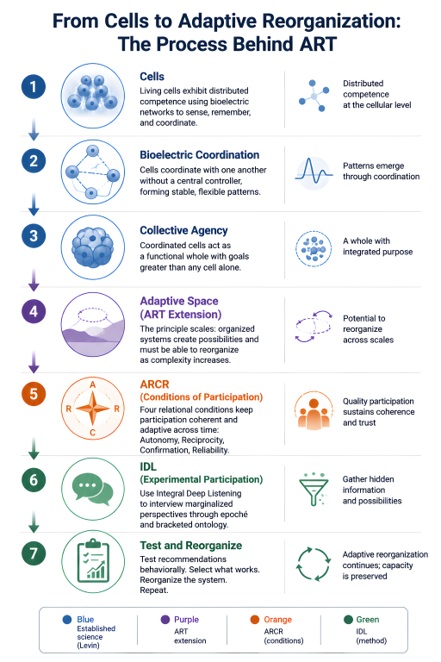
Levin demonstrates that coordination matters while ARCR attempts to specify the relational qualities that make coordination adaptive. Whether future biological research ultimately reveals analogous principles operating within multicellular systems remains an intriguing open question.12 IDL as Experimental Adaptive ParticipationPerhaps the greatest difference between Levin and ART concerns methodology. Levin experimentally manipulates bioelectric signaling to study how cellular collectives reorganize anatomy. IDL experimentally manipulates participation among perspectives to study how human adaptive systems reorganize cognition.13 These interviewed perspectives are intentionally approached through indefinite ontology. They are not assumed to be parts, archetypes, unconscious complexes, spirits, morphic fields, or objective entities. Their metaphysical status remains suspended. Their adaptive value is evaluated behaviorally. This methodological restraint gives IDL unusual theoretical flexibility. If future neuroscience explains interviewed perspectives as emergent neural organizations, IDL remains compatible. If predictive processing proves most useful, IDL remains compatible. If Levin's multiscale cognition eventually expands into richer theories of distributed agency, IDL remains compatible. If entirely new theories emerge, IDL remains compatible. Its experimental methodology remains independent of any single ontology.14 Ontological neutrality does not imply theoretical neutrality: explanations can still be compared according to their predictive power, explanatory economy, and functional fit with observed outcomes. ConclusionMichael Levin may ultimately become for developmental biology what John Holland was for complex adaptive systems or what Karl Friston has become for predictive processing: a thinker who redirects an entire field toward organization, information, and adaptive coordination. ART does not compete with that program. It extends its logic. The relationship between the two frameworks is therefore asymmetrical. Levin provides ART with compelling biological evidence that adaptive organization emerges through distributed coordination rather than centralized control. ART broadens that principle into a general theory of adaptive reorganizability applicable to psychological, organizational, scientific, civilizational, and artificial systems. IDL then supplies an experimentally testable human methodology for increasing adaptive participation through systematic engagement with otherwise marginalized perspectives. Levin's experiments demonstrate several biological phenomena independently predicted or emphasized by ART. ART proposes a broader generalization: ARCR and IDL generate additional hypotheses that remain to be tested. If Levin demonstrates how evolution learned to coordinate cells into coherent organisms, ART asks the next question: What conditions allow any adaptive system—biological, psychological, social, or civilizational—to remain capable of continual reorganization rather than becoming trapped by its own prior success?
Notes1. Michael Levin, “Bioelectric Signaling: Reprogrammable Circuits Underlying Embryogenesis, Regeneration, and Cancer,” Cell 184, no. 8 (2021): 1971-89, https://doi.org/10.1016/j.cell.2021.02.034. Levin reviews evidence that endogenous membrane-voltage patterns generated by ion channels and gap junctions coordinate cell behavior at tissue and organ scales. These bioelectric networks influence gene expression and morphogenesis and can participate in restoring large-scale anatomical organization following perturbation. The significance for ART is that anatomical organization cannot be adequately described merely by enumerating molecular components; coordination among those components is itself causally important. 2. Michael Levin, “Bioelectric Networks: The Cognitive Glue Enabling Evolutionary Scaling from Physiology to Mind,” Animal Cognition 26, no. 6 (2023): 1865-91, https://doi.org/10.1007/s10071-023-01780-3. Levin's basal-cognition program treats capacities normally associated with cognition as existing in simpler forms below the level of nervous systems. The relevant claim is not that individual cells possess human-like cognition, but that biological systems can exhibit memory, goal-directed error correction, information processing, and adaptive responses without brains. This distinction is important for ART because it permits functional continuities across scales without requiring psychological equivalence between those scales. 3. Michael Levin, “Technological Approach to Mind Everywhere: An Experimentally-Grounded Framework for Understanding Diverse Bodies and Minds,” Frontiers in Systems Neuroscience 16 (2022), https://doi.org/10.3389/fnsys.2022.768201; Levin, “Bioelectric Networks.” Levin proposes that evolution did not suddenly invent cognition with nervous systems. Rather, mechanisms involved in cellular and physiological homeostasis, information processing, and coordination were progressively recruited into larger-scale cognitive architectures. His account describes an “evolutionary pivot” in which capacities originally used to navigate physiological and anatomical problem spaces became available for behavioral navigation. 4. The characterization of Levin's work as an “independent scientific convergence” with ART is an ART interpretation, not a claim made by Levin. The convergence concerns distributed organization, multiscale competency, collective problem solving, and the causal importance of coordination. Levin's framework should therefore be treated as independent evidence compatible with several ART premises rather than as empirical confirmation of ART itself. This qualification is important because ART extends these principles into psychological, organizational, scientific, civilizational, and artificial systems for which Levin's biological experiments do not themselves provide evidence. 5. Jessica L. Whited and Michael Levin, “Bioelectrical Controls of Morphogenesis: From Ancient Mechanisms of Cell Coordination to Biomedical Opportunities,” Current Opinion in Genetics & Development 57 (2019): 61-69, https://doi.org/10.1016/j.gde.2019.06.014; Alexis Pietak and Michael Levin, “Bioelectrical Control of Positional Information in Development and Regeneration: A Review of Conceptual and Computational Advances,” Progress in Biophysics and Molecular Biology 137 (2018): 52-68, https://doi.org/10.1016/j.pbiomolbio.2018.03.008. These reviews describe cell-to-cell bioelectrical communication as one mechanism by which local cellular activity becomes integrated with large-scale pattern formation. Gap-junction coupling and membrane-voltage states can carry instructive information affecting gene regulatory and signaling networks rather than merely reflecting downstream cellular activity. 6. Michael Levin, John Selberg, and Marco Rolandi, “Endogenous Bioelectrics in Development, Cancer, and Regeneration: Drugs and Bioelectronic Devices as Electroceuticals for Regenerative Medicine,” iScience 22 (2019): 519-33, https://doi.org/10.1016/j.isci.2019.11.023. Levin and colleagues distinguish genetically specified cellular “hardware” from physiological processes that function more like reprogrammable control systems. The analogy should not be interpreted literally as implying software separable from biological embodiment. Its significance is that cells with essentially the same genome can participate in very different large-scale anatomical outcomes depending upon higher-order regulatory states. 7. Levin intentionally uses terms such as goals, preferences, decisions, and intelligence in a functional rather than necessarily phenomenological sense. For example, he describes organisms as collective intelligences possessing goals, preferences, and memories at scales not reducible to those of their individual cellular constituents. Michael Levin, “Bioelectric Networks”; see also Levin, “Technological Approach to Mind Everywhere.” ART's preference for terms such as adaptive orientation, reference state, and organizational attractor therefore represents primarily a difference in theoretical vocabulary rather than a rejection of Levin's experimental findings. 8. Levin, “Bioelectric Networks.” Levin calls bioelectric networks “cognitive glue” because electrical coupling offers a mechanism through which formerly local physiological competencies can become integrated into larger collective agents. His broader claim is that intelligence is inherently collective: organisms themselves consist of competent subunits whose interactions produce capacities possessed by the higher-order whole rather than by any single constituent. 9. Michael Levin, “The Computational Boundary of a 'Self': Developmental Bioelectricity Drives Multicellularity and Scale-Free Cognition,” Frontiers in Psychology 10 (2019): 2688, https://doi.org/10.3389/fpsyg.2019.02688; Michael Levin, “Collective Intelligence: A Unifying Concept for Integrating Biology across Scales and Substrates,” Communications Biology 7 (2024). Levin explicitly rejects a binary division between cognitive and noncognitive biological systems in favor of gradations of competency operating in different problem spaces and at different organizational scales. The claim is not that cognition is identical at every scale but that experimentally investigable continuities connect relatively simple homeostatic competencies to increasingly complex collective agency. 10. Levin, “The Computational Boundary of a 'Self.'” Levin describes the functional boundary of an agent in terms of the spatiotemporal scale of events it can sense, model, pursue, and influence—its “computational surface” or cognitive boundary. Multicellularity can therefore be understood partly as the integration of smaller competent agents into larger agents capable of pursuing outcomes across expanded spatial and temporal scales. ART's concept of adaptive space is related but not identical: it refers to the range of organizational possibilities accessible to a system and therefore focuses more directly on reorganizability than on the boundary defining an agent. 11. ARCR—autonomy, reciprocity, confirmation, and reliability—is an original hypothesis of Adaptive Reorganization Theory and Integral Deep Listening, not a concept derived from Levin. ART defines these terms functionally rather than morally. Autonomy refers to preservation of sufficient independent organization for a participant to contribute distinct information; reciprocity to bidirectional influence among participants; confirmation to iterative testing of signals, interpretations, or contributions for functional fit; and reliability to sufficient consistency of relationships and responses for coordination and learning to persist through time. ART hypothesizes that these conditions increase the probability that expanded participation will produce sustainable adaptive reorganization rather than fragmentation or destructive destabilization. This hypothesis requires empirical testing across domains. 12. Levin's research supplies considerable evidence that coordination, communication, and maintenance of larger-scale organization matter in multicellular systems, but it does not currently establish ARCR as a biological law. The suggestion that biological systems may display functional analogues of autonomy, reciprocity, confirmation, and reliability is therefore an ART prediction. It becomes scientifically useful precisely because it can fail: if sustainable collective adaptation routinely occurs without functional counterparts of these conditions, the proposed generality of ARCR would be weakened. Levin's recent work on multiscale collective intelligence provides a promising domain in which such propositions might eventually be operationalized and tested. 13. The comparison between Levin's experimental manipulation of bioelectric networks and IDL's manipulation of perspectival participation is an analogy of research strategy, not an assertion that the mechanisms are equivalent. Levin experimentally modifies ion-channel activity, gap-junction coupling, and bioelectric states and observes changes in anatomical outcomes. IDL alters the conditions under which normally marginalized or weakly represented perspectives participate in conscious problem solving and evaluates whether this produces behavioral changes. The appropriate empirical question for IDL is therefore whether systematic increases in perspectival participation, under specified ARCR conditions, produce measurable improvements in adaptive reorganizability relative to appropriate controls. For Levin's experimental program, see Levin, “Bioelectric Signaling,” and Juanita Mathews and Michael Levin, “The Body Electric 2.0: Recent Advances in Developmental Bioelectricity for Regenerative and Synthetic Bioengineering,” Current Opinion in Biotechnology 52 (2018): 134-44, https://doi.org/10.1016/j.copbio.2018.03.008. 14. Indefinite ontology is a methodological principle of IDL. Interviewed perspectives are provisionally treated according to their observable functions, relationships, reports, predictions, and behavioral consequences rather than assigned a predetermined metaphysical or psychological identity. IDL therefore need not determine whether such perspectives are neural assemblies, predictive models, dissociated cognitive organizations, symbolic constructions, emergent agents, or something else before investigating their functional consequences. This epistemological suspension resembles epoché in phenomenological methodology, although IDL gives it a specifically experimental purpose: competing ontological interpretations are bracketed while functional predictions are tested. Widget is loading comments...
|