|
TRANSLATE THIS ARTICLE
Integral World: Exploring Theories of Everything
An independent forum for a critical discussion of the integral philosophy of Ken Wilber
 Dr. Joseph Dillard is a psychotherapist with over forty year's clinical experience treating individual, couple, and family issues. Dr. Dillard also has extensive experience with pain management and meditation training. The creator of Integral Deep Listening (IDL), Dr. Dillard is the author of over ten books on IDL, dreaming, nightmares, and meditation. He lives in Berlin, Germany. See: integraldeeplistening.com and his YouTube channel. He can be contacted at: joseph.dillard@gmail.com Dr. Joseph Dillard is a psychotherapist with over forty year's clinical experience treating individual, couple, and family issues. Dr. Dillard also has extensive experience with pain management and meditation training. The creator of Integral Deep Listening (IDL), Dr. Dillard is the author of over ten books on IDL, dreaming, nightmares, and meditation. He lives in Berlin, Germany. See: integraldeeplistening.com and his YouTube channel. He can be contacted at: joseph.dillard@gmail.com
SEE MORE ESSAYS WRITTEN BY JOSEPH DILLARD Beyond Metaphysical InflationSupplementing Abstract Non-Dualism With Functional Non-DualismJoseph Dillard
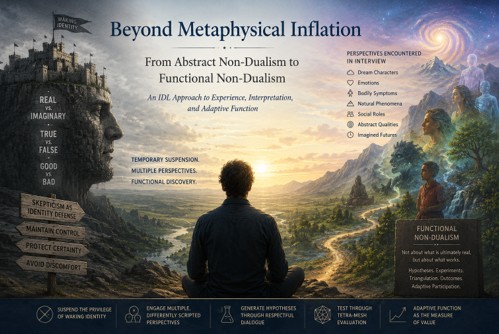 Frank Visser's recent essay, Mystical Oneness: Experience, Interpretation, and the Problem of Metaphysical Inflation, performs an important philosophical service. It reminds readers that mystical experiences do not automatically justify metaphysical conclusions. The experience of "oneness" is one thing; the claim that reality itself is fundamentally One is quite another. This distinction between phenomenology and ontology deserves far greater attention than it has generally received in both religious and integral discourse. The central claim of this essay is that my work, Integral Deep Listening (IDL), extends phenomenological suspension beyond metaphysical interpretation to include the epistemic privilege of waking identity itself. Functional non-duality therefore becomes not a doctrine about reality but an experimental method for generating and testing perspectives differently scripted from ordinary consciousness. Visser's analysis, while disciplined, still leaves one important step unexamined. He suspends metaphysical interpretation but continues to privilege psychological and neuroscientific interpretation. From the perspective of IDL, the suspension of interpretation must go further. The issue is not merely whether mystical experiences reveal ultimate reality. The deeper question is whether any explanatory framework—religious, philosophical, psychological, or neuroscientific—should itself be exempt from critical suspension. I do not believe Frank Visser makes that assumption, but it is an easy one to overlook, and it needs to be made explicit. IDL therefore proposes a more comprehensive epoché that brackets not only metaphysical claims but explanatory claims as well, redirecting inquiry toward adaptive function rather than ontological certainty. The First EpochéVisser correctly distinguishes between experience and the meanings subsequently attached to it. A report such as, “I became one with the universe,” is phenomenological. The conclusion, “Reality therefore consists of one universal consciousness,” is metaphysical. The experience does not logically entail the doctrine. Religious traditions have repeatedly converted similar experiential structures into radically different ontologies. Christian mystics describe union with God. Advaita interprets the same broad class of experiences as realization of Brahman. Buddhism often frames them in terms of emptiness or non-self. The diversity of interpretations itself counsels epistemic restraint. The Second EpochéYet suspension should not end with religion. Replacing "I experienced Brahman" with “my default mode network temporarily reduced self-referential processing” may sound more objective, but it too is an interpretation. Neither the default mode network nor predictive processing nor self-modeling appear directly in experience. These are explanatory models that may prove scientifically fruitful, but they remain theoretical constructions rather than phenomenological givens. IDL therefore extends the same skepticism to scientific reductionism that Visser applies to metaphysical inflation. Both religious and neuroscientific explanations are valuable hypotheses. Neither should be mistaken for experience itself. The Persistence of Psychological GeocentrismEven after metaphysical claims have been suspended, another assumption often survives unnoticed: The waking self remains the unquestioned center of inquiry. The grammar reveals it: “I experienced…” “My awareness expanded…” “My ego dissolved…” The narrator survives every account. IDL refers to this assumption as psychological geocentrism: the tendency to regard waking identity as the privileged observer around which all legitimate knowledge revolves. Mystical experience may soften egocentrism while leaving this deeper epistemological assumption intact. The question therefore shifts from “What did I experience?” to “Must waking identity remain the sole authoritative interpreter of experience?” Why Interview Other Perspectives? IDL responds by interviewing perspectives that ordinarily remain outside the waking self's habitual identity. These include dream characters, emotions, illnesses, imagined futures, bodily symptoms, natural phenomena, transpersonal experiences, social roles, historical figures, or abstract qualities such as fear, justice, compassion, or emptiness. The important point is that IDL deliberately suspends their ontology. It does not ask whether these perspectives are independently real, unconscious complexes, imaginative constructions, archetypes, spiritual beings, or neurological simulations. During the interview, waking identity temporarily relinquishes its priority as the sole organizer of experience while retaining its later role as evaluator. Instead, it asks what recommendations emerge when these perspectives are engaged respectfully and phenomenologically. IDL replaces ontological certainty with procedural rigor. This naturally raises an obvious question. Why should these perspectives offer anything useful? “This is Shadow/Parts Work”Jungian active imagination, Gestalt empty chair, Psychodrama, Internal Family Systems (IFS) parts work, Voice Dialogue, and even certain mindfulness or focusing techniques all interview imaginal perspectives. The difference lies in function: these therapies view the purpose of interviewing perspectives as supportive of self-integration. The object is to produce a more healthy, balanced, or actualized self. Jung's individuation provides one example, but all the approaches and many more assume that self development is the goal of therapy. But what if the variety of adaptation required is not centered on strengthening the self? What then? These therapies do not provide an answer to that question. IDL does. By temporarily suspending the assumption that self healing, balancing, and transformation is the priority, it opens the individual to reframings that are not filtered through identity and may be more adaptive than identity. Because IDL is phenomenological the determination of the ontological status of an interviewed perspective is not the focus of the methodology. Instead it asks, “Does a phenomenological approach provide reframings that result in objectively observable improvements in adaptation?” This suspension of interpretation is also a matter of respect. We are affording to the interviewed other the same degree of autonomy that we expect others to extend to us. While we may be mere symbols to others, that is not how we view ourselves. While we may serve as projections of the interests, feelings, and priorities of others, that is not how we view ourselves. We are more than how others define and perceive us. Therefore, in an act of respect and reciprocity, IDL temporarily suspends such assumptions and allows interviewed perspectives the opportunity to define themselves and express their priorities. Does IDL Simply Give Permission for Projection?Projection occurs and IDL expects it to occur. Projection is not regarded as a failure of the method but as one of the phenomena the method exposes. Because recommendations are operationalized, tested, and triangulated with external feedback, persistent projection tends to reveal itself behaviorally rather than remaining protected by introspection. Relative Freedom from ConditioningIDL does not claim that perspectives encountered in interview possess privileged access to truth, nor that they represent higher consciousness, enlightened awareness, or ultimate reality. Their potential value lies elsewhere. They are relatively less conditioned by the particular scripting that organizes waking identity. “Scripting” refers to the largely automatic interpretive habits created by biological imperatives, developmental learning, family systems, cultural narratives, religious assumptions, social institutions, and personal history. These scripts organize perception before conscious reflection occurs. Human identity develops within overlapping systems of conditioning. Biologically, survival organizes attention around food, security, reproduction, status, and threat. Children quickly internalize distinctions between good and bad, acceptable and unacceptable, success and failure, belonging and exclusion. Culturally and religiously, identities absorb shared assumptions about reality, morality, gender, authority, and meaning. Socially, responsibilities to occupation, nation, institutions, reputation, and group membership further stabilize particular interpretations of experience. These forms of conditioning are indispensable. They make coherent social life possible, yet they also narrow perception. They encourage the mind to repeatedly organize experience according to familiar scripts or cognitive constructs. IDL does not assume that conditioning disappears when another perspective is interviewed. Rather, conditioning appears to be unevenly distributed across perspectives. Just as different people notice different aspects of the same event because they occupy different social and psychological locations, perspectives encountered in interview appear to organize experience around different assumptions than waking identity. Their value therefore lies not in being unconditioned but in being conditioned differently. Perspectives encountered in interview participate differently in these constraints. As encountered in interview, a dream mountain does not ordinarily express concerns organized around biological survival. Interviewed nightmare monsters rarely organize experience around employment, reputation, or economic survival. Depression personified as a deep hole does not ordinarily divide experience into the familiar moral dualisms through which waking identity routinely interprets events. An interviewed perspective may express preferences, values, assumptions, or even obvious cognitive biases, but these are often organized differently from those of the waking personality. Consequently, such perspectives may disclose possibilities that remain invisible within ordinary self-reference. We do not know if the conditioning of interviewed perspectives is helpful or not until it is tested, which is exactly what IDL proposes to do. Relative Rather Than Absolute Non-DualityThis distinction is essential. IDL does not regard perspectives encountered in interview as absolutely non-dual. They frequently express biases. They may contradict themselves. While some prove remarkably insightful, others may prove trivial, confused, defensive, grandiose, or simply mistaken. They are neither infallible nor spiritually privileged. Their value lies precisely in their difference. Waking consciousness spends enormous energy protecting identity, reputation, consistency, goals, security, and status. Perspectives encountered in interview often don't. That is why they surprise us. Their relative epistemic value appears to derive less from possessing superior knowledge than from investing less cognitive energy in defending waking identity. Because they are relatively less constrained by the biological, familial, cultural, and social scripting that structures of waking identity, they often approach situations from unexpected directions. They are less engaged in identity maintenance and as a consequence, may provide an epistemic advantage associated with the temporary suspension of normal waking filtering of information. Their relative freedom from ordinary identity maintenance makes them useful participants in triangulation. Triangulation is a problem-solving and validation strategy that compares waking experience, the input of external others, and the input of interviewed “interior” others. Interviewed others are subjective sources of objectivity. They are subjective because they are at least partially self-aspects. They are relatively objective in that they are not subject to the same scripting conditioning that we are. Decision-making consulting all three of these sources is superior to consulting only our own reasoning and intuition, or only external authority, or both. Functional Non-DualityIDL speaks of functional non-duality rather than metaphysical non-duality because these perspectives reframe life issues in specific ways and make recommendations that can be operationalized and tested empirically. This is not generally done with metaphysical non-dual experience because of its global, abstract nature. The issue is not whether perspectives encountered in interview transcend all conditioning. They don't. The issue is whether they are relatively free of the assumptions that form waking identity, thereby expanding the range of adaptive possibilities available for investigation. Most discussions of non-duality remain concerned with ultimate reality. IDL asks a different question. Not, “What is reality ultimately?” but, “What recommendations improve adaptive participation?” The recommendations generated by perspectives encountered in interview are treated neither as revelations nor as fantasies. Functional non-duality is not a state, practice, method, or outcome. Rather, it is a perspective that is not centered on good/bad, right/wrong, true/false, real/imaginary dualisms and, at the same time, is operational. The Assessment of Functional Non-DualityFunctional non-duality is accessed through a twin process of 1) disidentification from waking identity, its worldview, assumptions, preferences, and interpretations in order to 2) identify with, or take the perspective of, some other perspective. The recommendations produced by the interview become hypotheses to be operationalized using the SMARTER formula. SMARTER operationalization converts subjective recommendations into behavioral experiments that can be independently evaluated rather than merely believed. SMARTER is an an acronym that asks, “Is what is being measured Specific?” “Is it Measurable?” “Is it Achievable?” “Is it Relevant?” “Is it Time-bound?” “Evaluated?” “Revised?” Recommendations from perspectives encountered in interviews are therefore tested behaviorally. If applying a recommendation made by an interviewed perspective increases resilience, empathy, flexibility, cooperation, predictive accuracy, or successful adaptation, they gain provisional credibility. If they do not, they are discarded or revised. Recommendations from interviews are provisional because positive results are subject to feedback by others and to more formalized, collective assessment. The criterion is neither mystical authority nor scientific prestige. It is adaptive effectiveness, as determined by tetra-mesh in all four quadrants. Behavioral effectiveness is assessed across subjective experience, observable behavior, interpersonal relationships, and systemic consequences rather than by personal conviction alone.
“Both/And, not “Either/Or.”"IDL emphatically supports the cultivation of abstract non-duality due to its many proven benefits in all four quadrants of life experience. It recognizes that abstract non-duality provides benefits that functional non-duality does not. At the same time, it notes that abstract non-duality is not designed to cultivate objectivity or problem solve around specific day-to-day life issues, while it can indeed provide general life enhancements that make their resolution more likely. In contrast, functional non-duality specifically targets the sorts of concrete, day-to-day life issues that preoccupy most of our attention.
The Complementary Strengths of Abstract and Functional Non-DualityThe distinction between abstract and functional non-duality should not be understood as a rejection of traditional mystical non-duality. Both have important strengths. They simply address different human needs. Abstract non-duality is valuable for reducing attachment, expanding perspective, and cultivating existential openness. Functional non-duality is valuable for making concrete adaptive decisions. Abstract non-duality asks questions about ultimate reality. Is consciousness fundamental? Is all existence ultimately One? Is the separate self an illusion? Such questions have occupied contemplative traditions for millennia because they can profoundly alter one's relationship to suffering, attachment, and identity. Whether these metaphysical conclusions are ultimately correct is a separate question from whether they produce beneficial psychological effects. For many practitioners they clearly do. Experiences interpreted as non-dual often reduce existential anxiety, soften rigid self-identification, increase compassion, diminish fear of death, and cultivate a broader sense of participation in life. They may reduce attachment to status, achievement, and personal control. Even when interpreted differently across traditions, such experiences frequently foster humility, openness, and emotional equanimity. These are genuine strengths and IDL does not challenge them. In fact, the IDL curriculum has training labs on developing it using meditation and pranayama. Abstract non-duality is valuable for reducing attachment, expanding perspective, and cultivating existential openness. Rather, IDL asks whether these benefits, valuable though they are, are sufficient for adaptive decision-making in everyday life. Abstract non-duality tends to operate at a high level of generality. It offers orientations toward existence rather than specific behavioral guidance. It may encourage acceptance, compassion, or surrender, yet often leaves unanswered questions such as, “Which job should I accept?” “Should I leave this relationship?” “How should I respond to this conflict?” “Which of several competing obligations deserves priority?” “What specific experiment should I conduct this week?” At this point functional non-duality becomes useful. Rather than asking participants to contemplate ultimate reality, it invites them to consult multiple relatively differently scripted perspectives regarding a concrete problem. These perspectives generate specific recommendations that can be operationalized, tested, evaluated, and revised. Abstract non-duality therefore tends to reduce attachment to outcomes while functional non-duality helps determine which outcomes are presently most adaptive. Abstract non-duality expands consciousness while functional non-duality expands participation. Abstract non-duality frequently cultivates wisdom through detachment while functional non-duality cultivates wisdom through experimentation. One need not replace the other. Indeed, they may prove mutually reinforcing. A person less attached to defending a fixed identity may become more willing to consult unfamiliar perspectives. Likewise, repeated engagement with differently scripted perspectives may gradually loosen rigid identification with the waking self, producing many of the psychological benefits traditionally associated with non-dual realization. From an IDL perspective, therefore, the question is not whether abstract or functional non-duality is superior. Rather, they represent complementary responses to different dimensions of human life. A Gradual Decentering of Waking IdentityAbstract non-duality addresses our relationship to existence. While functional non-duality addresses our participation within it. One seeks freedom from unnecessary attachment while the other seeks increasing adaptability within an ever-changing world. Ultimately, both may be understood as different expressions of the same movement: a gradual decentering of waking identity. Abstract non-duality accomplishes this by loosening identification with the self through contemplative insight. Functional non-duality accomplishes it by temporarily redistributing epistemic authority among multiple perspectives and then testing their recommendations in lived experience. One primarily transforms how we understand reality; the other transforms how we participate in it. Abstract non-duality is primarily descriptive while functional non-duality is primarily generative. Abstract non-duality describes what reality is—or appears to be. Functional non-duality generates novel adaptive options. This explains why IDL can respect the contemplative traditions while still arguing that they are not, by themselves, sufficient as a methodology for adaptive living. Triangulation Rather Than RevelationThis explains why IDL does not privilege perspectives encountered in interviewing over waking consciousness, nor does it privilege waking consciousness over perspectives encountered in interviewing. Each is partial, conditioned, and contains blind spots. Objectivity emerges not by discovering an infallible observer but through systematic triangulation among multiple relatively independent perspectives, each constrained in different ways. Functional objectivity therefore differs fundamentally from metaphysical certainty. It is always provisional, corrigible, and empirical. Beyond InterpretationMystical experiences deserve careful attention, and so do neuroscientific explanations and religious traditions. Each contributes something important, but none should be granted final interpretive authority. IDL therefore recommends a double suspension: Suspend metaphysical certainty and suspend explanatory certainty. Then engage multiple relatively independent perspectives whose different conditioning allows each to illuminate aspects of reality that the others overlook. Their recommendations are not accepted because they originate in dreams, mystical states, neuroscience, or philosophy. They are accepted only insofar as they repeatedly demonstrate greater adaptive effectiveness in lived experience. In this way, non-duality, at least in its functional variety, ceases to be primarily a doctrine about the ultimate nature of reality. It becomes a practical epistemology, a disciplined method for escaping the gravitational pull of psychological geocentrism through the systematic triangulation of relatively independent perspectives, each tested not by belief but by its consequences for adaptive participation. Why IDL Invites SkepticismOne of the first reactions many people have to Integral Deep Listening is skepticism. This reaction is understandable. Interviewing a nightmare monster, a mountain, an illness, or an imagined future initially appears irrational. It seems to blur the distinction between reality and imagination, inviting the criticism that IDL encourages magical thinking or regression to pre-rational forms of cognition. IDL welcomes these objections. Indeed, they reveal something fundamental about the structure of waking identity. Waking identity evolved to maintain coherent prediction and coordinated action. It therefore has good reasons to resist procedures that temporarily redistribute epistemic authority. From an evolutionary standpoint, skepticism functions as a conservative mechanism protecting behavioral stability. IDL does not regard this conservatism as pathological. It simply observes that the same mechanism that preserves coherence may also limit exploration. The immediate impulse to ask, “But is it real?” assumes that waking consciousness already possesses the authority to determine what kinds of inquiry are legitimate. Before the interview even begins, waking identity has decided which perspectives deserve attention and which do not. This assumption usually remains invisible because it is so familiar. We naturally assume that our ordinary way of organizing reality is simply reality itself. IDL temporarily suspends this assumption. Notice that this suspension is methodological rather than metaphysical. IDL does not ask participants to believe that dream characters exist independently. It does not ask them to believe in spirits, archetypes, or autonomous psychic entities, nor does it ask them to reject those possibilities. It simply postpones the question. The interview proceeds as though the perspective has something to say, regardless of its eventual ontological status. This suspension resembles the phenomenological epoché far more than it resembles belief. Skepticism as Identity MaintenanceWhy does this temporary suspension often feel uncomfortable? Because waking identity is organized around executive control. From infancy onward we learn to distinguish reality from fantasy, safety from danger, self from other, acceptable from unacceptable. These distinctions are indispensable. Without them coherent action would be impossible. These same distinctions usually become identity-maintaining habits. The waking self does not merely use them; it becomes them. Consequently, when IDL asks participants to interview a nightmare monster or a mountain without immediately deciding whether it is "real," many experience a subtle loss of psychological footing. The discomfort is understandable. What is being suspended is not rationality; it is the executive monopoly of waking identity. Skepticism therefore serves two quite different functions. One is genuinely scientific. It protects us from gullibility, self-deception, and wishful thinking. IDL strongly encourages this form of skepticism. The other function is defensive. Here skepticism protects identity rather than inquiry. It refuses to investigate because investigation itself temporarily decentralizes the waking self. The objection, “This is ridiculous,” may sometimes represent careful reasoning. At other times it may represent the understandable anxiety of an identity asked to relinquish—even briefly—its exclusive authority over experience.
The two forms of skepticism often feel identical from the inside. One expands inquiry while the other terminates it before it begins. The distinction cannot be determined by introspection alone. Both forms feel like “being rational.” The difference only becomes apparent behaviorally. Scientific skepticism investigates before concluding. Defensive skepticism concludes before investigating. A Temporary Redistribution of AuthorityPerhaps the most radical feature of IDL is not that it interviews dreams or imagined perspectives. It is that, for a few minutes, waking identity agrees not to occupy the judge's chair. This redistribution of epistemic authority is temporary. After the interview, waking reasoning returns. Recommendations are examined critically. They are operationalized and tested. Some are rejected, but many participants report that recommendations prove useful when operationalized and tested. Nothing is accepted merely because it emerged from an interview, yet during the interview itself something unusual occurs. Identity is invited to participate rather than dominate. This temporary decentralization often produces perspectives that waking identity could not easily have generated precisely because its ordinary habits of interpretation have been interrupted. Whether those perspectives arise from imagination, unconscious processes, distributed cognition, or something else remains an open question. IDL deliberately leaves that question unanswered. What Does It Mean to Suspend Control?The invitation therefore is not to believe, nor is it to abandon skepticism. The invitation is subtler. Can skepticism itself be temporarily suspended as the exclusive gatekeeper of inquiry while remaining available later as a tool of evaluation? Science routinely does something similar. Researchers temporarily entertain hypotheses they do not yet believe. Artists temporarily inhabit fictional worlds without mistaking them for literal reality. Mathematicians explore impossible geometries. Children engage in pretend play that fosters cognitive flexibility. IDL extends this methodological freedom to the exploration of consciousness. The experiment lasts only a few minutes. Then critical evaluation resumes. An Uncomfortable QuestionThis raises a question that every participant must answer personally. If suspending the exclusive authority of waking identity for fifteen minutes feels threatening, why? What exactly is being protected? If identity can safely return after the interview—as it invariably does—what is lost by allowing another perspective to speak first? Is the discomfort itself evidence that waking identity has become so accustomed to executive control that even a temporary redistribution of epistemic authority feels like a threat to its existence? IDL does not answer these questions for the participant. It simply creates the conditions under which they become impossible to avoid. ConclusionScience abandoned the search for the perfectly objective observer generations ago. Instead, it relies on communities of differently situated investigators whose disagreements gradually expose individual biases. IDL proposes an analogous epistemology within consciousness itself. Objectivity emerges not from discovering an infallible self but from triangulating among differently scripted perspectives. The deepest challenge posed by IDL is therefore not metaphysical but existential. It asks whether waking identity is willing, for a few minutes, to cease being the unquestioned governor of experience and become instead one participant among several in an ongoing experiment. If that possibility feels threatening, the question is not whether IDL is irrational. The question is why temporarily sharing epistemic authority should feel like a threat at all. The efficacy of IDL must be determined in the two realms of personal experience and collective validation. A study has recently been completed, with journal publication pending, with nine child therapist co-authors, on the efficacy of IDL for the elimination of nightmares in children. Here is a summary of the study and its results:
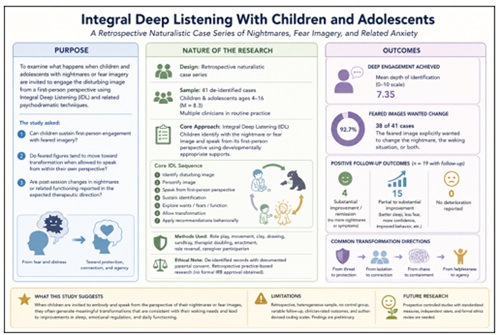
This was a small pilot study and much more research needs to be done before the efficacy of IDL can be demonstrated in the court of peer acceptability. These results are not conclusive, only indicative. However, anyone can take up the practice for themselves and test its recommendations in their own life. An Introduction to Integral Deep Listening provides both an overview and instructions. A Therapist's Guide to Integral Deep Listening is designed for coaches and mental health workers.
Widget is loading comments...
|