|
TRANSLATE THIS ARTICLE
Integral World: Exploring Theories of Everything
An independent forum for a critical discussion of the integral philosophy of Ken Wilber
|
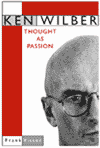
PRAISE FOR KEN WILBER: THOUGHT AS PASSION, SUNY 2003
"Frank Visser has certainly studied this material as carefully as anybody, and I am deeply appreciative of
his efforts to make an integral approach more available to the public."
— Ken Wilber, from the Foreword. – Read More...
"Finally, in a single highly readable edition we have a description of the life
and work of one of the most controversial and profound thinkers of our age."
— Allan Combs, author of
The Radiance of Being.
– From the cover.
"This book is an excellent overview and introduction to the extraordinary work of Ken Wilber, a visionary genius of our time."
— Frances Vaughan, author of Shadows of the Sacred. – From the cover.
"A clear, helpful and in-depth introduction... Visser's personal access to Wilber brings warmth and nuance to the presentation, while reference to the works of Wilber's critics ensures balance."
— Choice: Current Reviews for Academic Libraries.
"The first work detailing the 'intellectual biography' of a brilliant autodidact whose foundational contributions to most fields cannot be ignored... An excellent introduction for the average reader, but the Wilber veteran will find it an insightful synthesis and framework for his comprehensive vision."
— Religious Studies Review
"Described by the publisher as "an Internet specialist who studied the psychology of religion," Visser more than adequately acquits himself in expounding the thinking of Ken Wilber-the popular "guru of transpersonal psychology."
— Library Journal
"Visser has rendered invaluable service to anyone wanting a careful and comprehensive overview and analysis of Ken Wilber's massive output. His is itself a scholarly presentation, represented not only by the quality of the text but also by the many charts and diagrams, by the complete bibliography of Wilber's publications, and by the extensive notes and index."
— Quest Magazine – Read More...
Religious Studies Review - April-July 2004.
This is the first work detailing the "intellectual biography" of a brilliant autodidact whose foundational contributions cannot be ignored. Visser admirably captures Ken Wilber the person, spiritual practitioner, developmental psychologist, philosopher, integral theoretician, and most translated American author of academic books. An adequate overview of this prodigious "oeuvre" required interviews with Wilber and his written foreword. The text follows Wilber's self-described four phases of personal evolution, wherein his "All Quadrant, All Level" map of human potentiality was gradually envisioned aiming at a mystical and transformative spirituality. An enthusiastic Visser Calls for many specialists to assess Wilber and concludes by suggesting future discussions engaging materialism, orthodox psychology, transpersonal psychology and metaphysical sources for Wilber's premises. Based on the "Great Chain of Being" in all major wisdom traditions, Wilber's integral model may be received by religious adherents as threatening or exhilarating, but always challenging. This is an excellent introduction written for the average reader, but the Wilber veteran will find it an insightful synthesis and framework for this comprehensive vision. For those whose own passion inquires at the door of integral spirituality, Visser as butler leads us into Wilber's loft where an extraordinary processing of the Formless is being formed and reformed. Steve Spina, University of Wisconsin.
CHOICE: Current Reviews for Acadamic Libraries - February 2004.
Ken Wilber is a significant contemporary thinker who is difficult to categorize succinctly. His most recent academic work seeks to synthesize Eastern and Western philosophical, religious and psychological insights concerning human subjectivity with the more objective human experiences of body, culture, and society. The name he gives to this is "integral psychology". Visser (an independent scholar) offers a chronologically organized account of the development of Wilber's thought that incorporates significant biographical detail. The result is a clear, helpful and in-depth introduction organized around four chapters describing the stages that Wilber himself has identified as significant in the development of his thought. Visser's personal access to Wilber brings warmth and nuance to the presentation, while reference to the works of Wilber's critics ensures balance. Visser provides a comprehensive bibliography of Wilber's publications, helpful notes, and an index. Summing up: Recommended. Advanced undergraduates and above. E. S. Steele. University of Scranton.
Library Journal Review:
Described by the publisher as "an Internet specialist who studied the psychology of religion," Visser more than adequately acquits himself in expounding the thinking of Ken Wilber-the popular "guru of transpersonal psychology." This relatively new field of study considers the whole gamut of human endeavors that can lead to self-actualization, including consciousness studies, mind-body relationships, and spiritual inquiries, among others. Wilber's especial concern in this field is spiritual; his many published works are all oriented to showing how contemporary thinking (especially the scientific) is materialistic and also mistaken in devaluing the ultimately more important subjective, spiritual elements of human existence. He has developed an elaborate system based on Eastern mystical experiences (he meditates regularly, we are told) and ideas that Visser clearly finds compelling. It is clear that Wilber considers himself a pioneering "philosopher," but contemporary academic philosophy would insist that mystical revelations must, in the final analysis, be judged on the truth claims they make, and here it would find that Wilber had not adequately dealt with that aspect of his system. Public libraries would be the most logical and natural place for this book.-Leon H. Brody, U.S. Office of Personnel Management Lib., Washington, DC Copyright 2003 Reed Business Information.
|