|
TRANSLATE THIS ARTICLE
Integral World: Exploring Theories of Everything
An independent forum for a critical discussion of the integral philosophy of Ken Wilber
 British-born, Canadian Gerry Goddard was an astrologer, metaphysician, transpersonalist, consultant, writer, teacher and scholar whose special interest was the bridge between foundational astrology and the field of post-Jungian transpersonal studies. Gerry died unexpectedly in November of 2007 at the age of 64. Much of Gerry's written work is available at his memorial website: www.islandastrology.net British-born, Canadian Gerry Goddard was an astrologer, metaphysician, transpersonalist, consultant, writer, teacher and scholar whose special interest was the bridge between foundational astrology and the field of post-Jungian transpersonal studies. Gerry died unexpectedly in November of 2007 at the age of 64. Much of Gerry's written work is available at his memorial website: www.islandastrology.net
Consciousness and the
|
Introduction
This paper can be read as Part 2 of my paper, "Holonic Logic and the Dialectics of Consciousness" (hereafter referred to as "HLDC") in which I suggested a revisioning of Ken Wilber's Four-Quadrant model with respect to certain of its logical and epistemological limitations. In that paper I dealt only with one major band of the evolutionary hierarchy — the self-reflexive human level. In this paper, in terms of both the dialectical and the Janus-faced holonic logic which I explicated in my earlier paper, I would like to offer a revisioning of the lineaments of Wilber's account down to the bottom level of physics. In "HLDC" I provisionally accepted as logically possible and holonically elegant the panexperientialist view which drives consciousness — in particular the polarity of subjectivity and objectivity — all the way down to atoms. Now I actually believe that this view, in addition to being counter intuitive, is unnecessary — an overdetermined explanation of the appearance, at the advent of life, of consciousness in the cosmos. At the same time, it is an inadequate explanation with regard to identifying the necessary condition(s) for cosmic evolution while placing questionable constraints on an adequate account of transcendent states of consciousness. I believe that at the very least, an adequate transpersonal model is not required to adopt the panexperientialist view since this view has itself been an attempt to save a naturalistic rather than a transpersonal view of the universe. (See Griffin's defense of a panexperientialist physicalism, pp. 218-242). In an adequate transpersonal view we are not compelled to locate in the realm of physics both the necessary and sufficient conditions for all higher level properties including consciousness.
In the Four-Quadrant map, Wilber drives the distinction of 'individual' and 'social' down to the level of physics where, following Jantsch, the social and individual categories take appropriate quantitative or purely spatial form as the macro and the micro respectively. As certain critics have pointed out, placing societies at a higher level of the same category as galaxies and planets is counter intuitive, except in the purely formal sense as the larger and containing environment for all particulars from atoms to organisms. Similarly problematic is the extending of the sequence, atom to molecule to cell to organism and then on to the process which produces ever more complex organisms. To maintain logical consistency this combinatory process would have to proceed by combining organisms with organisms to produce super-organisms which of course is not what occurs biologically — but something like this combinatory sequencing does happen socially. When we adopt a dialectical process consistent with the epistemological analysis I offered in "HLDC", we bring Wilber's horizontal modeling of 'social' and 'individual' more adequately in line with the macro and micro. In that paper I argued that Wilber's structuralist model with its distinct four quadrants did not map the dialectical dynamics which drove upward development, consequently opening his model to criticisms as to its restrictive linearity despite Wilber IV's spiralic modifications. The difference between Wilber's stage by stage model and our dialectical model especially shows up in the identification of two major transition points on the vertical hierarchy; namely, the transition from non-living to living cosmos and the transition from biologically centered and self-reflexive consciousness to transcendent or transpersonal domains. Thus are structured archetypally, three major 'deep structural' domains with their substructures: namely, (1) the pre-living or pre-biotic level, (2) the biological level, which includes at its higher levels, the psychological, and (3) the transcendent, from nature mysticism to a merging with the Ultimate Source. (The numerous step-by-step levels in Wilber's model are now ordered as substructures within these broad deep structures). An ontological symmetry is maintained between micro and macro, individual and social, consciousness and unconsciousness so that certain tendencies to categorize social holons as less than individual holons (e.g. the statement that social holons fall somewhere between individual holons and heaps), or to categorize rock formations as heaps rather than as ontologically equivalent macro forms to the micro realm crystals, is avoided.
I would like to offer a clarification with regard to the use of the holon concept as indicated in the title of these two papers. Since it can be as misleading to speak of reality as composed of holons as it is misleading to speak of reality as composed of things, or even events, my understanding of the holon concept can be framed as the claim that the most adequate account of the foundational structure of 'reality' is revealed through the language and categories of holonic logic — a bi-polar, dynamic, logico-archetypal infrastructure of all manifestation.
The Agency/Communion dialectic in relation to the Macro/Micro and Social/Individual Categories
It is of central significance that the line which distinguishes the level of physics/chemistry from the level of biology, the transition from the pre-biological to the biological, is reached when the evolution of the macrocosm has converged, not in precise size, but in creatively interactive location with the evolution of the microcosm. A jump to a new level, the advent of life, occurs when micro and macro converge to produce a creative interpenetrating fusion that brings forth what is at once a global superorganism and a global society of organisms (prokaryotes). We need to understand this first great horizontal dividing line on the vertical axis in terms of the Gaia hypothesis of Lovelock and Margulis.
Both a complex and global society of the most primitive cellular life forms and an actual superorganism, Gaia is the 'breathing' earth itself as an open and evolving system in relation to the sun and solar system. Gaia is nothing other than the foundational matrix for all life on earth. The physicodynamics of the earth have evolved in interdependent relation with the action of these primitive life forms — the prokaryotes — which have formed an oxygen-producing web which covers the entire earth. From this basis, after thousands of millions of years, a higher self-organizing and composite cell emerged, the eukaryotic cell which is a hierarchical structure grounded in the prokaryote. As Erich Jantsch describes the higher order cells: "Today, the majority of all living species — green algae, higher plants, fungi, protozoa (single cell organisms) and animals — consists of eukaryotic cells. Only this new cell is capable of forming cell tissues and giving rise to multicellular organisms." (p122). The more primitive prokaryotes were then both taken up in the higher structure of the eukaryote while also continuing to exist as interdependent parts of the Gaian fabric.
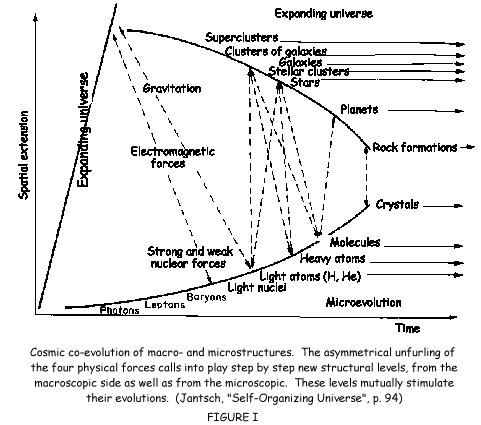
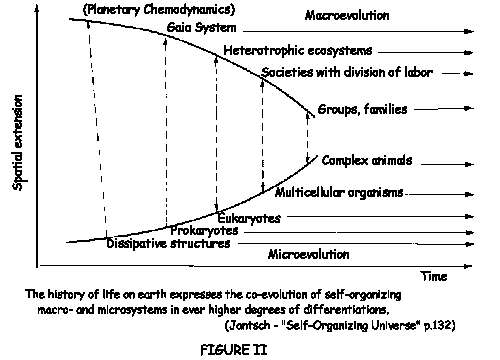
According to Erich Jantsch (see Figures I and II) cosmic evolution needs to be understood in terms of a parallel development of macro and micro realms — a fundamental conception incorporated into the model of Ken Wilber. The macro and micro lines of the 'physical' world converge "on cool planetary surfaces where the formation of crystals in microevolution meets with rock formations in macroevolution" (Jantsch, p94). From the level of galaxies and atoms, the poles of the macro and the micro, we need to recognize two fundamental modes of development — a differentiating or precipitative mode and an additive or combining mode. While within both macro and micro domains development occurs through an interactivity of differentiation and integration, within each realm, one or the other principle can be see as the dominant mode from a holonic point of view. Crudely put, through strong and weak nuclear forces, atomic nuclei are synthesized following which atoms combine with atoms to form molecules and so on. Under the force of gravitation, galaxies precipitate or condense out to form stars, planets and so on.
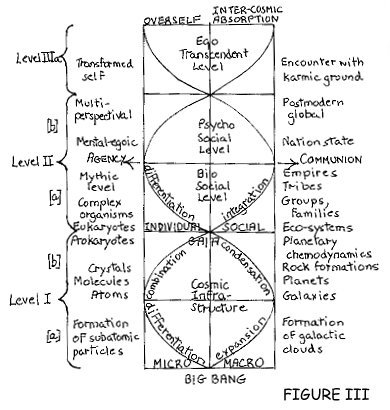
These complementary domains which developmentally meet at Gaia need to be mapped as converging developmental lines across the two basic and holonically distinct categories — macro and micro, which at the biological level, in agreement with Wilber, become the emergent categories of social and individual. (See Figure III). In diagram III, Level I is divided into two levels: Level Ia and Level Ib. The base point of Level Ia denotes the Big Bang which forms galactic clouds on the right and subatomic particles on the left. (We can also infer a Level 0, not on our map, which denotes the ground of all universes from which numerous big bangs and space-time's emerge and into which the universe(s) eventually fall(s) back at the hypothetical big crunch). So the developmental line on the left of Level Ia is drawn in a differentiating direction — i.e. the Big Bang point differentiates into the countless subatomic particles. On the right we see an expansion to form the vast galactic clouds. At the point beginning Level Ib the dialectical lines shift direction as subatomic particles come together to form atoms etc. and galactic clouds precipitate out to form galaxies etc.
As Wilber's parallel lines in his Four-Quadrant model do not adequately map the developmental interactive dialectics across the structural categories of macro and micro, individual and social, Jantsch's diagram is similarly limited (see Figures I and II). In agreement with Jantsch and Wilber, galaxies, planets, rocks, ecosystems, and societies are indeed macro just as atoms, molecules, cells, and organisms are micro. But something changes with the convergence of macro and micro which Gaia represents. Gaia is a fusion and total convergence of the differentiating and integrative lines across the macro and micro domains. Jantsch and Wilber picture Gaia as belonging to the social or macro category. But Gaia cannot be symbolized solely as ecosystemic and social. Prokaryotes do not stand in relation to Gaia in the same logical sense as molecules stand in relation to planets. What Gaia is is the interpenetration of the planetary chemodynamics (Earth's crust etc.) and the emergent dissipative structures and prokaryotes. Gaia is both superorganism and a global social network; an interpenetration of the micro and the macro. Thus, with the formation of the living cell from dissipative structures in relation to planetary chemodynamics in far from equilibrium conditions, a new level order of life is generated from the Gaia transition. That which arises from Gaia upward cannot be simply continued in parallel even though the subsequent levels are arranged correctly in their respective macro and micro categories (i.e. societies above macro, individuals above micro). The advent of life is precisely a convergence across macro and micro lines so that the developmental process which at prebiotic levels unfolds through the macro continues to unfold through the individual domain (directly above the micro but not developmentally continuous with it) at biological levels (i.e. Level II, Figure III). Vice versa for the micro and the social.
So as said, the polarity of macro and micro converges sufficiently in terms of size to effect a dynamic interpenetration as Gaia — the interpenetration of earth's chemodynamics and crust with the prokaryotes: "The autocatalytic units in this system which make possible the formation of a dissipative structure far from equilibrium and maintain the through-flow of the various gases are none else but the prokaryotes". (p116) After this confluence, a simple parallel continuance is not logically called for. In Jantsch's modelling, the macro/micro pair is taken as the sole criterion of parallel development. But the complementary size directions of macro and micro no longer clearly hold once the biological level is reached, since both organisms and societies are getting larger (though societies are larger spatially than organisms so there is still some extended sense in the category distinction of micro and macro. But at the mental-egoic level, society, beyond its communing individuals, cannot be said to have size anymore than a thought occupies space).
Contrary to Jantsch's precise model, biosocial communities, which indeed fall in the domain of the macro, are not a simple continuation of the macrocosmic differentiation process. Although the sequence, galaxies to planets to rocks is a logical differentiation or 'condensation', the linear step from planetary rocks to ecosystems and societies seems to be rather arbitrary and logically nonsequential despite all entities falling within the macro category. Similarly, while atom combines with atom to form a molecule and molecule combines with molecule to form a cell, the next step in this logical sequence is not actually cell combining with cell (prokaryote with prokaryote) to form a multicellular higher level structure. Rather, the first simple cells combine within a social order or fabric, a process which naturally leads to the social domain. And even if cells did thus combine, we know that organism does not combine with organism to form a superorganism, but rather to form a society. There is something logically different between galaxies and planets on the one hand and ecosystems and societies on the other, even though both pairs belong to the macro category. Similarly, there is a logical difference between atoms, molecules, and dissipative structures on the one hand and living eukaryotic cells and multicellular organisms on the other. These sequences belong to different major levels on the hierarchy since the latter is not a simple stage/level by stage/level sequence. The biosphere is indeed above the physiosphere; the accessing boundary, the leap, is Gaia. More exactly, there is something logically different and ontologically 'more', in terms of a parallel coevolution, between the relationship of organisms and societies on the one hand, and the relationship of molecules and planets on the other.
So the physical level micro line leads to the social macro line at the advent of life. Similarly, the physical level macro line leads to the individual line at the advent of life. (Figure III). Before we reach the true advent of conscious life, we must cross this boundary which itself denotes the first organisms — as individuals and as social patterns. We have said that the macro line is an increasing differentiation or condensation which forms the stars, planets and rocks: e.g. "[A]ccording to the simple condensation model...the formation of stars is imagined in such a way that clouds of interstellar matter...condense into a multiplicity of protostellar clouds....in the case of the sun, the protostellar cloud reached beyond the orbit of Pluto...it is estimated that the sun contracted within a decade from a diameter corresponding to the orbit of Mercury." (Jantsch, p89). On the other hand, the micro line is an additive and associative line. But biological level societies are primarily additive, so that while they still fall within the macro category, they are actually the logical (archetypal) continuation of the original micro line. That is, atoms come together to form molecules which come together to form simple prokaryotic cells, then these cells associate, not at first to form higher level eukaryotic cells but to form Gaia, a socially related interconnected fabric which forms the basis for all future societies of more complex organisms (multi-celled creatures). As said, we do not see organisms coming together with other organisms to form a superorganism along this same line. Rather, once the Gaia point is reached, this associative and connective trajectory from atoms upward begins to produce societies. (Elsewhere [1997], I have pointed out this shift in Wilber's modeling concerning the alleged simple linear sequence in hierarchic structuration — i.e. that his paradigm of hierarchy as the sequence; atom, molecule, cell, organism etc is inadequate at higher levels). Beyond the Gaia point, the biological level's further associative connection (from atoms onward) now manifests as society, based on the proto or foundational society, Gaia — that is, Gaia seen as a global society (other than its being seen as a superorganism). Differentiation, increasing agency or individualization is the dominant mode of the dialectical pair through the Individual sphere of Level IIa. (This is not to ignore the sense in which various emergent and differentiated systems and functions — e.g. the limbic system and the frontal cortex — are integrated or combined into more complex systems just as new level social orders also involve emergent differentiations along with new dominant socio-cultural combinings and fusions).
So Gaia means the relational web of prokaryotes and the earth's physico-dynamic structures and elements. Prokaryotes therefore lead, through their next step, to the social dimension (i.e. prokaryotes of the micro line point toward the Level II Social — not to a simple continuation of the individual micro line!). But prokaryotes also persist as individuals which stand over against the Gaian social fabric and in association with it, constitute the logical ground of the Individual. It is their relation to Gaia which forms the next stage of hierarchic stratification to form the substructure of eukaryotic cells. This is no simply linear sequence. The prokaryotes, in integral association with the earth produce the Gaian fabric and in individual-based association with the planetary conditions created by the Gaian fabric (this happens at the beginning of Level IIa just beyond the Gaia point) produce the eukaryotes and their ecosystems. Just as we cannot go in a simple linear sequence from planets to Gaia to ecosystems (as does Jantsch and Wilber), we cannot go — in parallel — through a simple sequence from molecules to prokaryotes to eukaryotes. Logically speaking, molecules do not interact with planets, but prokaryotes do interact with the planetary chemodynamics to form Gaia which then, as an integrated superorganism, produces higher level living forms and their social orders — "the biosphere creates its own microscopic life."(Jantsch, p9) This affirms the cross-over of the dialectical lines we see in Figure III.
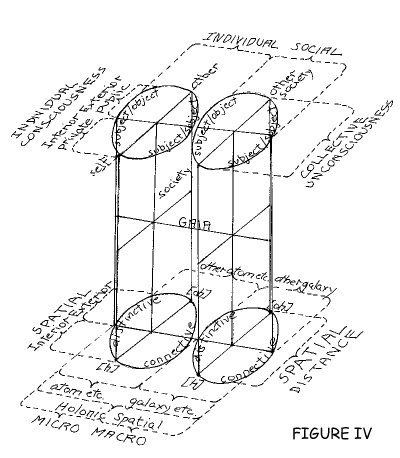
In terms of the holonic polarity, agency and communion, interpreted at the spatial level, we can say that galaxies are communal in their relationship to other galaxies which is a part of their reality and without which they would not be what they are. But it is in their internal structure (defined in the strictly structural/spatial sense) that they differentiate into planets and stars etc. That is, the developmental line from galaxies to Gaia is the macro developing in its agentic mode. Opposing and parallel to this process, atoms combine in their communal mode with other atoms in their surrounding environment to move toward Gaia. So at the pre-biotic level, the basic structural categories of holonic logic are the macro/micro and the internal/external (defined purely in the spatial sense). The dialectical categories are the dynamic principles of differentiation and integration (i.e. condensation and additive connection) and the principles of agency (the internalized) and communion (the relational). (See Figures III and IV).
The Structures of Level II
In agreement with Wilber's holonic division between macro and micro, social and individual, just as galaxies are more than large collections of atoms and atoms are more than merely small parts of galaxies, so too individuals are not simply parts of societies. We have seen that in the structural sense, as we move upward into the biological levels, the macro becomes the social category while the micro becomes the individual category. While macro and micro are strictly spatially defined, the social/individual division refers to something more than mere spatial size. As said, since Gaia is the combination of prokaryotes (from the micro line) and earth's physico-dynamics (from the macro line), then Gaia appears as both proto-society (the social) and as planetary superorganism (the proto-organismic individual). As prokaryotes come together as the logical next step, not through a linear progression within the individual domain to form a new hierarchic multicellular organism, but to form a social web, so to does the planetary earth and crust come alive as one superorganism — not a superorganism as solely a hierarchy of prokaryotes, but as a blended marriage of the society of prokaryotes with the unity of planetary earth. So Gaia logically forms the source of the new biological Level II, of living multicellular autopoietic organisms in relation to their ecosystemic and social environments.
Extending the condensatory or differentiating line into Level IIa (Figure III), it then crosses from the macro domain into the individual domain via the Gaia point — understood as planetary organism — to form the eukaryotes. At the same time, we extend the additive or integrative line from the micro domain into the social domain via the Gaia point — understood as the combinatory connectedness of prokaryotes — to form societies of eukaryotes. The developmental social line continues the additive line (which was individual at the pre-biotic level), yet now what are being added together are organisms which, rather than combining to form a super-organism, combine to form a society — a society which is constituted by the species mind-pattern informing communions of the organisms which are unfolding at this new level. Of course, the main lines of differentiation and integration must be understood not as solely integrative or differentiating since the interplay of differentiation/integration operates within each of the two domains. For example, organismic evolution is both an integrative and differentiating process, but in individual development, the pulse or rhythmic emphasis is on the differentiating function whereas in social development the emphasis is on the combinatory or integrative tone. As life complexifies beyond Gaia, at first (the level of the lower animals) both individual and social holons are informed by an equal balance between the overarching principles of agency and communion (say, 5 points each for agency and communion on a 10 to 0 scale). As we move upward to the point beginning Level IIb, the individual and the social holons will become maximally differentiated as linguistically informed, self-reflexive humans and their societies (say 10 points agency to O points communion as informing individual development and vice versa for societies).
The terms agency and communion are here used in the archetypal sense as overarching polar principles (directions) guiding overall development; not to characterize the personality or temperament of a particular individual. For example, at the maximal differentiation point, roughly half of humanity, namely women, manifest primarily communal characteristics since they represent the repressed and marginalized pole as agency increasingly overcomes communion in the development of the individual. But it is men, and predominantly, highly agentic men (both will and intellect), who will be dominant from this phase on until higher in Level IIb at the postmodern and post-patriarchal phase when agency and communion will optimally be moving toward a (5-5) balance — toward a conscious integration rather than the relatively unconscious fusion of agency and communion at primal levels.
To recapitulate the account I gave in "HLDC": The interplay of agency and communion is to be understood differently whether applied to the holonic individual category or to the holonic social category. Individual agency refers to the structure and maintenance of the autonomous and distinct self while individual communion means the individual's relational exchanges with others. Social agency refers to a distinct and self-maintaining group or society which allows (and encourages), in its agentic distinction from other groups and social forms, maximum individual communion within its own cohesive form, within its unifying mythos (i.e. insuring conformity at base levels). The agency of the 'social holon' refers to its cohesive structure which allows and encourages a range of individual communions but puts a preventative counter pressure on the developing agentic individual (except as leader, shaman etc.). The communality of the social holon refers to its intermixing with, or enculturation of, other societies and cultures which allows, and is in fact facilitated by the development of individual agency. The agency and communion poles of the individual psyche exist in an 'either/or' relationship. The same holds for the agency and communion poles of a particular society or culture.
We can say that the more society has an agentic form as it did originally within tribal and early village culture (and is again now forming in a new way at a new level, i.e. high in Level IIb) the more a person can operate in a communal mode. Conversely, the more society takes a communal form, the more the individual can, and is required to, operate in an agentic mode, since individual agency operates against the conformist, familial and traditional pressures and taboos of society at its early social-agentic phase. Hence, we see that the increasing agency through individual Level IIa means that the self develops forcefully and agentically overcoming and repressing its own communal needs symbolized by the decreasing communion and it is, at this level, through such leading individuals that psychological and social development procedes. The increasing communal principle through the social category means that society develops through an ever larger blending of social and cultural units.
Under the individual category we see an agentic and assertive self developing rather than a relational self. Historically, we see in parallel under the social category, the relational coming together of peoples (united by their particular mythos) to form ever more culturally complex social orders. Human society begins with small groups based on blood and kinship operating through direct person-to-person connectivity — individual communion roughly equivalent to individual agency. But as the development of society proceeds through an often violent social and cultural blending, the original person to person contact, though still basic, is more and more replaced by a social order beyond blood and personal interactivity. As small bands and tribes gradually blend and intermix to form larger units (village cultures etc.), eventually the direct concrete person-to-person, instinctual and emotionally empathic personal level of contact and interchange, although remaining structurally foundational, has less of a directive part to play in the complexifying machinery of public life. In terms of collective power and decisions, there is an increasing marginalization of personal interchange and blood/family connections marked by decreasing social agency. So the dialectical tension operating in the 'either/or' mode across the individual and social categories is the tension between the developing agentic self and the agentic mode of society. Similarly, the rising communal force in the social sphere is in dialectical tension with the communal force in the individual (i.e. effecting a falling communal force in the individual sphere). The agentic increase of self is actually unfolding in tandem with the communal increase of society, both contributing to the developments of each other.
At the transition from Level IIa to Level IIb, we see a most interesting (and dangerous) extreme yet interdependent duality. Self development can proceed no further through merely acting assertively against the counter pressure of natural and social order. Purely agentic individualism has gone as far as it can go (later identified as at the core of existential alienation and modernist disconnection); it now has to allow the gradual emergence of the individual communal principle so that agentic consciousness can gradually become more integrated and effectively balanced with communal factors (e.g. the development of democracy in Level IIb as a better balance between individual and collective orders). Correspondingly (by A/C), society (as empire and later as imperialist expansions of large nation states existing in states of tension and war with other nation states) has expanded to monolithically homogenize so much diversity that there is now an archetypal impulsion to move in a direction that allows more cultural diversity and group distinction (the rising differentiation or precipitative factor in the social category — e.g. the nation-state 'precipitates out' of Empire. e.g. Modern Germany still forming from out of the final demise of the Holy Roman Empire circa 1800.).
So in Level IIa we see individual and social development unfolding from an order of nature at, and just above, the Gaia point. The advent of humans beyond this point nevertheless recapitulates from conception and early pre-history the early largely fused agency/communion stage through a process of increasing distinction and differentiation coming to establish a humanly and linguistically constructed order at point A/C (Diag. III) marking the beginning of Level IIb — modern and postmodern humanity. Point A marks the consolidation of individual mental-egoic selfhood. Point C marks the consolidation of an ever more inclusive social and public order (maximum communality of the social holon). While these two polar forces have, through Level IIa, increased in unison, they nevertheless manifest to human consciousness as an ultimate duality. Historically, what unfolds from here can be seen as a response to this foundational existential condition.
Although the early self-conscious mental-ego at A, and the overarching cultural paradigm and political structure at C, have in actuality mutually informed one another, they represent the extremes of inner and outer, the tiny individual and the great cosmos, the (small) citizen and the (large) government, enthnocentric identification and international distrust. The individual qua individual has no active place within the collective; the collective qua collective has no active place within the individual, even though both are interdependently informed at the same level of the Great Chain of Being. Such a participation was lost in its original tribal form and will not be experienced again until the formation of the democratic state and internationalism higher in Level IIb. In terms of epistemological categories (see below), here are the extremes of subjectivity and objectivity — absolutely distinct; absolutely interdependent. To human self-consciousness they present a powerfully irreconcilable duality — ultimately that between the human sphere and the divine. This very duality of A and C represents the confrontation of individual and collective consciousness constituted by the either/or dialectic between the individual agentic principle and the social agentic principle; between the social communal principle and the individual communal principle. Historically, we see here the establishment of patriarchy and large pre-democratic societies — an almost purely agentic maleness dominating an almost purely communal femaleness. (There is a complex dialectic here explaining the historically inevitable establishment of patriarchy — pointing toward its later inevitable end — which is beyond the scope of this paper to articulate). With the agentic principle informing the individual still strong and the communal principle informing the collective still strong, the changing directions of the developmental lines through Level IIb signify the eventual development of the democratic state and the increase of the individual's participation in that state. Then higher still, as individual and collective principles move toward an eventual balance (in SD terms, an eventual yellow integration?) we see the emergence of the multicultural green meme combining Enlightenment democratic universalism and a new awareness of collective uniqueness and value (exemplifying an increase of individual communion and social agency from the sixties) .
So from A/C onward, we see a gradual integrative movement of the two principles within the individual and within society. Through Level IIb, the differentiating and integrating principles are gradually relaxing the 'either/or' developmental tension that characterized their relationship through Level IIa — they are now moving back to a now conscious rebalancing of agency and communion (Figure III). While the result of Level IIa was the establishment of two extremes of subjectivity and objectivity, inner and outer, individual and collective (state), the optimal outcome of Level IIb brings late modern and postmodern paradigms and insights along with an interpenetrative mingling of individual and collective categories as an increasing agentic/communal balance within the individual, between the genders and within the global multicultural fabric.
Epistemic Categories of Level II
We now need to map the holonic epistemic categories of Level II — the level signifying the emergence of living biological forms along with their environmental and social/species contexts and the gradual emergence of intentionality and consciousness. As we have seen, the social and individual categories that hold above the Gaia point can be distinguished from their logically corresponding strictly spatial macro and micro categories (Level I). Similarly, the differentiating and integrative developmental lines that hold beyond Gaia, are logically distinguishable from the lines of spatial condensation and combination. In the same way, it would appear to follow that the categories of experience called subjectivity and objectivity, along with the primal intersubjectivity of the pre-reflexive levels, are distinct from though, in terms of holonic logic, correspondent with, the pre-biotic categories of spatial 'inside' and 'outside' and their interrelations (see Figure IV).
Each circle at the bottom defines in one hemisphere [h] the internal structure of a particular atom (or galaxy) defined by its 'boundaries' and in the other hemisphere [oh] the internal structure of the other atom (or galaxy) which is external to the first and vice versa. That is, hemisphere [oh] denotes the structure of the local environment of the [h] atom (or galaxy), the environment which includes neighboring atoms (or galaxies). Since there is no absolute point or location, everything has its existence and its qualities only in relation to a point of view defined as [h] where any particular can be substituted at [h] and where defined boundaries remain fluid. We see here that the immediate environment is not the social; the environment is the concrete 'other'. The environment of an atom is 'other' atoms; not galaxies. At Level I, the relationship of the hemispheres is to be understood in two ways: mechanistically and systemically — cause and effect or resonantly in terms of fields (or even, perhaps, in terms of the trans-spatial or non-local interconnectivity of Bell's theorem). As we have seen, upward development unfolds as an emphasis on either the connectedness of these hemispheres (communion, as is the case for atoms etc.) or as 'interior' development (agency, as is the case with galaxies etc.).
At Level II, the interior/exterior structures and their relations take an epistemic form. The hemispheres of subjective experience and the modes of subject/object and subject/subject perception beyond Gaia lie directly over, but are not reducible to (in accordance with the basic principle of perennialist emergent hierarchy) the circle beneath Gaia. The hemispheres in Level II become both the complexified biological structures of distinct organisms (or societies) and their relations. The relationships manifest as subjective and objective domains of the experiential manifold of each. The two modes of epistemic relationship corresponding to the Level I mechanical and systemic modes respectively are subject/object perception and subject/subject resonance. As the subject/object epistemology of Level II is grounded on the energy field boundaries and concrete differences at Level I, so the subject/subject epistemology of Level II is grounded in the 'field resonance' (or immediate connectivity) of Level I where different holons all resonate to the same formative pattern.
The interior/exterior of Level II — that is, in the epistemic sense of subjectivity/objectivity or the interior/exterior perceptual relationship — can be extended down only to the advent of life (see my rejection of panexperientialism below). But further down, these categories correspond to the strictly spatial 'interior' and 'exterior', where their relations are defined by the bounds of the particular system be it atom or planet. Wilber (2000, p. 279) argues that every exterior (which even an atom possesses) implies an interior; therefore, atoms have interiors. But this does not prove that the logical categories of epistemic subjectivity and objectivity can necessarily be driven all the way down. The atom's 'exterior' is merely its spatial boundary in relation to the boundaries of other atoms. Therefore, the interior is merely spatially defined. At higher biological levels, what is called 'interior' is not a distinct kind of space — namely, mind-space — to 'exterior' physical-space. Private mind is (nonreductively) supervenient on physical organismic/brain processes (hemsiphere [h]) while the experienced world is the whole complex event pattern (nonreductively) supervenient on the structural pattern of brain in complex relation to the environment spatially beyond the boundaries of the organism (i.e. the pattern of relationship of hemisphere [h] to [oh]).
Experiential event patterns (be they the private or public aspects of the experiential manifold) are not 'in space', but in their specific qualitative patterns they are constituted and constrained by the spatial relations — i.e. in accord with the neural networks and organism/environment relational patterns. The complexity of mind indeed unfolds with so-called physical complexity. But this is not to be mapped as a lateral bi-polar holonic identity in the sense of the holonic identity for which I argued in "HLDC" regarding the equivalence (in the epistemological sense) of the objective and subjective poles of perceptually relating holons. There, I argued to the effect that the 'objective' brain state of holon [a] correlative with the qualia of holon [a] as holon [a] observes object [x] is equivalent to the quale of holon [b] observing the brain state of holon [a], the quale of holon [b] also showing up as the brain state of holon [b] when observed by some holon [c] and so on. (See Velmans below). This relationally (spatial) based identity of experience and brain state is an identity of the relations of a/b and b/a. It speaks entirely within the realm of experience; entirely in epistemological terms. But the scientifically inferred infrastructure underlying the subjective/objective human experiential manifold refers to subordinate levels on the hierarchy — this relationship is not lateral and bi-polar but vertical and emergent. At variance with my earlier "HLDC", I am looking to map the hierarchy without pushing the strictly epistemological level, the horizontal subjective/objective distinction, all the way down to molecules and atoms. But in the larger sense in which, for example, the social is 'pushed down' to the macro, experiential interiority is pushed down to simply the boundaried definition of the structured space which constitutes the particular which exists only in relation to other particulars of its own kind.
The higher we go from the base of the biological the more consciousness emerges and does so along the holonic axis of the subject/object and subject/subject epistemological polarity, an epistemic polarity in harmony with the developmentally changing balances of agency and communion (i.e. the more individual agency the more consciousness is structured by a dominant subject/object epistemology and so on.). At first these two epistemological modes are undifferentiated as sensation of the outer world and instinctual resonances to one's own group (level of natural society). At the outset of the mental-egoic (mental society) they differentiate as subject/object knowing more and more dominates over subject/subject knowing. Early in level IIa, subject/subject knowing, communal individuality, and agentic social forms exist in a largely predifferentiated state (i.e. participation mystique) while subject/object knowing is present as basic sensory perception along with agency expressed as pure organismic survival and structure.
The hemispheres of each circle denote the structures of two or more of the same holons, e.g. atom and atom, organism and organism. The epistemic interior and exterior experience of one living holon coincides with the epistemic exterior and interior of the other holon. The objective experience had by holon [b] of holon [a] is a relationship of holon a and holon b This epistemic relation which cuts both ways — as each observes the brain states of the other while experiencing each other — coincides with and rests upon the lower level spatial [ha] and [hb] (as internal structure and inclusive dynamic relational pattern). This gets us beyond the epistemic gap between the experience of the object and the concrete time-space reality of the object since both are (nonreductively) 'supervenient' on the foundational spatial infrastructure. So each side shows up as interior to itself (responsive to the other) and as exterior (objective) in relation to the other. Hence, we see the holonic relativity of subjectivity and objectivity as I argued in "HLDC". Two kinds of relationships exist between them — subject/object and subject/subject. The social holon is the common shaping among individuals.
At the top of Level IIa (A/C), individuality is informed through a maximal overarching agency structurally speaking and a maximal subject/object epistemology standing over against a society informed structurally through a maximal overarching communion and a subject/subject epistemology. Now what does epistemology mean within the social holon? I hold that a group-mind or field-mind 'builds up' on the social line as individual mind 'builds up' on the individual line. Consciousness and unconsciousness emerge together at the Gaia level and go on increasing in complexity and intensity. At Level IIa, emerging consciousness is at first almost as much group mind as individual mind (say, 6 individual agency to 4 social agency [and individual communion] in tribal conditions). At higher levels of Level IIa, social agentic, group-mind consciousness becomes more and more a collective unconsciousness which is as phenomenally real and formative as is individual consciousness at the same level.
Within the individual domain, the interplay of consciousness and unconsciousness coincides directly with the interplay of self and other (object) through the two dialectically related modes: the subject/object and subject/subject epistemologies. Through Level IIa individual consciousness has been maximally informed by overarching agency and subject/object awareness. At the same time, subject/subject or individual communion has become increasingly unconscious, but now, as we move from IIa to IIb there is a change of direction. At higher levels of IIb, the self begins to bring together in consciousness both subject/subject and subject/object modes coincident with a movement toward a now conscious balance between agency and communion. This corresponds to an increase in social agency (new diversities and new groups of like-minded people within connected communities) and an awakening into group consciousness of group-mind. But now individual and social are integrated rather than predifferentiated. In the social sphere, subject/object is "us and them", distinction between one group and another. This manifests most significantly as the ending of foundational gender asymmetry. At the top of Level IIa (A/C), societies are fusing into a dominant culture (e.g. the Greco/Roman/Judaeo/Christian fusion).
Through Level II, what appears as consciousness is centered from the point of view of particular organisms. But as the atom has a certain spatial and resonant relationship with the planet or galaxy, consciousness has a higher level relationship with the society without which it would not be what it is. In both individual and social spheres, it is the preponderance of agency which is associated with consciousness and communion with unconsciousness. But unconsciousness, being a dynamic and formative psychic reality, is not simply an absence of consciousness! However, this relationship is not one of self and other; it is a higher level play of particle and field. So consciousness (which at Level II is necessarily individual consciousness) stands in relation to a morphic field which we (somewhat inadequately) may describe as 'collective unconsciousness'.
At the outset of Level II, individual and collective are predifferentiated, so that emerging consciousness is both individual and group. The centre of consciousness is as much a centre of gravity in the group as it is a centre of gravity in the organism (brain). But as we move up from Gaia to point A/C the collective aspect becomes the collective unconscious (or morphic fields) while the individual aspect becomes conscious. As this occurs, subject/subject perception recedes (the individual communal mode) while subject/object perception becomes increasingly dominant. In the social sphere at this level, the conscious group-mind pattern is no more. Society at the conscious level (collective consciousness) becomes a network of individuals informed by overarching agency (whether or not they would be described as agentic persons). But at this point the direction of further development means that consciousness is gradually moving back to a new and higher level of group mind balanced with individual mind. But this process is driven by connecting individuals rather than driven so much by collective unconscious factors which belong to Level IIa.
Beyond the intersubjective (linguistic) web, a new level of subject/subject connection and social agency gradually emerges. There is a rediscovery of group or field-mind interconnection, which implies an increasing collective consciousness. Reflecting the complementarity of light as wave and particle, rather than acting as particles always trying to create bridges, individuals gradually begin to experience themselves more as waves, already inclusive and resonant. As we reach the new level, the beginning of Level III, we see the developmental lines again intersecting and crossing as they did at the Gaia point. Now individual mind and collective mind begin to merge; individual consciousness and collective unconsciousness begin to intermingle and flow together.
Level III signifies ego-transcendent states either when embodied or following death and between lives. In Figure III, the categories of Level IIIa above the individual and the social have been termed the higher Self or Overself, a kind of transformed trans-individual situatedness which stands in holonic relation to inter-cosmic egoic-absorption as one experiences Bardo and subtle dimensions where consciousness and unconsciousness, individual and collective, commingle and interpenetrate. In the embodied spiritually developing sense, the Level IIIa higher self category would signify the instantiation of cosmic consciousness in fully embodied (and transformed) being — fully functional in and as this body-world. The Level IIIa egoic-absorption category would denote the expansion and journeys of consciousness beyond the Level IIb ego in absorption in spiritual/collective and transcosmic domains.
The Mind-Body Issue — a critique of the panexperientialist "solution"
If we accept the materialist account of the universe, then the sudden appearance of a subjective ontology appears to be nothing short of a miracle. Contrary to the materialists' pride in their own tough-minded logic, such an appearance of mind out of matter, subjectivity out of objectivity, is entirely 'magical'. Hence, is born the mind/body 'problem' in its 'hard' version (Chalmers). As it is currently framed, the mind-body problem exists as a problem rather than as a metaphysical challenge primarily for those attached to the belief that physical science offers us a description of the world that is ontologically complete, or at least, in principle, offers us a complete descriptive and explanatory physical account without ontological remainder. In this way, the debate around the mind-body 'problem' — more specifically, the relation of the material brain to consciousness (i.e. neurons and synapses to sounds, colours, moral convictions and cognized meanings) — is more about the attempt to save the naturalistic and physicalist world view from such threats as idealism, perennialism and mysticism, than it is about the attempt to arrive at a coherent account which incorporates the full dimensionality of direct human experience and scientific description in a spirit of open curiosity as to where such a multi-faceted approach may lead us.
The commitment to science as providing the fundamental ontology is evident not only among materialist eliminativists and their ilk (those who seem to deny consciousness altogether) such as the Churchlands and Dennet but also among those more open yet still 'naturalistic' thinkers who recognize that consciousness is a real and essentially nonreducible feature of the universe such as Chalmers, Searle, McGinn and Nagel. The implicit and unquestioned assumption in all these positions is that, in science's historical account of the universe (which I am not here questioning in its broad empirical outlines), since consciousness arose after the original and non-conscious 'stuff' it is therefore derivative of, and ontologically secondary to, the original 'material' stuff — consciousness is one 'property' among other properties of this prima materia. For example Colin McGinn seeks a scientific redefinition of 'matter in space' since, "Given the fact of emergence, matter in space has to have features that go beyond the usual conception, in order that something as spatially anomalous as consciousness could have thereby come into existence. Somehow the unexstended can issue from matter in space, and this must depend upon properties of the basis that permit such a derivation." (p7) The a priori assumption is not only that the fundamental ontology of the universe is material or physical (i.e. different states and interactive fields of energy etc.), but that this material, describable in strictly quantitative and functionalist terms, must somehow provide both the necessary and sufficient conditions for the later generation of consciousness via the brain in humans and higher animal species.
It is precisely because the appearance of mind 'out of' matter — more precisely, consciousness out of the absolute absence of consciousness — is seen as nothing short of miraculous, that panexperientialists wishing to preserve an essentially realist view of the cosmos (i.e. a non-idealist view, in that the universe 'did really exist' prior to the advent of life) have felt compelled to posit the subjective ontology along with the objective ontology as constituting, in prototypical form, the very foundations of the universe — the domain of physics. In the panexperientialist view, the universe is to be explained fundamentally in terms of the subject/object relation. They justify this by arguing, quite legitimately, that the (temporally later) subject cannot be derived from the (temporally earlier) object. This argument is valid and can be strengthened by the point that the subjective and the objective are logically interdependent terms. But I believe that in prescribing some sort of prototypical intentionality or prehension to atoms in order to account for the appearance of intentionality and consciousness in living organisms, the panexperientialists may be taking materialism and its 'hard problem' too seriously. The materialist hypothesis which produces the 'hard problem' is not wrong simply because it apparently involves a 'miracle'. It is certainly miraculous, a great wonder, that anything at all exists in the first place whether it be a self-organizing material world or a divine causa sui. We cannot avoid a sense of the miraculous however we may choose to understand the ultimate nature of things! No, the materialist hypothesis is wrong because either it involves a logical impossibility or it is at least unintelligible!
Basic to the materialist hypothesis are two dogmas: (1) the claim that the level identified by physics is simply and radically not-mind containing not a hair of what might be termed consciousness, the seed of consciousness or anything smacking of a formative cosmic intelligence or final causes. And (2), the claim that this material and objective ontology (currently understood as physical energy fields) is the sole explanatory principle of all that is and ever may come to be. Having already excluded sensory qualities from the one explanatory domain, the sudden appearance, not simply of new quantitative and objective patterns, but of a new ontology — a qualitative or subjective ontology — is impossible, that is to say, it is logically impossible! Materialism may seek to escape this charge of logical contradiction by asserting an ontological monism where subjectivity is a special state of objectivity having no ontological status in itself. (Searle asserts something like this).
If materialism resorts to this strategy, it undercuts the ground of its own authority since consciousness can have no epistemological validity or capacity to 'know' the nature of things since it is merely one 'event' among any number of events. Not only is such an event powerless in terms of intentionality (a mere product), it will be epistemologically empty! There is a generally accepted statement that forms the base line for naturalistic accounts of consciousness, namely, that "consciousness is always consciousness of something". Science is concerned with the investigation of the 'something', while the means but not the end of the investigation, is the 'consciousness' part. From this very partial epistemological starting point of science, materialist or physicalist thinkers, taking the objects of science (energy fields) as the ontological ground, then explain the 'consciousness' part as derivative of the 'something' part. I believe that this is a self undermining position since if the 'something' is reliably taken to be the most veridical part it must be that 'consciousness' is taken as a reliable and authoritative mode of knowing, hence, not a mode which is contaminated, limited, or constrained by its being merely a derivative and causally ineffectual epiphenomenon — which is precisely what it is seen to be! To explain the 'consciousness' strictly in terms of the 'something' is then to undercut and devalue the very means by which one unmistakably decided on the veridical nature of the 'something'. The scientific view itself arises out of the third person perspective to the exclusion of the first person perspective on which it is fundamentally reliant (not to mention the exclusion of the Wittgensteinian second person perspective — i.e. language as necessarily social). Hence, in its essential logical shape, its conception of 'prior' reality is confined to an abstract third-person world. To say that the original and foundational ontology is objective or material is to import into that primary level one pole of a logically inseparable pair at the human epistemological level, namely subject and object, mind and matter.
The problem comes about because it is assumed that the nature of the universe prior to and 'beneath' mind (in the compound sense of levels of order) is a thoroughly objective ontology, for to suggest otherwise implies some form of panpsychism. But the assumption that the foundations prior to the advent of consciousness constitute an objective ontology is a logically unjustified inference. It comes about only because of the one sided, third person epistemological standpoint of science which by logical necessity reveals only objects. But objectivity and subjectivity only have their meaning from the double aspect of human epistemology, the fact of perspective which creates the first person and third person viewpoints which as Velmans points out do not justify ontological dualism by themselves. Velmans describes a situation where E, through an experimental arrangement, observes the brain of a subject S focusing his attention on a cat.
While the subject focuses on the cat his phenomenal world includes the cat. It is fashionable (at present) to think of E's 'observations' (of the subject's brain) as public and objective. S's 'experiences' of the cat, by contrast, are private and subjective. indeed this radical difference in the status of E and S is enshrined in the different terminology applied to what they perceive; that is, E makes 'observations', whereas S merely has 'subjective experiences'. But suppose they turn their heads, so that E switches his attention to the cat, while S switches his attention to what is going on in E's brain. Now E is the 'subject' and S is the 'experimenter'. Following the same convention, S would now be entitled to think of his observations (of E's brain) as public and objective and to regard E's observations of the cat as private and subjective. But this would be absurd — as nothing has changed in the character of the observations of E and S other than the focus of attention. (p11)
Velman's argument is in full accord with the holonic epistemological account I gave in "HLDC" which rests on the spatial infrastructure informing the perspectival contextuality of subject/object holons in perceptual interrelationship. In light of such an analysis of the logic of the terms, subjective and objective, it is apparent that in labeling the prebiotic levels as objective one term of an inseparable logical polarity has been split off and projected down through a category error upon the universe as it is beneath or prior, not only to human but also to organismic primordial experience. These lower, foundational and initial levels cannot legitimately be characterized either as objective or subjective without committing a simple anthropomorphic projection.
The assertion of an ontological monism where subjectivity is a special state of objectivity having no ontological status in itself put forward by materialism in order to answer the charges of logical contradiction, is unintelligible. This is not simply a 'hard problem', it is a logically impossible one! It follows that since the problem is nonsensical, we are not called to come up with something that answers the problem! But panexperientialists seem to be trying to come up with an answer to it — which is what I mean by their taking it too seriously. We are not compelled to come up with an answer to a pseudo problem, we are only obliged that our epistemological and ontological accounts of the nature of things must be coherent and free of logical contradiction while most adequately taking new evidence into account. The 'hard problem' is more like a reductio ad absurdum which demonstrates that at least one of these dogmas is untrue.
Panexperientialism claims that the problem with the materialist hypothesis is that the original prima materia must be something more than purely objective. It must be constituted not only by an objective ontology but also by a subjective one. Panexperientialism posits that the qualities of this subjective ontology must be present in some primordial form at the material level. This view is in agreement with my argument above concerning the epistemologically self-undermining stance of scientistic objectivism and the illogic of deriving a subjective ontology from a radically objective ontology. But at the same time, the panexperientialist move involves an inadvertent acceptance, without consideration, of the second dogma of materialism; namely, that everything that arises in development must be explained solely in terms of the original ontology and therefore must be embedded in some prototypical form in the original conditions. Rather than questioning the second dogma — radical reductionism — panexperientialism appears to accept it, feeling compelled to answer something which it is actually unnecessary to answer.
Certainly transpersonalists like Wilber or de Quincey do not actually agree with the naturalistic dogma 2, but then why do they feel obliged to counter dogma 1 with a counter-intuitive hypothesis of "slightly conscious or slightly intentional atoms"? (Actually, Wilber waffles on the idea of driving some sort of prototypical prehension all the way down but finally decides for it — "exteriors imply interiors" — and incorporates the panexperientialist view into his Four-Quadrant model. If he didn't, his logically tight model would look peculiarly lopsided and logically unbalanced with only his Right Hand quadrants going all the way down!) If dogma 2 is false, then it is at the very least logically possible that the initial appearance of the universe — the manifest level of physics — may be entirely without awareness of any sort that we can ascribe to it specifically (except that it may be comprehensible only in teleological rather than in naturalistic and mechanistic terms) where a quantitative description is exhaustive of all its inherent properties. Dogma 2 claims that what comes after must necessarily be explainable strictly and solely in terms of what is present at the beginning, which in the case of an 'unfolding' universe may or may not be true. For example, even a naturalistic universe may be unfolding according to information such that the forms and material ontological substance at the beginning is only the first manifest phase of its development.
Although it is only a suggestive metaphor; examining the larval stage will tell us nothing about the mature insect unless we can identify and read the information coded in the DNA program. And most significantly, nobody will say that the mature insect (in this case, signifying the human phenomenal world of everyday experience, the deepest values, artistic epiphanies, meditative self mastery, extrasensory and mystical states) is any less real than, or only an epiphenomenon of the caterpillar (i.e. the foundational layer of physics). While the ground — the level of time-space physics — is a necessary condition, there is nothing which dictates a priori that that which is foundational must provide a sufficient condition for that which comes later or higher. The building of a basement constrains the general size and overall shape of the superstructure, but does little to tell us anything of the exact nature of the superstructure. Naturalism and physicalism looks to the basement and seeks to understand the superstructure as a property of the basement. Why do we believe a priori that only physics and only the basement is going to tell us the nature of the universe which is so much more than the basement? Panexperientialists seem to want to explain the superstructure by locating the plans in the basement rather than seeing the plans as Source, giving rise first to the basement (as the necessary foundation without which there can be no superstructure) and then to the superstructure.
Once, we drop dogma 2, we are no longer forced to describe the original or primal level as providing both the necessary and sufficient conditions for what occurs at higher and later levels as the panexperientialist hypothesis feels obliged to do. When we say the Universe unfolds (i.e. evolves) to reveal all domains and levels, the referent of 'Universe' cannot be the lowest level, some of the levels, or even all the levels since higher levels may yet arise. If the referent of 'the universe' is not the lowest level, then the lowest level does not have to contain all the potentials that later reveal themselves as actualities.
But panexperientialism does rightly challenge the logical contradiction involved in characterizing the fundamental ontology as radically objective. I agree with de Quincey, for example, that "Ontologically, subjectivity just cannot emerge from wholly objective reality," but I am not constrained to agree with him that "Unless energy, at its ontologically most fundamental level, already came with some form of proto-consciousness, proto-experience, or proto-subjectivity, consciousness, experience, or subjectivity would never emerge or evolve in the universe." (p.4 of on-line paper)
Certainly, in terms of the logic of human epistemology, the one term does imply the other — to characterize the foundation as actually physical and objective logically implies that it is also mental and subjective. But what if we do not call this level objective but characterize it only as the initial and necessary (though not sufficient) condition of the later emergence of subjectivity and objectivity. Thus the first level of physics can be described, without remainder, in strictly quantitative terms, although the fact of its existence cannot be explained in simple quantitative terms — this is the sense in which a transpersonal model is not constrained by dogma 2. Now, there is a possible objection to this line of thought. When, say, a person (level II) perceives a rock (level I) it would seem to follow, if we reject panexperientialism, that we have a subject/object holon perceiving a holon which is not a subject but solely an object — a Level I object — and if anything is an object, surely a rock is an object! But if this is correct, then it follows that not all holons are subject/object holons (forgetting for now that in Wilber's language rocks are only heaps). Since we cannot have exteriors without interiors, objects without subjects, then panexperientialism is surely valid! But what I have argued is that the holons of Level I including rocks and molecules cannot be said to be ontological objects in themselves. Objects can only be objects in relation to subjects. Any object 'in itself' is actually a subject/object holon in relation to another subject/object holon. Rocks and molecules become objects only when perceived. Now this may seem to be reminiscent of Berkeley, but it is not quite the same, since the existence of rocks and molecules is not subtracted from them by subtracting their objectness — locating the latter form solely within Level II epistemology. Existences such as rocks and molecules (which can only be objects, physical or otherwise, when in relation to Level II perceptions) are the necessary condition for the existence of Level II forms and consciousness, and of level II subjectivity and objectivity.
So is there actually a need to call this first level 'subjective' as well as 'objective' if to call it objective in the first place is both vulnerable to my relativising critique of the objective category and logically inconsistent with the claim of radical reductionism, i.e. the claim that the first level is both the necessary and sufficient condition of higher levels — a claim that the transpersonalist is not constrained to accept? While I do see, to some extent, that panexperientialism answers the logical incoherence of materialism; nevertheless it is counter-intuitive and along with the fact that transpersonalism is obviously not constrained to accept dogma 2 — transpersonal evidence is in fact direct evidence against dogma 2 — its 'answer' to the mind-body problem is overdetermined. But in addition, I wish to at least suggest that panexperientialism is questionable in terms of its logical coherence.
As I described in "HLDC", the necessary infrastructure for epistemology (i.e. to frame things intelligibly in terms of the concept of 'epistemology' in the first place) was the realist dynamic map of spatially located centres. The complex epistemology of the subject/object and subject/subject relations rests upon this foundational spatial reality of particles and fields, energy and matter. The nature of the lowest level is that of a necessary precondition of the subject/object to subject/subject epistemological polarity in the first place — namely spatial relations. The subject/object and subject/subject relations cannot be defined without reference to a spatial location framework, a relational and numerical framework. Significantly, higher levels do not and logically cannot create lower levels as existences precisely because they presuppose and rest on these lower levels. Human epistemology — the starting point of science and of the reasonings of Descartes to Kant — does not create its infrastructural ontology, rather it creates a rich phenomenology. Kant was correct (even if only trivially, i.e. in the tautological sense) to distinguish the phenomenon and noumenon in that we can never know — i.e. sensorily perceive — the 'object-in-itself'. This is logically so because the 'object-in-itself' is not an 'object'; an object is a function of a relationship. Ergo, it is logically impossible to drive the subject/object to subject/subject epistemology 'all the way down' — it needs the most elementary notion of particle (the base of the subject/object) and field (the base of the subject/subject) in purely space/time relational terms. In plane words, "How is it logical that epistemological logic can serve as the ground of epistemological logic except to say that there is only epistemology which sounds like radical Berkelian idealism?" So the necessary ground or preconditions for epistemology cannot use epistemological logic. Consequently, the ground cannot logically be called objective, subjective or both.
I suggest that subjectivity and objectivity are the fundamental conditions which structure the second major level of the hierarchy (Level II) but they do not extend to the lowest levels (level I) or to the transcendent levels (Level III). If we feel compelled to posit prototypical consciousness at the bottom in order to explain its existence further up, we are likely thinking in terms of more and more complexity of the basic elements, a sort of amplification process. But conceptual self-reflexivity, for example, is more than an amplification of simple sensation. Similarly, so are values and meanings more than amplifications of simple instinctual drives. If each of these properties indeed constitutes something ontologically more than simply a result of a process of amplification, then why cannot even the simplest mode of prehension be new at some level — that is, if the nature of the universe is not constrained by its first levels to an objective ontology?
Beyond a Substance Monism
A cosmos whose most adequate mapping is in terms of the categories of holonic logic cannot ultimately be a substantive cosmos (i.e. pertaining to the possibility of a meaningful assertion as to the substance or stuff which constitutes the cosmos — in the transpersonal view, consciousness or spirit rather than matter). If, from a transpersonal context, we insist on a substance monism, than we likely assert something like Spirit as the essence or substance of all things — a word generally synonymous with such terms as 'Absolute Consciousness'. Consequently, the pre-biotic, the biological, the bardo realms etc. would all be different states of Spirit. In this metaphor, atoms, molecules, galaxies, stars, etc. would all be sleeping spirit (in deep sleep). Biological evolution might be seen to consist of a gradual stirring of spirit from its 'entrapment' in energic/material forms eventually to awakening to itself as pure Spirit (Void, Absolute etc.). However, such a view still does not justify a need to apply the epistemological and dialectical polarities of Level II to Level I, polarities which engage consciousness in relation to unconsciousness, sentient interiority to exteriority. But further, this alleged gradual 'awakening' of the cosmos in Level II does not appear to be an awakening of sleeping atoms and molecules — these entities remain 'asleep' and apparently their sleep constitutes the necessary foundation for the emergent higher level awakening. The only thing that can be said to be in various states of 'awakening' are the complex patterns of cells in organ systems and brain centres. But how does a more complex pattern of the same basic 'stuff' constitute an awakening of the stuff itself? If such complexifying developments do not constitute an awakening of the stuff, then what is this developmental process an awakening of? The metaphor is not really intelligible. (The same difficulty holds with the paradigm of the 'ground' as unconsciousness which is supposed to gradually become more and more conscious. On the contrary, life (level II) emerges as an ever more complex interplay of consciousness and unconsciousness through ever more complex structures and processes. Consciousness and unconsciousness deepen and complexify together. Consciousness does not stand ontologically higher than unconsciousness in the sense that Level II represents consciousness and Level I unconsciousness. Consciousness and unconsciousness are holonically related in the same logical sense as individual and collective etc.)
Disentangling the notion of existence from the notion of abiding substance which has dogged Western metaphysics since Aristotle, I think that instead of a substance ontology (everything is fundamentally mind or fundamentally matter/energy) we are looking at a radically relative ontology (but not one which denies the ultimate Source or different levels of cognition and value). What exists at any one time exists through its relation with other existents at the same level of development. At human stages of Level II, the description of a thing depends on its relation to the describer and the language of description. I am not here pulling the ontological rug out from under epistemology and consequently contradicting myself re. my above arguments as to the logical untenability of panexperientialism. The ontological basis for any description is the archetypal logic itself which is the necessary condition for any statement as to the truth of ontological relativism. Hence, the holonic viewpoint necessarily presupposes an archetypal formative basis to the cosmos. There is no absolute space and time, no absolute location, no absolute substance such as mind or matter or energy, hence no absolute existence! As an entity has only a relative existence, so must our universe exist only in relation to other universes, whose existence cannot be absolute. All forms have a relative existence. The existence of one Cosmos implies the related existence of another Cosmos. (This existential relativistic 'truth' claim is not subject to the accusation of the performative error since it does not claim that all truth is relative).
Reality and its developmental unfolding is participatory precisely because consciousness in its interface with cosmos (energy structures) is necessarily situated at some centre or point of view. Consciousness meets cosmos only from some centre. This centre must be a certain level of complexity to achieve a decisive internal/external distinction or boundary. Experience (qualia) is the interface of consciousness and the cosmos from the point of view of a certain type and complexity of centre and point of view. As said, existence itself and not merely form and pattern is dependent on relationship — that is, horizontally speaking, since the existence of Level I is not dependent on the perceptions of Level II. From Gaia and upwards, evolution is propelled through a prototypical participation of consciousness and cosmos. From the extreme agency and communion poles A/C (subject/object individual and subject/subject social), what unfolds is not further biologically impelled development but a psycho-social development (which is not to deny the accompanying synapse complexities and areas of activity within the deep biological structures of the homosapien brain which are now solely the effects of psycho-social development), the adequacy of which is nevertheless evolutionarily critical to the foundational biospheric balance. This comes through a utilization or expression of the biological structures as fundamentally given. Further evolution is entirely dependent on intentionality from here on, which includes deeper insight into our total relation and interdependence with the biospheric process (the evolutionary crisis and requirement we are now facing).
Beyond holonic polarities
As to the ultimate question of the ontological relation of consciousness to matter/energy, we cannot map this ontological relationship — the nature of the interface of consciousness and cosmic structure — through an holonic bi-polar logic. We cannot logically draw a holonic complementarity of consciousness/matter or consciousness/energy as we can with subjectivity/objectivity, agency/communion, macro/micro, social/individual. Consciousness and energy (at any level of subtlety) do not imply one another as do these latter complementary pairs, even though both consciousness and energy are necessarily included within an overarching transpersonal paradigm within which organismic experience necessarily depends on their conjunction. Within this view, pure consciousness ultimately lies beyond forms and energy, and therefore it is at the very least logically possible that energy/form can subsist purely without consciousness — as I am claiming it does at Level I. The whole cosmology rests of course upon the generation from an Absolute Ground of Being.
Nevertheless, consciousness does stand in complementary holonic relation to unconsciousness, and this holonic relation is born of the marriage of pure consciousness and energy, the event and process where consciousness identifies situationally with what it is and consequently is separated from what it is not, thus bringing into being the phenomenal manifold identifying and distinguishing the self domain and the world domain. But the ontological relationship of consciousness/unconsciousness to subjectivity/objectivity is not logically holonic — neither laterally nor in the vertical sense where a subordinate level is a part of, or is contained within, a superior level. So the ontological relation of consciousness and energy cannot be described holonically as the panexperientialist De Quincey describes it with reference to the Woodhouse vs.Dorsey debate; namely, that the outside of energy is the physical and the interior of energy is consciousness (though, admittedly, he articulates this complementarity in a time-based processive mode a la Whitehead rather than in space-based terms). The idea of interiority cannot (even metaphorically) be equated with consciousness per se since the meaning of interiority rests upon our ordinary sense of the private range of the manifold of experience, a manifold which actually includes both public and private domains. To say that experience is interiority is either to identify consciousness with the private and not the public domain, or to see both private and public experience as interiority which leaves objective energy somehow outside and beyond yet in some way causative of experience and not simply its objective 'outside' — whatever 'outside' means. This seems to me to be a strange hybrid of Cartesian and Kantian dualism and is certainly not holonic. Consciousness and cosmos (energy) cannot be described in the terms of inside and outside. Beyond the distinction of thought etc. and sensation etc., the most meaningful inside/outside language is actually space-based — an intraorganismic (brain) phenomenal field and an extraorganismic phenomenal field; namely, that which lies inside any boundaried system and that which lies outside it. Any qualia pattern (experience) necessarily is constituted by these two domains, so experience or consciousness cannot be meaningfully described as specifically interior.
Similarly, it is misleading to characterize the essence of consciousness as does de Quincey: "Energy talk fails to account for what is fundamentally most characteristic about consciousness, namely its subjectivity." (p.4). This is to import one of the categories of the mind/world relation to describe consciousness. In an ultimate ontological sense, consciousness can be identified with neither mind nor world, even though Level II is characterized by that state of being in which consciousness does indeed identify, first with the undifferentiated sensory manifold of mind and body/world Level IIa, then with the mind/self as distinct from the world at Level IIb.
We need to avoid the Cartesian tendency to conflate 'mind' with consciousness. Both mind and world equally possess an energic nature whereas consciousness does not. Thoughts are energy and process but consciousness is present when it is in interdependent relation to these 'mental state/brain state' processes. Hence, at various levels of energic subtlety — electromagnetic to biological to psychic energies-- mind and body are equally 'physical' (in agreement with materialism) and through interface with consciousness, they equally possess an experiential phenomenal nature — in agreement with Humean phenomenalism and contra Cartesian dualism, both subjective and objective are experiential. Ultimately, consciousness in itself is pristine 'nothingness', 'emptiness', whereas energy at all levels of the Great Chain is form or form/substance. The spatial inner/outer infrastructure underlies the experiential subjective/objective. The objective holds no special privilege over the subjective as regards spatial infrastructure so it makes no sense to name this infrastructure the objective. Therefore Wilber's left and right hand quadrants are both experiential while both are grounded in the spatial infrastructure as I argued in "HLDC".
Not only can the relation of consciousness to energic infrastructure not be mapped through the same logic as subject and object, agency and communion, macro and micro, individual and social, the relationship cannot even be mapped as Level II over Level I, since Level II is not pure consciousness — it includes higher level infrastructure inextricably entwined with emergent consciousness manifesting as the phenomenology of experience. If panexperientialism were correct, then the infrastructure would be mapable in terms of the polarity of subject and object (all the way down) as I provisionally accepted in "HLDC". But in the present account, 'subjective' and 'objective' are peculiar to Level II. As said, consciousness is not the 'interior' of energy. Cosmos is structure — patterns of dynamic energy fields; but consciousness is not structure. It aligns to whatever structure is present. It is not incoherent that a certain level of complex structure must occur before any sort of consciousness can cohere, can interface with cosmos. Consciousness has no structure in itself — like water it takes on the structure from time/space or higher dimensional locality and relation. An adequate container does not seem to begin to occur until biological forms. In a transpersonal and teleological cosmos, the evolutionary 'intelligence' which draws evolution forward is not situated in the atom; it is not and cannot be situated anywhere! Situated consciousness arises at a certain point — Gaia — in the establishment of cosmic structure.
It is the conjunction of cosmic energy and consciousness at each stage/level within Level II constellated by the holonic structure of self and other (resting on the spatial distinction and relation of particular holons in space-time) which constitutes the phenomenal manifold of both private and public, subjective and objective domains (Wilber's Left and Right quadrants) as well as the dynamic relation of consciousness and unconsciousness. When we become aware of some natural feature or process, there is present a complex experiential pattern (qualia patterns) the phenomenal features of which are the result of the conjunction of consciousness and the infrastructural energy forms. In any moment of perception, both the experienced self and the experienced world come into existence. We cannot properly say that a holon is conscious of an object (i.e. energy form). We can say that a holon has an experience of itself being conscious of an object (at first, in a predifferentiated way, then later, self-reflexively). Consciousness does not belong to a self looking at an object. Both self and object are holonically structured products (epiphenomena) of the conjunction of consciousness and the energic archetypally informed cosmic infrastructure. So-called interior or private mind/thoughts are (nonreductively) supervenient on intraorganismic spatial energy processes (with environmental situatedness as background) just as the experiential field of the environment is (nonreductively) supervenient on the complex energy patterns of organismic structure in relation to the environment now as foreground. But at higher stages of Level IIb (close to level III), one becomes directly aware of being energy (beyond the experience of energic emotional states such as anxiety or excitement), a more 'plastic' awareness closer to the root of the mysterious ontological interrelationship of consciousness and energy which stands behind and constitutes the manifold of experience. This transition to the transpersonal domains of level III is not of course the ultimate 'realization' of pure unconditional consciousness. As 'soul leaves body' (or, rather differently, as embodied consciousness is meditatively absorbed in higher states), consciousness transfers its identification to another, and higher level dimensional cosmic energy system (subtle body).
While holding that individual experience, like iron filings aligning with a magnetic field, is constellated by the individual structures of both Level II and Level I, it is a most interesting feature of our model that if we trace the 'source' of individual experience down before or beneath Gaia into the Level I structures, we do not find ourselves traveling down to molecules and atoms as the panexpexperientialists would do. Rather, we find ourselves traveling down the line through Gaia into rocks, planets, solar systems and galaxies. Thus the most direct source or ground of individually situated consciousness would appear to be the macrocosm (but not in the sense of proto-consciousness instantiated within these Level I structures even though they are 'sourced' from a transcendent Ground). This is suggestive of the intuition of eco-holists and astrologers who see the human mind as in direct sympathetic resonance with its planetary and galactic 'ground' rather than, as Wilber would describe them, as simply asserting a false holarchy of organism within biosphere within solar system! When science, and the sort of philosophical enquiry allied with the scientific view, looks to the ground of being it looks to the rocks and then divides the rocks up into their smallest components — the molecules which 'make up' the rocks. In this quest for the ground, they are collapsing the macro category to the micro — a reductionism which Wilber rejects yet actually himself commits in labelling rocks 'heaps' — randomly made up of molecules. Then the molecules are carved up into their constituent atoms etc. — correct enough. But this common quest has taken a strange turn which violates the principles of holonic logic since it weaves down first through the macro and then through a horizontal reduction jumps across the holonic logical boundary to the micro line. So contra Wilber et al, if we are going to trace the 'source' or 'ground' of mind, we trace it out into the solar system and the galaxy even as it rests upon and is informed by individual structures from atoms to brains. Conversely, mind in the social category — meaning the collective unconscious of Level II and not the concrete interchanges of communing individuals-- will be sourced in the micro. While there might be a tendency to ground the collective unconscious (which can be understood at least partly in terms of Sheldrake's morphic fields) solely in the macro realms, as we trace that line down we finish up with Level I individuals — molecules, atoms, subatomic particles etc. This suggests that the unconscious yet formative power of morphic fields is a composite phenomenon, a phenomenon which 'builds up' from countless instances (the record of all events through natural and psycho-social history) rather than a process that archetypally 'condenses out' of galactic and solar fields, the original macro-based fields which would actually be the source of individual consciousness and intelligence.
Concluding thoughts — toward a non-ultimate dualism
The main purpose of this paper has been to argue that the vertical axis of development needs to be mapped centrally in terms of an interweaving dialectic of agency and communion across individual and social holonic domains, to call into question the logical coherence of panexperientialism within a transpersonal perspective and, further to my revisionings of the Inner/Outer relation in my "HLDC" paper, to explicate the epistemic structures exclusive to Level II and their relationship to Level I. The relationship of experiential interiority/exteriority to spatial interiority/exteriority that I've articulated reveals a significantly different ontological model to the Left/Right, Inner/Outer map of Ken Wilber. (With different implications concerning a number of issues — e.g. the integration of science and religion, the nature of the transition from green to yellow, the relationship of Level III consciousness to measurable Level II brain states etc.). Given my dialectical and non-ultimate dualistic account of the relation of consciousness and energy, I would like in this last section to briefly suggest a transpersonal cosmogony that is more coherent with this modelling than the involution/evolution metanarrative broadly adopted by Wilber. (Such a non-ultimate dualistic view of consciousness and energy needs to be articulated without falling into some sort of neo-Cartesian interactionism a la Eccles or into a Sankhya-like dualism of purusha and prakriti).
Although my account does not drive consciousness — as subjective interiority/objective exteriority — down beyond Gaia to atoms and galaxies, implicit within it is a paradigmatic commitment to the idea of an Ultimate Source or Absolute from which all dualities arise and within which all dualities are reconciled. Consequently, since Level I cannot be explained naturalistically, it must be informed by some generative archetypal dimensionality with Level II consciousness being seen, not as an emergent property arising from a state of implicit potentiality within Level I, but as something entirely new which has suddenly 'entered the mix'. This formative 'intelligence' which constitutes Level I is not 'in or of' these structures' in the same sense that consciousness is apparently 'present' within Level II structures. Now since Level II cannot be explained simply as an emergent structure beyond Level I, and consequently, Level I cannot be seen as a further step-down from Level II in a purely involutionary process, the account I have outlined implies an overarching duality (not a Cartesian substance duality) informing the evolutionary process compelling an articulation of the ontological relationship between two generative principles arising simultaneously as and from two poles of the Absolute: namely, pure consciousness and pure energy (cosmos). (We might also name them the Divine Mind and the Divine Power.)
I question the adequacy of the story of Involution where pure Spirit (Consciousness) forgets itself (avidya) through a series of 'step-downs' until the lowest level is reached — the level furthest from pure consciousness, namely, the realm of matter, which then begins to unfold through evolution level by level back to the One. On the contrary, the universe — its physical and biological forms — is the generative force and vehicle for the soul's development and eventual transcendence; the cosmos itself (Level I) is not moving 'back toward God' through successively higher layers of consciousness. Rather, like the biological body which at death 'falls back' into the physiosphere, the cosmos will 'fall back' into the Ground Source at the death of the universe. Explaining all ontology by the involution of Consciousness asserts an idealist monistic substance ontology in which all forms are ultimately reducible to consciousness, thus perpetuating the inadequacies of Platonic and Neoplatonic philosophy. The Buddhist "form is emptiness, emptiness is form" does not reduce everything to consciousness; it is not ultimately idealist and for this reason is incompatible with Wilber's involutionary metanarrative (though Wilber explicitly embraces both these views).
Most interestingly, such a pure emanation (idealist) doctrine is especially at odds with a panexperientialist (realist) account. While, as said, a model of pure emanation or involution of consciousness is thoroughly idealist in that it implies that energy is ultimately reducible to consciousness, in a holonic understanding neither complementary term of the holonic pair, interiority/exteriority or individual/social (or as in panexperientialism — energy/consciousness), is reducible to the other. Certainly, a radical emanation model is not coherent with a panexperientialist account unless the term Spirit (or 'Consciousness' as synonymous with Spirit) is an entirely different concept not referring to interiority as such. But then it is hard to see what relevance the posit of Level I interiority has to explain the 'sudden' appearance of consciousness at Level II.
If we drop panexperientialism to preserve a purely emanationist doctrine, then Level I must be understood, not as a symmetry of proto-sentient interiority/exteriority, but as absolute unconsciousness. But as I have argued, such an absolute ontological unconsciousness, rather than awakening as Level II structures merely serves as the ever 'sleeping' substratum of level II biologically conscious structures — hardly the evolutionary reawakening of previously swooning Spirit. (I hold that the so-called 'physical' universe cannot be validly described as the least real level of the Great Chain as implied by the pure involution doctrine). Another formulation is that the involution of spirit means that all the potentials of the higher levels are instantiated in the lowest of levels which then emerge stage by stage. But that would be an investment in the realm of physics, in nature, of the numinous forces of the divine, a view perhaps embraced by some nature mystics as they plumb the depths of nature to experience resplendent spirit there — a view however which Wilber is keen to deny. If involution cannot be into matter, or as matter, containing all potentials, then it could be seen as Spirit losing itself in some sort of implicate order which then unfolds and awakens stage by stage — the level of physics first etc. But this seems to be an extra and unnecessary step. Why cannot the universe unfold directly and forcefully from Source? Why cannot Source give birth spontaneously to the fundamental dialectic which drives time-space evolution? For one thing, pure involution does not provide a plausible metanarrative to account for the wild, creative and uncertain dialectical ride that evolution is. There are problems with an overarching metaphor of emanation — an involution of spirit or absolute consciousness — as the explanans of the ontology of all levels. A model of pure involution of absolute consciousness (Spirit) cannot adequately explain the ontological differences — beyond merely describing degrees of intensity or transparency — between the structures.
The idea of the involution of spirit actually makes logical sense only if there is already some sort of structure for spirit to involve into. We see this in the re-incarnating 'soul' attaching itself to the fetus a la the Tibetan Book of the Dead — a text and process cited by Wilber in his Atman Project as illustrative of involution. But from this perspective, in order for a pure emanation model to possibly make sense, there would actually have to be a two-phase involution. First an involution to create a stable entirely unconscious nature as infrastructure (Level I), then another involution of spirit into this stable infrastructure which brings forth living forms allowing more and more of an involution of spirit as increasingly complex patterns of experience. At some point of biological complexity — the human — this evolved soul (the marriage of spirit and energy) can enter, leave and re-enter the structure eventually to return to highest source. Presumably, at the end of time within any cosmos, the bottom end is eventually lifted up back up into Source — electrons etc. apparently realize themselves as pure spirit! To me, such an explanation, even if refined beyond this crude account, is an unnecessarily complicated story called forth by the need to save an exclusively involutionary cosmogonic doctrine.
In terms of overarching creation mythologies, a more adequate account posits that all manifestation arises from a primal differentiation of the NonDual Source. The origin of manifestation occurs from a primal event of ignorance (avidya) where Brahma separates into two complementary streams — the ontological and the epistemic, energy and consciousness, which then, like two hands, touch and combine in an infinity of new ways — an evolutionary participation where in terms of this primal event of splitting "the left hand knoweth not what the right hand is doing". The physical universe, the energic infrastructure, can be understood as a forceful and expressive creation from Source. From the 'other arm' of this same Source, consciousness emanates and involves down to Gaia. Consciousness 'steps down' as nature 'rises' so to speak. At this interface where emanation touches creation, at Gaia, life and situated consciousness is born giving rise to increasingly complex life forms, bio-psychic energies and eventually — through an interface with countless other creation cycles, other universes — the evolution of the transcendent subtle domains ( a fusion of subtle energy and intensifying consciousness in multitudinous dimensions). The Ground or Source lies both at the evolutionary beginning and at the end of manifestation. This modelling preserves the idea of a holarchy of ever higher levels while also affirming the so-called Romantic intuition that the universe, rather than faintly subsisting at the farthest reaches from divinity is actually a direct and immediate expression of the power of the Divine Ground. ('Up' and 'Down' within a grand tubular circle [horus] point toward the same Source). In this way of viewing the genesis of immanent cosmos and transcendent soul, intuitions feeding both Plotinian emanation and Augustinian creation cosmologies come together as a complementarity.
I suggest that Level II — the evolutionary trajectory from the advent of biological forms capable of rudimentary experience to the threshold of trans-egoic consciousness — can be seen as an interface of universal Consciousness and Cosmos. The direction of evolutionary flow moves from the energy arm (thrust) to the consciousness arm (pull) of the Absolute. I suggest that universal consciousness participates with the cosmic energic infrastructure to bring forth biological life capable of eventually supporting a reincarnating 'individual' soul. Rather than pure consciousness, the 'individual reincarnating soul' is the ontological interface of consciousness and subtle trans-cosmic energy forms evolving from and returning through the reincarnational process to Level II — remember that from a transpersonal perspective the evolution of humanity is taking place not only on the earthly plane but between lives and within the collective unconscious. 'Between-life' souls at Level III have evolved from the original interface of cosmic energy forms and pure emanating consciousness through countless universes. That is, they are not higher level existences informed by original involution waiting to be reawakened, but rather, they are products of the dance of creation and involution.
Life, from the emergence of Gaia to complex biological forms, is not the interactivity of an individual soul and 'dead matter', it is the interactivity of the two 'universal arms of God' (i.e. Ultimate Source) — consciousness and cosmos (energy). The duality between Cosmos (all universes, dimensions, energy forms) and absolute formless Consciousness can be seen ultimately to dissolve back into Nondual Source as in the Buddhist sutra: "form is emptiness, emptiness is form". As said, this statement of ultimate Identity is not idealist in that it does not ultimately reduce form to emptiness, energy to consciousness, cosmos to Spirit.
In terms of Level II, the point where involution first meets creation, the Gaia point, is the most 'pure' manifestation of spirit, but only the hem of spirit as it were. From here onward, pure consciousness becomes more fully and complexly involved with 'creation' so that by the advent of the human it has been entirely interwoven with creation — the gnostics would say sullied with the flesh as the human drama of good and evil unfolds. Level II denotes a difficult and treacherous zone, an interface like a rapids which begins to smooth out deeper in Level III. This gives rise to suffering and the battles of experientially created good and evil. The human soul in this world, in meditative states, and in the bardo realms is not some lower strata of the pure emanation process awakening to itself, but the product of the complex historical marriage of emanation and creation, consciousness and complex energy forms. Spirit has acquired a long and overwhelming history in the form of human souls who in order to evolve further must reclaim this history in full consciousness (i.e. interfacing with collective unconsciousness back to Gaia — as I've addressed the Wilber/Washburn dispute over the 'U-Turn' as a pivotal transition from the centaur to the psychic/subtle [Level II to Level III] involving a necessary embrace and integration of collective unconscious levels down to Gaia, but not involving a return to Source. This transition between Level II and Level III reflects our larger dialectical story). Wilber has described the nature mystic's experience as projecting higher spirit onto lower nature. But not only is nature a direct expression of the Source, such nature mysticism can be seen as the participatory perception of the unsullied even though simple presence of involved spirit in Gaia, a pure expression of spirit, a simple purity which indeed has become lost through the difficult passage of evolution, a passage which rather than a series of unfoldings reversing involution, is an incredible and open adventure of creation where 'God(ess)' comes to endlessly fulfill His/Her infinite potential by manifesting as both yin and yang, 'reaching around' to embrace and unfold one another until returning to Source through ultimate mystical illumination.
The sharpest experiential dualities belong to Level II and are resolved somewhere in Level III (the holonic account answers Cartesian substance dualism by exposing the false identification of consciousness with mind), but the ultimate duality, or rather complementarity, of consciousness and cosmos is not resolved until a full return to the Absolute Unity of Source. Energy/consciousness continues to unfold at more and more subtle and higher dimensional levels until a level is reached where forms, energy states and fields, 'objects', distinctions, all drop away and only a pure unconditional consciousness remains — all is Emptiness. It is with reference to this level (about to enter Source at the Spirit pole) that idealist philosophy explains the existing cosmos as illusion where all dissolves into pure Consciousness. Even so, cosmoses go on arising, Brahma goes on separating as a complementary polarity — emanating and creating. The highest level of the pure emanation arm has been reached, but beyond this stage, lies the Unity of consciousness and energy — 'form is emptiness, emptiness is form' — Source is a Unity, infinite consciousness and infinite energy are One. This return to Source is not absolute knowing as in the higher levels of the consciousness arm, it is absolute Being which reunites the ontological pure energy arm with the epistemological pure consciousness arm. (Ontology equals Epistemology, Consciousness equals Energy — not ultimately as a holonic complementarity). I believe that the dialectical nature of evolution through Levels I and II indeed suggests an overarching yin/yang dialectic of creation/emanation rather than the back and forth flow along a linear path of involution and recapitulating evolution.
In articulating the interwoven agentic/communal hierarchic model and the possible emanation/creation paradigm within which I think it is best conceived, I have not mapped the categories of Level III — the domains of the transpersonal — and their ontological relation to Level II or the implications of the cross-over point connecting and differentiating Level II and Level III reflecting, at a higher level, the Gaia switching point. Elsewhere, (97, 98, 02) I've articulated a double-spiral model mapped in three dimensions as a kind of metaphysical double helix where Level III is seen as the 'Return arc' (following the 'Outward arc' beginning with Gaia) incorporating certain central 'recovery' features of accounts such as those of Grof, Washburn and Tarnas. I believe that the model I have outlined here, though not articulating the synthesizing features of my double helix account, is entirely compatible with it.
Bibliography
Chalmers, David J. (1995). Facing Up to the Problem of Consciousness (Originally appeared in the Journal of Consciousness Studies).
Churchland, Paul M. (1988). Matter and Consciousness; A Contemporary Introduction to the Philosophy of Mind. Revised Edition. (Cambridge, Mass., MIT Press).
Dennet, Daniel (1991). Consciousness Explained. (Boston, Little, Brown)
De Quincey, Christian (2002). Language, Energy and Consciousness
Goddard, Gerry (1998). Holonic Logic and the Dialectics of Consciousness: Unpacking Ken Wilber's Four-Quadrant Model
Goddard, Gerry (2002). "Dialectics of the transpersonal; mapping the perinatal." (forthcoming).
Goddard, Gerry (1997). Airing Our Transpersonal Differences
Griffin, David Ray (1998). Unsnarling the World-Knot: Consciousness, Freedom and the Mind-Body Problem. (Berkeley, University of California Press).
Jantsch, Erich (1980). The Self-Organizing Universe: Scientific and Human Implications of the Emerging Paradigm of Evolution. (Oxford, Pergamon Press).
McGinn, Colin (1995). Consciousness and Space (Originally in Journal of Consciousness Studies 2, no.3. 220-30.)
Nagel, Thomas (1974). What is it like to be a bat? (From The Philosophical Review LXXXIII, 4, 435-50).
Searle, John R. (1992). The Rediscovery of the Mind (Cambridge, Mass., MIT Press).
Velmans, Max. (1995). The Relation of Consciousness to the Material World (Originally appeared in Journal of Consciousness Studies, 2[3], 255-265.)
Wilber, Ken (2000), Integral Psychology: Consciousness, Spirit, Psychology, Therapy (Boston Shambhala).
February 2003