|
TRANSLATE THIS ARTICLE
Integral World: Exploring Theories of Everything
An independent forum for a critical discussion of the integral philosophy of Ken Wilber
  Frank Visser, graduated as a psychologist of culture and religion, founded IntegralWorld in 1997. He worked as production manager for various publishing houses and as service manager for various internet companies and lives in Amsterdam. Books: Ken Wilber: Thought as Passion (SUNY, 2003), and The Corona Conspiracy: Combatting Disinformation about the Coronavirus (Kindle, 2020).
Check out my other conversations with ChatGPT Osho and Adi DaTwo Spiritual Authors, Two Literary UniversesFrank Visser / ChatGPT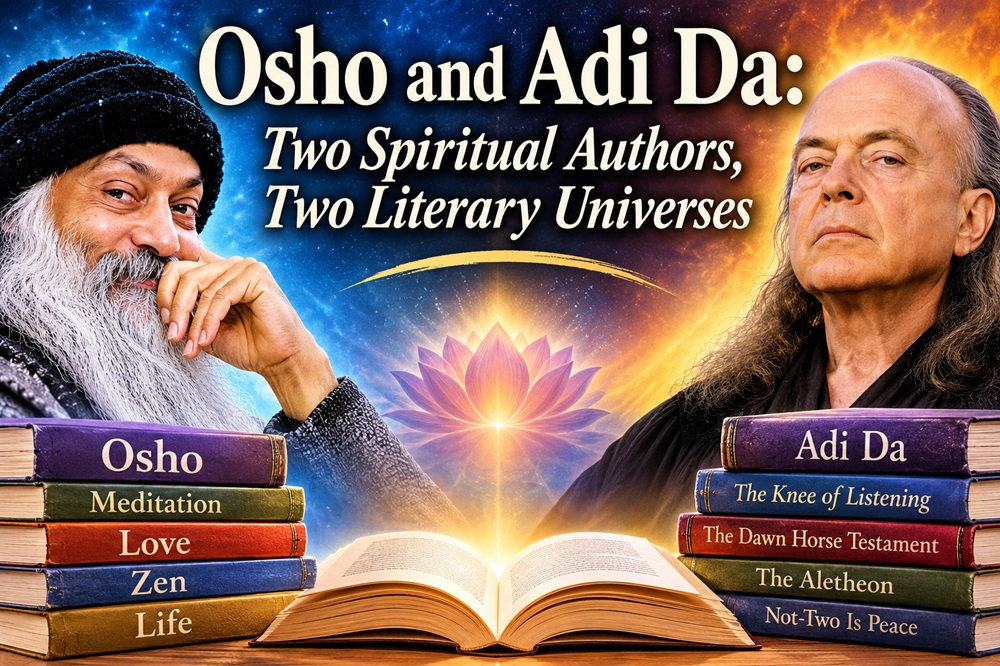 From the Spoken Word to the Sacred TextOsho (1931-1990) and Adi Da Samraj (1939-2008) were two of the most prolific and controversial spiritual teachers of the twentieth century. Both produced enormous literary legacies, both challenged conventional religion, both claimed to communicate a radically transformative understanding of human existence, and both attracted devoted followers who regarded their teachings as expressions of an extraordinary spiritual realization. Yet their literary output differs in fundamental ways. Osho was primarily an oral storyteller, philosopher, and interpreter of the world's religious traditions. Adi Da was a self-conscious metaphysical system-builder whose writings increasingly presented themselves as expressions of a unique, ultimate spiritual revelation. The difference is not merely stylistic. It concerns two different conceptions of spiritual authority, the relationship between teacher and text, and the status of language itself. Osho's literary universe is conversational, expansive, eclectic, and often entertaining. Adi Da's is dense, repetitive, metaphysically ambitious, and increasingly self-referential. One invites readers into an ongoing conversation with the world's wisdom traditions; the other asks readers to enter an elaborate spiritual universe organized around the person and realization of its author. Their respective literary achievements therefore deserve comparison not simply in terms of the number of books produced, but in terms of originality, readability, intellectual substance, literary form, and the relationship between literary production and spiritual authority. 1. Osho: The Great ImproviserOne of the most important things to understand about Osho is that he did not generally write the books attributed to him in the conventional literary sense. His principal method of communication was spontaneous speaking. He addressed audiences, answered questions, commented on religious scriptures, and told stories, with his talks subsequently recorded, transcribed, translated, edited, and published. The official Osho publishing operation describes an archive containing approximately 7,000 hours of audio and video recordings and hundreds of book titles. Its publishing model is essentially the transformation of spoken discourse into written literature. This distinction matters enormously when evaluating his literary achievement. Osho was not primarily a novelist, essayist, or systematic philosophical author. He was an improvisational communicator whose extraordinary ability to speak at length about almost any subject generated a vast publishing enterprise. His repertoire was remarkable. He discussed:
His commentaries on ancient texts are particularly extensive. The Book of Secrets, for example, is a monumental treatment of the 112 meditation techniques of the Vigyan Bhairav Tantra. His discussions of Lao Tzu, Patanjali, Heraclitus, Buddha, Jesus and other figures reveal a teacher who preferred to approach traditions through imaginative reinterpretation rather than historical scholarship. The literary strengths of OshoOsho's greatest literary strength is accessibility. He could take a complicated philosophical or religious subject and turn it into an entertaining conversation. He employed anecdotes, jokes, parables, paradoxes, provocative observations and everyday examples. His lectures frequently move between the profound and the ridiculous, sometimes within a few paragraphs. His humor is an essential part of his literary personality. He enjoyed puncturing religious solemnity, exposing hypocrisy, and making established authorities look ridiculous. There is also a considerable theatrical dimension to his discourse. Osho understood the importance of timing, repetition, suspense and surprise. His spoken language was designed not merely to communicate information but to produce an experience in his listeners. His books therefore work particularly well when read in relatively short passages. They invite browsing rather than systematic study. Another strength is his enormous cultural range. Osho was capable of finding something interesting in practically every religious or philosophical tradition he encountered. He did not feel obliged to defend the historical integrity of those traditions. He freely appropriated their stories and symbols for his own purposes. This eclecticism made his work attractive to readers who had become dissatisfied with conventional religious institutions. The literary weaknesses of OshoThe very qualities that make Osho entertaining also create problems. His improvisational method produces considerable repetition. The same stories, jokes, examples and arguments appear in different discourse series. His treatment of a subject can be stimulating without necessarily being historically accurate or philosophically rigorous. Furthermore, his apparent familiarity with so many traditions should not be confused with specialist scholarship. He often interpreted religious texts through his own spiritual vocabulary, sometimes imposing meanings that would be disputed by historians and practitioners of those traditions. His books also vary considerably in quality. Some contain memorable insights and brilliant observations; others are meandering, repetitive or dependent on extravagant claims about spiritual experience. There is an additional editorial problem. Since the books are predominantly transcriptions, the reader is not always encountering a carefully constructed literary work in the conventional sense. The editors and translators have necessarily played an important role in transforming spoken performances into publishable texts. This makes Osho's literary achievement somewhat unusual: his authorship is unmistakable in voice and personality, but the physical books are frequently collaborative editorial products. 2. Adi Da: The Architect of a Spiritual UniverseAdi Da presents a substantially different literary phenomenon. Where Osho was predominantly a speaker, Adi Da was also a dedicated writer. His literary production began in the late 1950s and continued throughout his life. His publishing organization identifies more than 75 published books, alongside thousands of hours of recorded discourses. His most famous early work is The Knee of Listening, an extensive spiritual autobiography that describes his childhood, intellectual development, spiritual experiences, encounters with teachers and eventual realization. The book is important because it establishes the narrative framework for much of what follows: Adi Da's life is presented not simply as the biography of an individual spiritual seeker but as the extraordinary manifestation of a unique spiritual realization. This autobiographical dimension is crucial to understanding his subsequent literary production. Osho's books generally invite the reader to investigate life, consciousness and religious traditions. Adi Da's writings increasingly ask the reader to understand the world through the unique realization and authority of Adi Da himself. A system-builder rather than an improviserAdi Da's writings are organized around an elaborate metaphysical and spiritual framework. His central concern is the transcendence of the egoic condition and the realization of Reality as already and always non-dual. He developed a comprehensive account of human development, spiritual practice, consciousness, devotion, embodiment and ultimate realization. His system distinguishes seven stages of life, the first six representing different forms of egoic development and the seventh representing the ultimate realization of Reality. This framework gives his literature a systematic character that is largely absent from Osho's more conversational output. Important works include:
His literary ambitions were not restricted to religious instruction. He also pursued poetry, drama, visual art and photography. His Orpheum trilogy is particularly interesting in this respect. It represents an attempt to communicate spiritual and metaphysical themes through experimental literary forms rather than conventional philosophical exposition. The language of Adi DaOne of the most immediately recognizable features of Adi Da's writing is its unusual typography. He developed a distinctive system of capitalization, punctuation, underlining and emphatic textual presentation. His publishing organization explains this as a deliberate literary device intended to undermine the reader's habitual egoic point of view and communicate non-dual Reality. Whatever one makes of that explanation, the result is unmistakable. Adi Da's prose can be extraordinarily dense. His sentences frequently accumulate qualifications, distinctions and repetitions. Capitalization is used to establish a hierarchy of spiritual significance. Certain terms become almost technical vocabulary, while ordinary words acquire specialized meanings. This creates a distinctive literary universe, but also a considerable barrier to entry. Unlike Osho, who often tries to make the reader comfortable through humor and conversational familiarity, Adi Da demands sustained attention to an increasingly specialized vocabulary. The reader is expected to learn his terminology, accept his conceptual distinctions and gradually become familiar with the internal architecture of his teaching. The literary weaknesses of Adi DaThe central weakness of Adi Da's literary output is its tendency toward self-referentiality. As his teaching developed, the person of Adi Da became increasingly central to the entire metaphysical structure. His writings do not merely describe a spiritual realization that readers might independently investigate. They increasingly present his own person as the unique manifestation of the ultimate Reality and the indispensable source of its transmission. Consequently, the distinction between an author's philosophical argument and his claims about his own spiritual status becomes difficult to maintain. This is especially apparent in the later Revelation Books, which are presented by the Adidam organization as the culmination of an unprecedented divine revelation. The problem is not that an author writes about personal spiritual experiences. Many important religious and philosophical works do precisely that. The problem arises when the author's claimed realization becomes the principal authority validating the entire system. There is also a literary problem with excessive elaboration. Adi Da frequently revisits the same fundamental distinctions, sometimes with increasingly elaborate terminology. What is presented as clarification can become a form of conceptual accumulation. The reader may eventually feel that the terminology has become an obstacle rather than an aid to understanding. 3. A Direct Literary ComparisonThe differences become clearer when we compare their literary characteristics side by side.
There is an interesting irony here. Osho produced an enormous literary legacy without primarily being a literary author. Adi Da, on the other hand, consciously pursued the creation of a comprehensive body of sacred literature. Osho's books are generally easier to enter, but harder to organize into a consistent philosophical system. Adi Da's books are more systematically organized, but harder to read without becoming immersed in his specialized conceptual vocabulary. The difference is between a vast conversation and a vast doctrine. 4. Two Different Relationships with the World's Wisdom TraditionsPerhaps the most revealing difference concerns how the two teachers approached the intellectual and religious heritage of humanity. Osho treated the world's wisdom traditions as an enormous reservoir of stories, insights and possibilities. He could spend weeks discussing a single Zen anecdote, then move to Nietzsche, Jesus or Lao Tzu. His interpretations were often unconventional, but his approach encouraged readers to explore traditions beyond their original institutional boundaries. He was, in this sense, a spiritual cultural omnivore. Adi Da also undertook an extensive examination of religious traditions, but with a different objective. He sought to demonstrate that the world's spiritual traditions could be understood as expressions of a single developmental process, culminating in his own seventh-stage realization. His Basket of Tolerance is an extraordinary bibliographical undertaking. According to his organization, it documents approximately 100,000 books, articles and audiovisual materials examined during his lifetime, with roughly 10,000 items included in its annotated bibliography. However, the difference between the two approaches is significant. Osho tends to liberate religious material from its original context and reinterpret it creatively. Adi Da tends to incorporate religious material into a comprehensive interpretative hierarchy that ultimately validates his own spiritual position. One could say that Osho makes the world's religious traditions his conversation partners, whereas Adi Da makes them witnesses to his revelation. Neither approach is neutral. Both appropriate religious traditions for their own purposes. But Adi Da's approach is considerably more hierarchical and self-validating. 5. Literary Achievement versus Spiritual AuthorityHere we arrive at a particularly important question: how should we evaluate the literary output of spiritual teachers? Should we judge their books by the profundity of their spiritual claims, or by recognizable literary and intellectual standards? These are not necessarily the same thing. A book can be spiritually inspiring to its followers without being philosophically convincing. A text can contain beautiful passages while advancing questionable metaphysical claims. An author can be extraordinarily prolific without being an especially original thinker. Osho and Adi Da illustrate these distinctions particularly well. Osho's literary achievement can be appreciated independently of his claims to enlightenment. His humor, rhetorical skills, cultural range and ability to make religious material accessible are recognizable qualities. One does not have to accept his metaphysics to enjoy many of his books. The same applies to Adi Da, although the separation is more difficult. His literary experimentation, ambitious metaphysical architecture and attempts to formulate a comprehensive philosophy of non-duality deserve examination. But his literary claims cannot simply be accepted because his followers regard him as an Avatar. Indeed, the more extraordinary the spiritual claims, the greater the need for independent evaluation. This is particularly relevant to the question of spiritual transmission. Adi Da's literature is embedded in a tradition of devotional surrender to the spiritual master. His teachings assign extraordinary importance to the relationship between devotee and Guru, including the Guru's capacity to awaken or transmit spiritual realization. Osho, too, valued the transformative relationship between master and disciple. But his literary personality was less dependent on the elaboration of a single comprehensive metaphysical authority. This difference becomes especially interesting when considering the role of shaktipat, the supposed transmission of spiritual energy or awakening through the Guru. The literary question is not whether such experiences are meaningful to devotees. It is whether descriptions of these experiences provide independent evidence for the metaphysical explanations attached to them. Neither literary eloquence nor spiritual testimony can substitute for that distinction. 6. The Problem of Prolific Spiritual AuthorshipBoth men belong to a larger phenomenon of modern spiritual publishing: the transformation of charismatic teaching into an enormous literary enterprise. In Osho's case, thousands of hours of recordings were converted into hundreds of books, audiobooks and translations. The publishing process made his spoken teachings accessible to an international audience. In Adi Da's case, the publishing enterprise was more closely organized around the preservation and dissemination of a comprehensive body of sacred writings, including successive editions, revised texts and posthumous publications. There is something paradoxical about both projects. Spiritual teachers frequently criticize intellectualism, excessive dependence on books and the tendency of the mind to accumulate knowledge rather than undergo transformation. Yet both generated enormous libraries of material. The question inevitably arises: does more spiritual literature produce more spiritual understanding? Not necessarily. In fact, the sheer volume of material can make independent evaluation more difficult. Readers may spend years studying a teacher's books without ever examining the fundamental assumptions upon which the teaching rests. This is particularly problematic when the literature repeatedly reinforces the authority of its own author. In such circumstances, reading can become an exercise in devotional confirmation rather than critical investigation. 7. Who Was the Better Literary Author?If we distinguish literary accessibility, intellectual originality, systematic coherence and experimental ambition, the answer becomes more nuanced. Osho was the superior communicator. His conversational style, humor, storytelling and remarkable ability to move between subjects make his books considerably more accessible. His best work can be enjoyed without accepting his spiritual worldview. Adi Da was the more ambitious system-builder. His literary output represents a sustained attempt to construct an encompassing metaphysical and spiritual architecture. His experimental writing, especially The Mummery Book, also deserves attention beyond the conventional category of spiritual literature. But ambition should not be confused with achievement. Adi Da's elaborate terminology and increasingly self-referential metaphysics can make his writing unnecessarily difficult. His claim to represent the culmination of humanity's spiritual traditions is a theological assertion, not an independently established literary or philosophical accomplishment. Osho, meanwhile, suffers from the opposite problem: an abundance of material without a sufficiently stable intellectual framework. His books can be stimulating, but they are not always reliable guides to the historical, philosophical or scientific subjects they discuss. If I had to recommend one author to a general reader interested in exploring contemporary spirituality, I would choose Osho. His writing is more inviting, more varied and generally more enjoyable. For someone interested in studying the construction of an elaborate modern spiritual system, Adi Da is a fascinating case study. His literature offers an unusually extensive example of how a spiritual teacher can develop an entire metaphysical universe around his own claimed realization. Conclusion: The Conversational Mystic and the Divine AuthorOsho and Adi Da represent two different extremes of modern spiritual authorship. Osho was the great improviser: a conversational mystic who transformed spontaneous speech into a vast international library. His greatest literary gift was his ability to make the world's religious and philosophical heritage entertaining, provocative and accessible. Adi Da was the architect of a spiritual universe: a prolific writer who sought to construct a comprehensive sacred literature, complete with its own metaphysical vocabulary, developmental hierarchy, devotional framework and ultimate revelation. Both produced enormous bodies of work. Both attracted devoted readerships. Both made extraordinary claims about spiritual realization. And both demonstrate how literary production can become inseparable from the construction of spiritual authority. But their literary legacies should not be confused with proof of their spiritual claims. A thousand books do not establish enlightenment. A sophisticated metaphysical vocabulary does not establish metaphysical truth. And a charismatic author's ability to inspire devotion does not demonstrate that his understanding of Reality is uniquely authoritative. Ultimately, the most valuable way to approach both Osho and Adi Da is to read them critically: appreciate their literary strengths, investigate their ideas, examine their claims and remain free to disagree. The best spiritual literature should expand the reader's intellectual independence, not make the reader increasingly dependent on the author. That, perhaps, is the most important literary test that both Osho and Adi Da ultimately leave us with. Comment Form is loading comments...
|